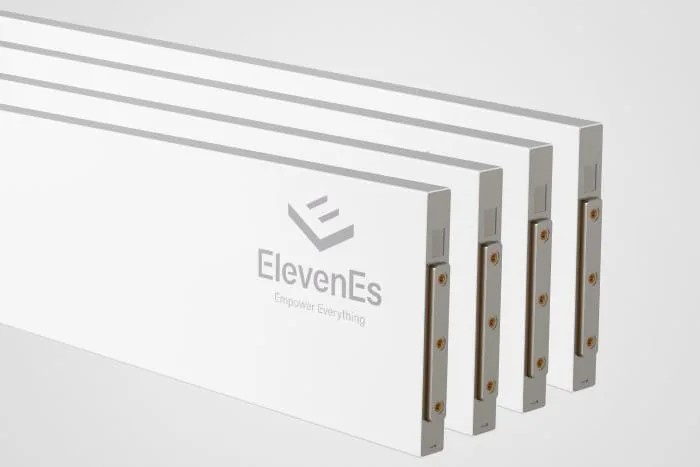
Serbian battery manufacturer ElevenEs has taken a major leap forward in battery innovation with the launch of its Edge574 Blade Cell, a cutting-edge lithium iron phosphate (LFP) prismatic battery designed for electric vehicles (EVs). With this announcement, the company not only expands its existing LFP portfolio but also enters the high-performance EV market with a product that boasts unprecedented fast-charging capabilities, enhanced durability, and optimized energy density.
A Next-Gen Battery for the Electric Era
The newly introduced Edge574 Blade Cell is specifically engineered to address three core challenges in EV battery design: charging speed, energy efficiency, and longevity. Measuring 57.4 cm x 12 cm x 1.6 cm, the slim and tall prismatic cell is ElevenEs’ first EV-focused product after previously targeting industrial and commercial applications with its Edge575 and Edge500 cells.
According to the company, the Edge574 can charge from 10% to 80% in just 12 minutes under optimal temperature conditions (above 25°C). Even at lower temperatures like 10°C, the cell achieves this charging range in 18 minutes thanks to a peak charging power of 650 kW. Although the company does not provide a definitive time for charging at 0°C, it still reports a maximum power delivery of 415 kW.
This is made possible by the cell’s ability to support a C-rate of 10, meaning that, in theory, a 100 kWh pack built with these cells could achieve charging powers of up to 1 MW. Such performance metrics are transformative for applications in electric cars, electric vertical take-off and landing aircraft (eVTOLs), and other fast-charging mobility platforms.
Performance by the Numbers
ElevenEs reports the following impressive specifications for the Edge574 Blade Cell:
- Gravimetric energy density: 190 Wh/kg
- Volumetric energy density: 420 Wh/l
- Fast charging: 10–80% in 12 minutes (at ≥25°C)
- Service life: At least 500,000 km
- Compatibility: Suitable for both cell-to-pack (CTP) and cell-to-body (CTB) integrations
These metrics place the Edge574 among the most competitive LFP cells on the global market. While LFP batteries are generally known for their thermal stability, long life, and safety compared to nickel-rich chemistries like NMC or NCA, they have historically lagged behind in energy density and charging speed. The Edge574 breaks this mold.
Innovations Behind the Blade Cell
The technological advancements of the Edge574 are a result of continuous R&D since ElevenEs’ founding in 2019. Compared to its predecessors, the new cell benefits from:
- Optimized electrode materials
- A new electrolyte formulation
- A 15% reduction in internal DC resistance
- A new mechanical housing with a thinner but more robust sheet metal shell
- Larger terminal connections for enhanced current flow and thermal regulation
These refinements contribute not only to faster charging but also to overall energy throughput, longevity, and safety—making the Edge574 a reliable choice for EV makers looking for stable, high-power, and scalable battery systems.
From Pilot to Giga: Scaling European Battery Manufacturing
ElevenEs is not just innovating in the lab—it’s also building serious industrial muscle. The company is manufacturing the Edge574 and other LFP cells at its pilot plant in Serbia, which launched in 2023. This facility works closely with its R&D center in Subotica, opened in 2021.
But ElevenEs has more ambitious plans ahead. In partnership with EIT InnoEnergy, a major investor in European battery startups such as Northvolt and Verkor, the company is on track to:
- Start construction on a 1 GWh gigafactory in 2025
- Launch an 8 GWh large-scale plant by 2028
- Open two more plants: a 20 GWh facility in Europe by 2030, and another 20 GWh facility in the USA by 2031
Altogether, ElevenEs is targeting a total production capacity of 48 GWh across three sites—positioning it as a significant player in Europe’s push for battery independence.
Sustainability and Strategic Positioning
As a spin-off of the AI Pack Group, a well-established aluminum processor, ElevenEs brings a materials-engineering edge to battery production. Its focus on LFP chemistry is strategic: unlike nickel or cobalt-rich alternatives, LFP materials are more abundant, less toxic, and less geopolitically constrained.
Moreover, the cell design aligns with the broader “cell-to-pack” and “cell-to-body” trends, which streamline battery system architecture by integrating cells directly into the structural design of EVs. This not only improves packing efficiency but also reduces weight and cost.
With growing global demand for affordable, safe, and high-performance EV batteries—and increasing regulatory pressure to localize battery production—ElevenEs is tapping into both a technological sweet spot and a strategic market gap.
Competitive Landscape and Outlook
In a field dominated by Chinese LFP producers like CATL and BYD, and a rising number of Western challengers such as Northvolt (Sweden), Verkor (France), and Freyr (Norway), ElevenEs stands out by offering:
- Ultra-fast charging LFP tech
- A European production base with pilot-scale readiness
- Strong institutional backing from EIT InnoEnergy
- Tailored cells for both automotive and stationary storage sectors
With its Edge500 and Edge575 already targeting commercial vehicles, buses, and Battery Energy Storage Systems (BESS), the Edge574 now brings ElevenEs into the high-stakes passenger EV segment.
The company’s ability to execute its gigafactory roadmap will be pivotal. If it delivers on its promises, ElevenEs may emerge as one of Europe’s most important battery manufacturers—providing a scalable, sustainable, and high-performance LFP solution at a time when global battery demand is soaring.
Conclusion
The Edge574 Blade Cell is more than just another battery—it’s a signal that European innovation in LFP battery technology is catching up with the global leaders. Offering 12-minute fast charging, robust energy density, and a 500,000 km lifespan, ElevenEs has created a product that directly addresses key pain points for EV manufacturers and users alike.
As the Serbian startup scales production and enters the mainstream EV supply chain, its focus on sustainability, efficiency, and speed may well define the next chapter in the evolution of LFP batteries. With a clear roadmap, strong partners, and a technically superior product, ElevenEs is charging ahead—literally and figuratively.