In a significant move to accelerate its global production and expand its influence in the next-generation battery landscape, Amprius Technologies, a California-based innovator in silicon anode batteries, has signed a major contract manufacturing agreement with a leading battery manufacturer in South Korea. Though the name of the South Korean partner remains undisclosed, Amprius states that this strategic alliance marks a “pivotal step” in scaling up its advanced SiCore battery platform.
Strengthening Global Production Capabilities
The newly established agreement centers on producing SiCore silicon anode cells at a manufacturing facility in South Korea, in strict adherence to Amprius’ specifications. This facility will not only support Amprius’ current battery platforms but is also engineered to handle the production needs of future designs optimized for high-demand sectors such as aerospace, defense, and electric mobility.
This move complements Amprius’ previously announced 1.8 GWh of contracted production capacity, expanding its reach into the heart of the global battery industry. South Korea, home to some of the world’s largest and most technologically advanced battery manufacturers, presents an ideal environment for scaling operations while maintaining high production standards and cost competitiveness.
Amprius emphasized that the Korean manufacturing partner brings “extensive experience in manufacturing advanced lithium-ion batteries across a range of form factors and cell chemistries,” offering immediate synergies with Amprius’ technology roadmap.
Focus on High-Demand Applications
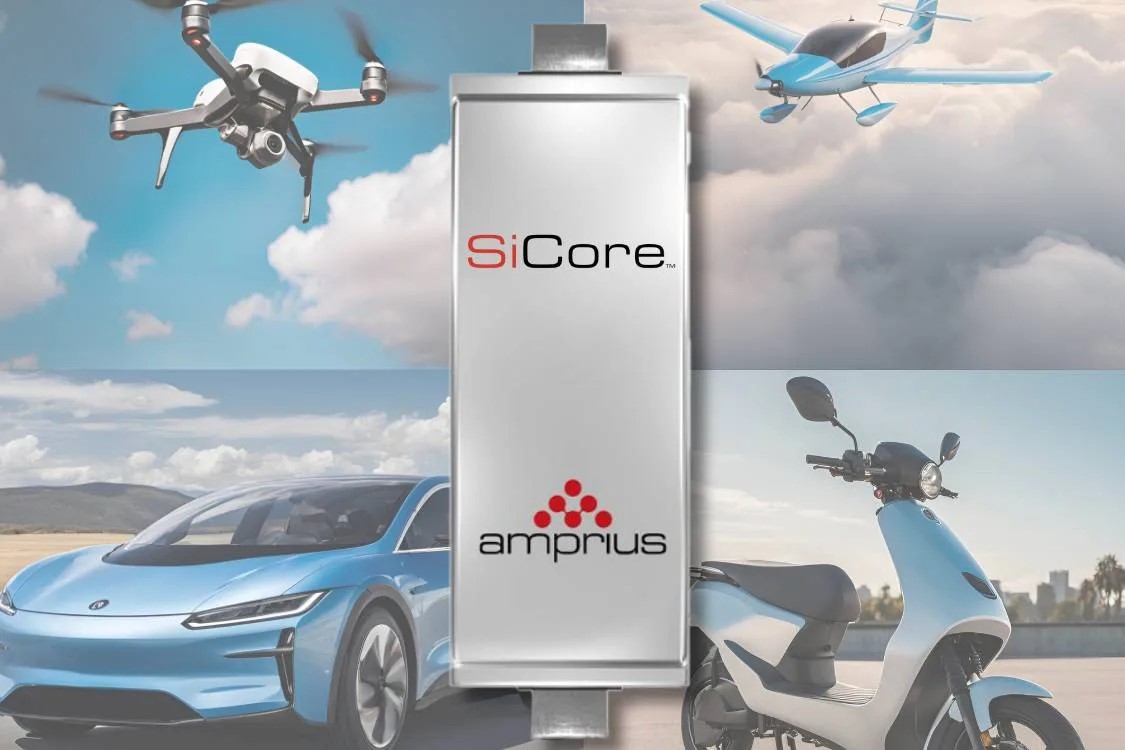
According to Amprius, this partnership will facilitate the production of a balanced SiCore cell optimized for “high-energy and high-power performance” specifically designed for use in an advanced drone platform. However, the scope of the collaboration goes far beyond unmanned aerial vehicles. Amprius’ SiCore batteries have demonstrated significant promise across aerospace, defense, and electric vehicle (EV) applications, where weight, power density, and durability are crucial.
In January 2025, Amprius introduced its new SiCore cell as a solution tailored to meet the rigorous standards of the aerospace and defense sectors. The company has already established partnerships with key players in those industries and is working actively to commercialize the technology. The new South Korean manufacturing capacity will be key to meeting growing customer demand and achieving volume scalability without compromising performance or reliability.
Advantages of Silicon Anode Technology
Traditional lithium-ion batteries rely on graphite anodes, a material largely supplied and processed by China. This dependency poses supply chain risks and geopolitical challenges, particularly for the U.S. and allied markets looking to reduce reliance on China. Silicon anodes, on the other hand, provide a viable alternative with significantly higher energy density and the potential for faster charging times.
Amprius has been a leader in commercializing silicon anode technologies, which offer up to 10 times the capacity of graphite. However, engineering challenges related to volume expansion and degradation during cycling have historically limited silicon’s widespread adoption. Amprius claims to have overcome these hurdles with its proprietary design and manufacturing techniques.
Recognizing the strategic value of silicon anodes, the U.S. Department of Energy funded Amprius, Group14 Technologies, and Sila Nanotechnologies in 2022 to establish domestic production of silicon anode materials. Amprius has since leveraged this support to build a global contract manufacturing network with gigawatt-hour-scale capacity.
Strategic Importance of the South Korean Deal
The latest agreement with the South Korean battery leader enhances Amprius’ supply chain resilience and geographic diversification. It also represents a shrewd move to tap into Asia’s mature battery manufacturing ecosystem, known for its production expertise and infrastructure efficiency.
By expanding into South Korea, Amprius positions itself to compete more aggressively in global markets, especially as the demand for high-performance batteries accelerates in defense, commercial aerospace, drones, and electric mobility solutions.
Moreover, the collaboration adds flexibility to Amprius’ global supply chain and reduces production lead times, an essential factor for defense and aerospace contracts that require strict delivery schedules and performance validation.
Outlook and Future Roadmap
Amprius is clearly on a trajectory to become a major player in the next-generation battery ecosystem. With strong backing from U.S. government programs and growing partnerships across the globe, the company’s SiCore platform is maturing at a critical time when the energy storage industry is undergoing profound shifts.
The company continues to refine its battery chemistries and production processes, aiming to meet the needs of high-demand and weight-sensitive markets where traditional lithium-ion solutions fall short.
As the EV sector seeks higher energy density for extended range, and as the aerospace and defense sectors demand lightweight, durable, and fast-charging energy sources, Amprius’ silicon anode solutions offer a compelling answer. The South Korean partnership now unlocks the capacity needed to scale these innovations from pilot lines to mass deployment.
Conclusion
Amprius’ new contract manufacturing agreement with a top South Korean battery maker is a milestone moment for the company and a signal to the industry. The ability to scale the SiCore platform globally, especially into Asia’s advanced manufacturing environment, provides a strong foundation for broader commercial success.
With the addition of this South Korean facility to its production portfolio, Amprius is not just expanding capacity—it is strategically positioning itself as a global leader in silicon anode battery technology ready to meet the demands of a rapidly evolving energy landscape.
As the push for lighter, faster, and more efficient batteries intensifies across sectors, Amprius’ vision of a silicon-powered future becomes more tangible—and this new international collaboration may be the turning point that accelerates its adoption across the world.