HPQ and Novacium Begin Large-Scale Production of GEN3 Silicon-Based Lithium-Ion Batteries
In a major advancement for next-generation battery technology, HPQ Silicon Inc., a Canadian innovator in advanced materials and critical process development, has announced that its French technology partner Novacium SAS has officially commenced industrial production of cylindrical lithium-ion battery cells using their third-generation (GEN3) silicon-based anode material.
This announcement follows earlier performance validations released on July 30, 2024, and March 19, 2025, which demonstrated the outstanding capabilities of 18650-format cells built with GEN3 anodes. Those tests revealed a capacity of 4,000 mAh with 1,000 charge cycles, sparking widespread interest among key players across mobility, telecommunications, consumer electronics, and defense sectors.
Now, in response to increasing commercial demand, Novacium is accelerating its transition from pilot testing to large-scale production — a strategic pivot aimed at positioning the GEN3 technology as a commercially viable and scalable solution in the competitive lithium-ion battery market.
High-Performance Battery Cells: 18650 and 21700 Formats Now Ready
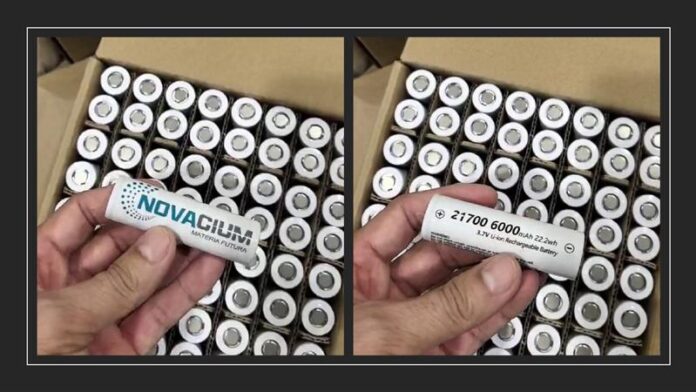
According to Novacium COO Dr. Jed Kraiem, the company’s initial industrial production has successfully yielded two of the industry’s most popular cylindrical formats: the 18650 and 21700. The new 18650 cells maintain the tested 4,000 mAh capacity, while the 21700 format pushes boundaries with an impressive 6,000 mAh capacity — both positioning the GEN3 product among the highest-performing commercial cells available globally.
These energy levels make the cells ideal for use in high-drain and mission-critical applications. For example, defense electronics, telecom infrastructure, power tools, medical equipment, electric scooters, and even certain classes of electric vehicles rely on high-cycle, high-capacity battery formats. The combination of increased energy density and long life span offered by GEN3 anodes gives OEMs a compelling reason to consider integration.
Seamless Integration with Existing Manufacturing Lines
A key element in Novacium’s successful market entry lies in the compatibility of GEN3 silicon-based anode material with existing lithium-ion battery manufacturing infrastructure. This technical advantage significantly reduces both capital expenditure and time-to-market — major considerations for industrial partners.
Novacium’s partnership with a leading industrial battery manufacturer, which already operates production lines with tens of millions of cells in annual capacity, allowed for rapid implementation and scaling of GEN3 technology. This adaptability has proven instrumental in meeting the growing market demand while preserving high throughput and quality standards.
“Our fast-track commercialization was only possible because of GEN3’s inherent flexibility and our partner’s operational scale,” noted Dr. Kraiem. “We’ve gone from lab-scale prototypes to market-ready industrial output in record time.”
Strategic Goals: Commercial Units and Partnerships by Q3 2025
Novacium is now targeting the delivery of its first commercial GEN3-based units and formalization of partner agreements by the end of Q3 2025. The company is currently distributing cells for partner evaluation, anticipating strong traction across multiple verticals.
“Our goal is not just to provide a high-performance product,” said Dr. Kraiem, “but to build an ecosystem of collaborators who understand the transformative potential of this technology in enabling next-generation electrification.”
This approach aligns with HPQ Silicon’s broader vision to create a vertically integrated supply chain that captures both upstream innovation and downstream manufacturing value. With its exclusive license for North America, HPQ is now preparing for localized production in Canada.
HPQ’s Role: Technology Transfer and North American Manufacturing
HPQ CEO Bernard Tourillon described the development as a “pivotal milestone in the monetization” of the company’s technology portfolio. The partnership with Novacium not only validates HPQ’s R&D investments but also enables the company to transition from a research-focused entity to a product-driven commercial operator.
“Thanks to the progress achieved by Novacium, HPQ is now strategically positioned to initiate its own North American cell production, fulfill the region’s growing energy storage needs, and generate revenues before the end of 2025,” Mr. Tourillon said.
The move to local manufacturing also supports wider national objectives in Canada and the United States, which are prioritizing the development of resilient, domestic battery supply chains in light of growing geopolitical concerns and resource access constraints.
A Leap Beyond the Lab: Moving from R&D to Industrialization
Perhaps the most noteworthy aspect of the announcement is the successful leap from research and validation to industrial manufacturing. In an industry where many battery innovations stall at the prototype phase, HPQ and Novacium have demonstrated an agile industrial strategy that bridges science and scalability.
The GEN3 technology, now proven to be scalable and manufacturable at high volumes, positions HPQ and Novacium ahead of many competitors in the race to commercialize high-performance battery materials based on silicon anodes. Silicon, with its superior theoretical capacity over traditional graphite, is widely regarded as the next frontier in lithium-ion battery design — yet its commercial adoption has been slowed by expansion challenges and processing complexity.
GEN3’s success in addressing these challenges while maintaining compatibility with industry-standard processes makes it a rare and valuable platform.
Unlocking Revenue, Growth, and Strategic Partnerships
The joint announcement also carries implications for HPQ’s financial strategy. With revenue generation now in sight, the company expects to unlock new growth opportunities, attract investment, and secure long-term agreements with commercial partners looking for a high-energy, low-barrier-to-adoption battery solution.
HPQ and Novacium’s work embodies a broader industrial trend: fast-tracked tech-to-market pipelines that don’t just push lab results but deliver them as scalable, bankable assets. The rapidity and flexibility demonstrated by the GEN3 project may well serve as a model for other advanced materials startups seeking similar industrial partnerships.
Conclusion: Shaping the Future of Battery Innovation
With its GEN3 silicon-based anode material now entering mass production and market deployment, HPQ Silicon Inc. and Novacium SAS have positioned themselves at the forefront of the next wave of battery innovation. From lab to large-scale manufacturing, their journey underscores the power of strategic collaboration, fast execution, and materials science breakthroughs.
As the demand for high-performance batteries continues to surge across industries, the ability to deliver energy-dense, long-life, scalable solutions will define the leaders of tomorrow’s energy transition. For HPQ and Novacium, that future has already begun.