According to data released on May 30 by Cui Dongshu, Secretary-General of the China Passenger Car Association (CPCA), global new energy vehicle (NEV) adoption has reached unprecedented levels. From January to April 2025, global vehicle sales totaled 30.26 million units, of which NEVs accounted for 6.18 million units—representing a record-breaking penetration rate of 20.4%.
This marks a continuation of a rapid upward trajectory in NEV adoption worldwide. Global NEV penetration stood at just 13% in 2022, increased to 16% in 2023, and reached 19.2% by the end of 2024. Now, in the first third of 2025, penetration has jumped yet again—paving the way for what may become a transformative year for the electric vehicle (EV) industry.
China: The Undisputed Leader in Global NEV Sales
China’s role in the global NEV market has become even more dominant in 2025. As of April, Chinese NEV passenger car sales accounted for a staggering 70.2% of the global total, marking a 3-percentage-point increase compared to the same period in 2024. More importantly, China contributed to roughly 80% of the incremental global NEV growth—a figure that underscores its unmatched influence on the global EV landscape.
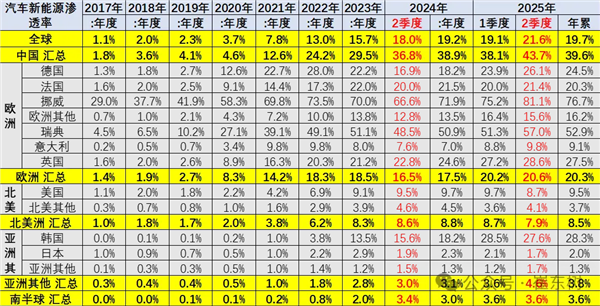
China’s domestic NEV penetration rate hit 44% during this period, making it one of the highest in the world. This is in stark contrast to major markets like the United States (8.7%) and Japan (2%), reflecting a significant disparity in the pace of NEV adoption across different regions.
Europe: Solid Progress Amidst Variability
European markets continue to demonstrate strong NEV adoption, though rates vary considerably by country:
- Germany: As the leading automotive market in Europe, Germany’s NEV penetration reached 26% in early 2025.
- United Kingdom: A solid 29% penetration rate highlights the UK’s continued commitment to electrification.
- Norway: Long considered the global bellwether for EV adoption, Norway’s NEV penetration remains unparalleled at 81%.
- France and Italy: Both countries reported more modest rates—21.4% and 10.3% respectively—still demonstrating year-over-year growth.
Europe’s overall NEV penetration reached approximately 26.1% as of Q2 2025, showing steady advancement despite slower uptake in southern regions.
North America: Slower Growth but Increasing Momentum
The United States reported a NEV penetration rate of just 8.7% in Q2 2025—significantly lagging behind global averages and well below the levels seen in China and Europe. However, growth is still visible, particularly in states like California where EV policies and infrastructure support are robust.
Canada and Mexico continue to show modest gains in NEV adoption, contributing marginally to the region’s overall EV market. Government incentives, consumer awareness, and charging infrastructure remain key factors influencing growth.
Asia (Excluding China): A Mixed Picture
Outside of China, other Asian markets are witnessing divergent trends:
- South Korea: With strong support from domestic automakers like Hyundai and Kia, South Korea achieved a NEV penetration rate of 13.4% in early 2025.
- Japan: The country continues to trail behind, with a penetration rate of only 2%. Despite having leading automotive manufacturers, Japan’s delayed transition to BEVs (battery electric vehicles) continues to draw scrutiny.
- Southeast Asia and Others: Penetration rates remain low overall, though countries like Thailand and Vietnam are beginning to adopt more aggressive EV policies to stimulate local markets.
The Global Picture: Penetration Rising, but Uneven
The global average NEV penetration rate of 20.4% in the first four months of 2025 represents a remarkable leap from previous years:
| Year | Global NEV Penetration |
|---|---|
| 2017 | 1.1% |
| 2018 | 2.0% |
| 2019 | 3.7% |
| 2020 | 4.8% |
| 2021 | 13.0% |
| 2022 | 15.7% |
| 2023 | 18.0% (Q2), 19.2% (Annual) |
| 2024 | 21.6% (Q1), 19.7% (Annual) |
| 2025 | 20.4% (Jan-April) |
The 34% year-over-year growth in global NEV sales for April alone is further evidence of the market’s accelerating momentum.
However, the pace of growth remains uneven. Developed markets like China and several European nations are sprinting ahead, while others, including the U.S., Japan, and much of Southeast Asia, continue to lag. This discrepancy raises important questions about policy, infrastructure, and industry coordination.
What’s Driving China’s NEV Supremacy?
Several factors explain China’s continued dominance in the global NEV space:
- Robust Industrial Ecosystem: China hosts the world’s most comprehensive NEV supply chain, including battery production, motor manufacturing, and vehicle assembly.
- Government Policy: A mix of subsidies, license plate incentives, and carbon reduction mandates have encouraged rapid NEV adoption.
- Consumer Acceptance: Chinese consumers have embraced electric vehicles for their affordability, low operating costs, and expanding model variety.
- Export Expansion: Chinese EV brands like BYD, NIO, and XPeng are increasingly penetrating international markets, boosting production volumes and global influence.
As a result, China is no longer just the largest NEV market—it’s the center of gravity for innovation, production, and strategic direction in the global electric vehicle industry.
Challenges and the Road Ahead
Despite strong numbers, challenges remain for the global NEV market:
- Infrastructure Gaps: Many regions still lack sufficient public charging infrastructure, hindering large-scale adoption.
- Raw Material Constraints: Global demand for lithium, cobalt, and nickel continues to outpace supply, raising cost concerns.
- Policy Uncertainty: In some markets, changing political climates and inconsistent regulations create investment hesitancy.
- Consumer Hesitation: Range anxiety, high initial costs, and limited model availability remain barriers for many buyers.
To maintain and accelerate the current growth trend, coordinated action among governments, automakers, and stakeholders is essential.
Conclusion: NEVs Are Going Mainstream—Led by China
The first four months of 2025 have further solidified NEVs as a major force in the global automotive market. With a global penetration rate now exceeding 20%, and China contributing more than 70% of all NEV sales and 80% of the market’s incremental growth, the path toward electrification is no longer speculative—it is reality.
The world will be watching how other major economies respond to China’s lead. For the NEV revolution to succeed globally, it must become a shared effort—accelerated by innovation, reinforced by infrastructure, and driven by consumer demand.
The question is no longer if electric vehicles will take over, but when and where the next big surges will come.