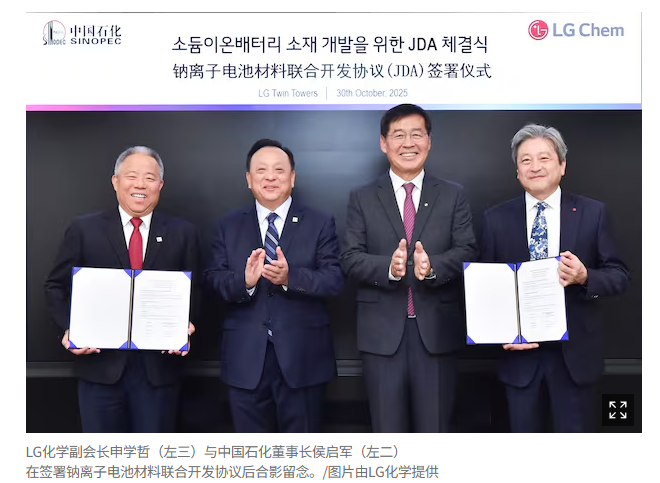
LG Chem announced on November 4 that it signed a joint development agreement with Sinopec on October 30 for core materials in sodium-ion batteries. This marks the official launch of strategic cooperation between the South Korean chemical giant and China’s largest integrated energy and chemical company in next-generation battery technology.
The two parties plan to jointly develop core components such as cathode and anode materials for sodium-ion batteries, while establishing a stable supply chain system and enhancing cost competitiveness. This collaboration will primarily target the global energy storage system and mass-market electric vehicle sectors, with plans to expand cooperation into environmental energy and high-value-added material fields in the future.
Sodium-Ion Batteries: The “Dark Horse” of New Energy
Sodium-ion batteries are becoming an increasingly attractive next-generation battery technology due to their abundant resources, low cost, high safety, and fast charging speeds. Compared to lithium-ion batteries, sodium is far more abundant on Earth and more widely distributed, giving sodium-ion batteries a natural advantage in raw material costs.
Energy storage is the largest application market for sodium-ion batteries, accounting for as much as 60% in 2023, followed by electric two-wheelers and new energy vehicles, which together account for approximately 40%. Sodium-ion batteries are particularly suitable for grid-scale energy storage, renewable energy supporting storage, and home energy storage systems, helping to achieve energy self-sufficiency and reduce electricity costs.
China Dominates Global Sodium Battery Industry
Market research institutions predict that the sodium-ion battery market will grow from 10 gigawatt-hours in 2025 to 292 gigawatt-hours in 2034, with an average annual growth rate of approximately 45%. Particularly noteworthy is that China is expected to account for more than 90% of global sodium-ion battery manufacturing output by 2030, becoming the major production hub in this field.
According to industry analysis, China’s sodium-ion battery shipments exceeded 1.5 gigawatt-hours in 2024, are expected to surpass 7 gigawatt-hours in 2025, and could break through 200 gigawatt-hours by 2030. In terms of market scale, it is expected to exceed 10 billion yuan in 2025, with shipment volumes reaching hundreds of gigawatt-hours by 2030.
Strategic Layout to Seize the Initiative
Shin Hak-cheol, Vice Chairman of LG Chem, stated that as a leading global battery materials company, LG Chem has been providing differentiated solutions to customers in the global battery market. Through cooperation with Sinopec, the company will develop next-generation battery materials in a timely manner and strengthen its business portfolio to align with customers’ future strategies.
As China’s largest integrated energy and chemical company, Sinopec’s business covers oil and gas exploration and development, refining, chemicals, new energy, and new materials. This collaboration with LG Chem not only leverages the complementary advantages of both parties in resources, technology, and markets, but also opens up new growth opportunities for Sinopec in its new energy transformation.
Complementing Rather Than Replacing Lithium Batteries
Industry experts generally believe that sodium-ion batteries are not meant to replace lithium-ion batteries, but rather serve as an important supplement. In the future, sodium-ion batteries will develop alongside lithium-ion batteries to meet diverse needs in different application scenarios. In fields such as large-scale energy storage, low-speed electric vehicles, and electric two-wheelers where energy density requirements are not high, sodium-ion batteries will have broad application space due to their cost advantages and safety performance.
With continuous technological breakthroughs and sustained policy support, China’s sodium-ion battery industrialization process is accelerating. Leading companies including CATL, BYD, and Sunwoda have all clearly defined their sodium-ion battery capacity plans, with some companies planning capacities at the gigawatt-hour level, and the industry is gradually entering the mass production stage.
The strategic cooperation between LG Chem and Sinopec is not only an important deployment by these two industry giants in the new energy field, but also indicates that the sodium-ion battery industry is about to enter a new stage of large-scale development. As technology maturity improves and costs continue to decrease, sodium-ion batteries are expected to play an increasingly important role in the global energy transition.