Shell Energy Europe and Sunotec, a leading European utility-scale energy storage developer, recently announced the signing of a landmark cross-border spread hedge agreement. This represents the first such innovative financial product in Central Eastern Europe, providing new solutions to address financing challenges for large-scale storage projects.
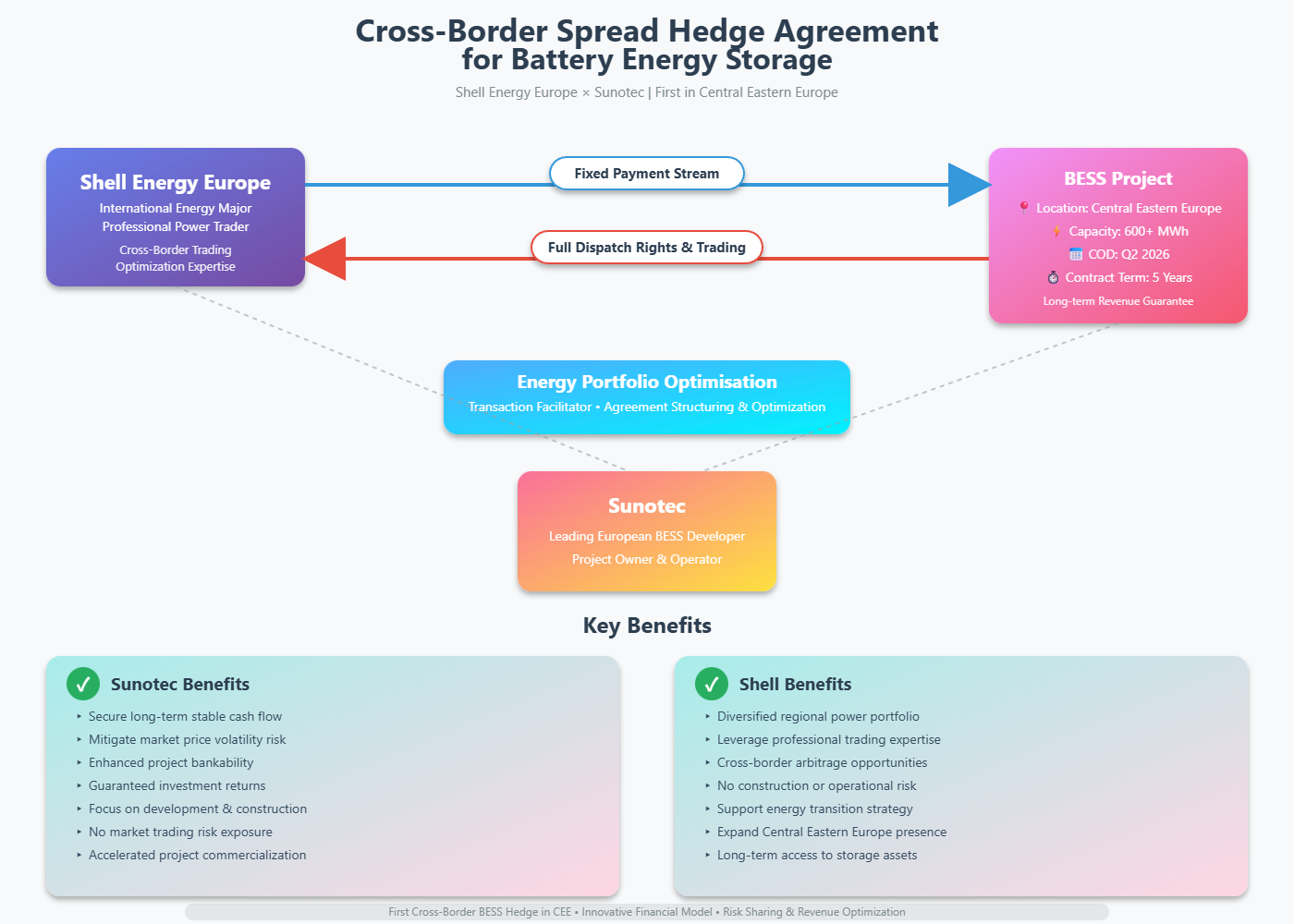
Core Agreement Details
According to information released by both parties, this five-year agreement is linked to a battery energy storage system (BESS) project exceeding 600 MWh capacity owned by Sunotec. The project is currently under development in Central Eastern Europe and is expected to reach commercial operations in the second quarter of 2026.
Energy Portfolio Optimisation played a key facilitation role in the transaction, helping both parties design an innovative structure that meets the developer’s financing needs while aligning with the energy trader’s risk management requirements.
For Sunotec, the core value of this agreement lies in providing long-term price stability for the project, significantly enhancing its financial viability and bankability. For Shell, the deal helps further diversify its power portfolio in the Central Eastern European region and expand its footprint in emerging storage markets.
Market Significance of Cross-Border Spread Hedging
While spread hedging has been applied in traditional energy trading for many years, its application to battery storage projects, particularly cross-border storage projects, is a first in Central Eastern Europe.
The profitability model of battery energy storage systems relies on electricity market price fluctuations—charging when prices are low and discharging when prices are high, capturing the price spread. However, the uncertainty of these revenues has always been a core challenge for storage project financing. Narrow spreads or insufficient market volatility can severely impact project returns and investment viability.
Through the cross-border spread hedge agreement, Shell effectively provides a revenue protection mechanism for Sunotec’s storage project. This means that even if market spreads narrow, the project can still secure relatively stable revenue streams, thereby reducing the project’s overall risk profile.
Regarding the cross-border component, Central Eastern European countries have varying levels of electricity market development, creating significant price differentials and arbitrage opportunities between nations. Shell, as an international energy giant with extensive cross-border power trading experience, can optimize the charging and discharging strategies of storage assets across different markets through its pan-European trading network, maximizing project revenues.
Sunotec’s Strategic Expansion
Sunotec is an integrated renewable energy services provider headquartered in Bulgaria and Germany, with business spanning engineering, procurement, construction, and operations and maintenance services for solar and energy storage projects.
The company has been highly active in Central Eastern European and Northern European markets this year. In July, Sunotec announced a strategic deployment agreement with Chinese energy storage equipment manufacturer Sungrow to deploy a total of 2.4 GWh of battery energy storage systems in Bulgaria and other European markets. Some of these projects will receive funding support from Bulgaria’s RESTORE national support program, valued at BGN 1.15 billion (approximately $670 million).
Also in July, Sunotec acquired a large-scale solar-plus-storage hybrid project in Latvia from Danish developer Danish Sun Energy. The project includes 400 MWp of solar capacity and 600 MWh of storage capacity, with a total investment of up to €245 million, expected to be fully operational in March 2027.
In October, Sunotec announced the completion of investments in seven storage projects in its home market of Bulgaria, including one co-located solar-plus-storage project and six standalone BESS projects, totaling 115 MWp of solar capacity and 763 MWh of battery storage capacity. These standalone storage projects have all been approved by Bulgaria’s Ministry of Energy and will receive subsidy support under the RESTORE program.
Kaloyan Velichkov, Founder and CEO of Sunotec, stated: “Agreements like the one with Shell highlight Sunotec’s commitment to working with leading energy players who share our vision for a sustainable and forward-looking energy future. This pioneering agreement demonstrates the power of collaboration in advancing flexibility and renewable-energy driven independence. By uniting technical expertise with financial ingenuity, we are helping to build a more resilient and integrated energy system.”
Notably, Sunotec is also one of four strategic partners of the Battery Storage Europe Platform initiated by SolarPower Europe. The platform aims to drive the business case and regulatory framework for battery storage across the European Union and currently features over 50 member organizations.
Shell’s Deep Commitment to European Storage Markets
As a global energy major, Shell has been increasingly active in the energy storage sector in recent years, particularly in European markets.
In the UK, Shell has established long-term cooperation with several large-scale storage projects. In August last year, Shell signed the UK’s first seven-year tolling agreement for a single storage asset with BW ESS and Penso Power. The agreement covers the Bramley storage project in Hampshire, with a capacity of 100 MW/331 MWh, which was the UK’s longest-duration storage system at the time.
Under the tolling agreement, Shell pays a fixed fee to the asset owners and gains full dispatch rights to the storage system, trading it into various ancillary services and wholesale markets. This business model provides revenue certainty for project developers while allowing professional traders like Shell to fully leverage their market optimization capabilities.
In September this year, Shell was selected by Google as the “24/7 Carbon-Free Energy Manager” for its new data center in Waltham Cross, UK. Shell will use its battery energy storage asset portfolio to help Google balance clean energy supply, including from the Moray West offshore wind project in Scotland, ensuring that Google’s UK operations achieve over 95% carbon-free energy operation in 2026.
Rupen Tanna, Head of Power and Systematic Trading at Shell Energy Europe, previously stated: “Tolls have been a feature of conventional energy trading for many years. By extending the business model to battery storage, Shell has the trading experience to add significant value, while supporting the UK’s ongoing energy transition. The experience gained through these early tolling contracts will be invaluable to the wider market.”
In the Australian market, Shell also has significant presence. In December last year, the Rangebank storage project jointly developed by Shell and Eku Energy, Macquarie’s battery storage platform, officially commenced operations. This is one of Victoria’s largest storage systems, with a capacity of 200 MW/400 MWh. Through a 20-year tolling agreement, Shell secured 100% capacity charging and discharging rights for the project. This also marks Shell’s first direct equity investment in a utility-scale storage system globally.
Opportunities and Challenges in the Central Eastern European Storage Market
Central Eastern Europe is emerging as a new hotspot in the European energy storage market. The region is experiencing rapid growth in renewable energy installations, but with relatively weak grid infrastructure, creating urgent demand for storage systems to provide flexibility support.
Bulgaria is one of the most active countries in storage development in the region. In May this year, a 500 MWh storage project in Lovech, northern Bulgaria, was announced as operational and was described as the largest storage project in the EU at the time. Bulgaria’s Energy Minister Zhecho Stankov stated that this is the first step toward the country’s goal of achieving 10,000 megawatt-hours of operating battery capacity within the next year.
The Bulgarian government’s RESTORE national support program, as part of the EU Recovery and Resilience Facility, is specifically designed to support large-scale storage deployment and enhance grid stability. Another Recovery Fund scheme that concluded in November last year specifically targeted renewable energy paired with storage projects, awarding funding to 3.1 GW of renewable energy and 1.1 GW of energy storage.
The Baltic States also demonstrate strong storage demand. This spring, the Baltic countries completed their decoupling from the Russia-led BRELL grid system and achieved synchronization with the Continental European grid. This historic transition created unique market opportunities. Developer Aura Power stated that by the end of 2025, balancing capacity demand in the Baltic region is projected to reach 1,500 MW, presenting substantial opportunities in balancing and ancillary services markets.
Countries like Latvia and Lithuania have introduced supportive policies. Lithuania has set a target to achieve 100% renewable energy consumption by 2028. The rapid growth of intermittent generation from solar and wind, particularly after the closure of the Ignalina nuclear power plant, makes large-scale energy storage even more critical.
However, the Central Eastern European storage market also faces numerous challenges. First is the financing difficulty—due to lack of historical operational data and mature revenue models, banks and investors take a conservative approach to risk assessment of storage projects, with relatively high financing costs. Second, regulatory frameworks remain incomplete, with policies on storage definitions, market access rules, and revenue mechanisms still in exploratory stages across countries. Additionally, whether electricity market liquidity and price volatility are sufficient to support the commercial viability of storage projects requires continued observation.
It is against this backdrop that Shell and Sunotec’s cross-border spread hedge agreement holds particular demonstrative significance. Through innovative financial instruments, transferring storage project market risks to large energy companies with professional trading capabilities both guarantees revenue stability for developers and investors while allowing traders to leverage their cross-market optimization expertise, achieving a win-win outcome.
Both parties stated that this partnership reflects their shared commitment to accelerating the energy transition through technology, infrastructure, and financial innovation, and will support regional market integration and large-scale renewable energy deployment. As more similar agreements are signed, the Central Eastern European storage market is poised to welcome a new wave of development.
For the broader European storage industry, this transaction provides a replicable template, demonstrating how cross-border cooperation and forward-looking financial mechanisms can enhance regional energy market integration and facilitate the deployment of large-scale renewable energy assets. In the future, with participation from more energy traders, developers, and financial institutions, similar innovative financial products are expected to be promoted more broadly across geographic areas.
About the Companies:
Shell Energy Europe is a leading energy trader operating across European power markets, with expertise in portfolio optimization, cross-border trading, and renewable energy integration. The company is actively expanding its battery storage portfolio as part of Shell’s broader energy transition strategy.
Sunotec is a European leader in utility-scale solar and battery energy storage system (BESS) solutions, providing integrated services including engineering, procurement, construction (EPC), and operations and maintenance (O&M). The company has a strong presence in Bulgaria, Germany, and expanding operations across Central and Northern Europe.
Energy Portfolio Optimisation is a specialized energy trading and portfolio optimization firm that facilitates innovative financial structures for renewable energy and storage projects across European markets.