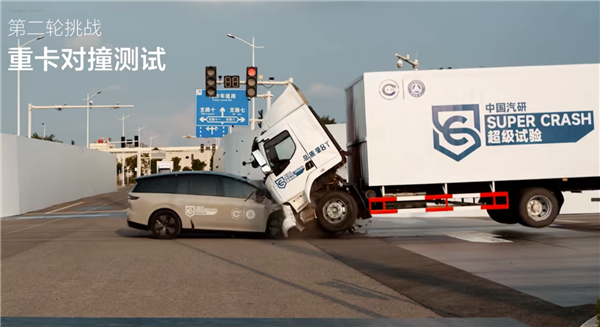
Recently, a crash test video released by Li Auto featuring its new SUV model, the Li Auto i8, has taken Chinese social media by storm. In the video, the 2-ton SUV collides head-on with an 8-ton Chenglong-brand truck, causing the truck to lift off the ground and slide backward upon impact. The dramatic footage quickly sparked public debate, ranging from praise for the i8’s robust build to widespread skepticism over the test’s authenticity. What began as a technical safety test swiftly escalated into a PR crisis and a test of industry credibility.
1. The Test’s Original Purpose: Safety, Not Showmanship
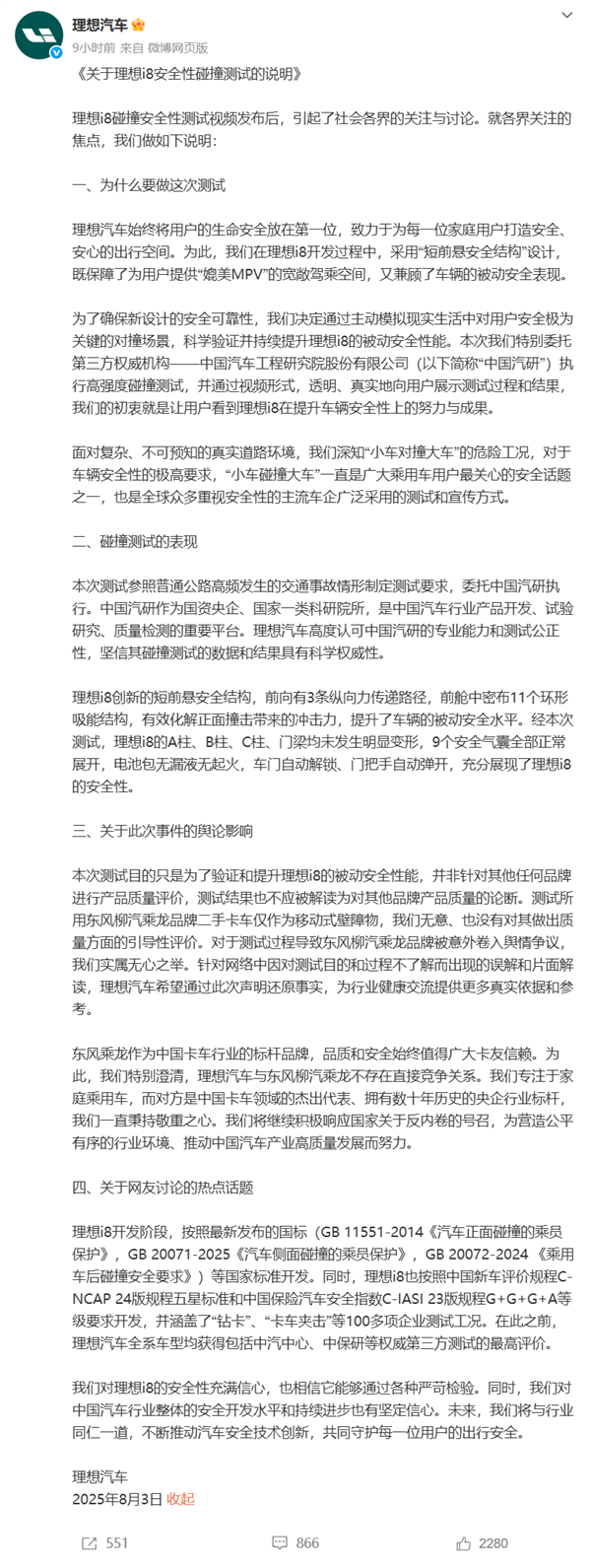
According to Li Auto’s official statement dated August 3, 2025, the test was designed to verify and improve the passive safety performance of the Li Auto i8. The company emphasizes that it has always prioritized the safety of families and drivers, and aims to design vehicles that can endure even the most severe road accidents.
The crash test was commissioned to China Automotive Technology and Research Center (CATARC)—a government-owned research institution known for its authority and scientific rigor in the automotive field. Li Auto stated that the Chenglong truck featured in the video served merely as a movable obstacle due to its appropriate mass, and was not selected for comparative purposes.
However, due to the absence of detailed public data, specifications, or methodology in the initial video, the test’s scientific integrity was called into question. The visual impact of the truck being launched into the air fueled speculation that the event was more about marketing than real-world testing.
2. CATARC Responds: It’s a Test, Not a Brand Comparison
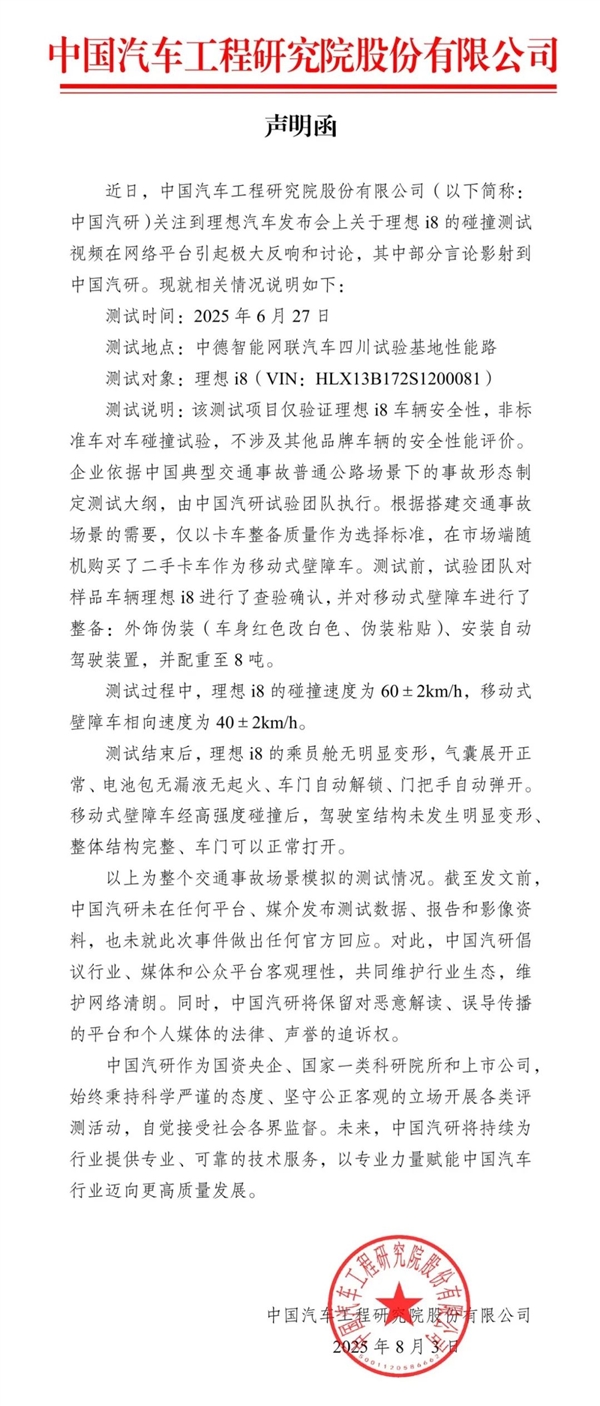
On August 3, 2025, CATARC issued a formal statement to clarify the controversy. According to the report:
- Test Date: June 27, 2025
- Location: CATARC’s Sichuan Proving Ground
- Test Vehicle: Li Auto i8 (VIN: HLX13B172S1200081)
- Crash Speed: Li Auto i8 at 60±2 km/h, truck obstacle at 40±2 km/h
The test was a custom simulation based on common real-world collisions between passenger vehicles and larger commercial trucks. The Chenglong truck, a second-hand vehicle, was randomly purchased on the open market and used solely due to its mass characteristics—not for brand assessment.
Results showed that the i8:
- Suffered no significant deformation to the passenger cabin
- Successfully deployed nine airbags
- Maintained fuel system integrity with no leakage or fire risk
- Doors remained operable after the crash
CATARC emphasized that no crash data or video footage had been released officially, and that online content circulating across media platforms was not endorsed or authorized. It also reserved legal rights against any misrepresentation or defamation.
3. Public Misunderstanding and Brand Fallout
A major catalyst in this controversy was the visible branding of the truck in the video—Chenglong, a sub-brand of Dongfeng Liuzhou Motor. Although Li Auto and CATARC clarified the truck was simply a “movable barrier,” viewers interpreted the crash as an intentional brand comparison or challenge.
Li Auto responded swiftly, stating that it holds great respect for Dongfeng—a longstanding state-owned automotive enterprise—and that there is no competitive relationship between the two, as Li Auto focuses on family passenger cars, while Chenglong specializes in commercial trucks.
Nonetheless, netizens continued to voice anger, accusing Li Auto of exploiting the incident for publicity, questioning the authenticity of the results, and even speculating on behind-the-scenes manipulation.
This reflects a broader issue: a lack of public understanding of crash test types, standards, and technical validation methods. Without clear explanations, even authentic tests can be interpreted as marketing stunts.
4. Standards and Testing Methodology
In its statement, Li Auto referenced multiple national safety standards, including:
- GB 11551-2014 (Frontal Crash Protection)
- GB 20071-2025 and GB 20072-2024 (Occupant Protection in Frontal and Side Collisions)
The company also claimed to have incorporated elements from:
- C-IASI 23 (China Insurance Automotive Safety Index)
- C-NCAP 2024 protocols
However, it’s important to note that mainstream safety ratings, such as C-NCAP and Euro NCAP, typically do not test car-to-truck crashes. Standard tests usually include:
- Frontal crash against a fixed barrier
- Side impact from a moving trolley
- Pole impact, rollover, and pedestrian protection
Thus, while the Li Auto i8 test might be rooted in technical ambition, it lacks benchmarking against recognized global evaluation frameworks. The vivid imagery—despite possibly being scientifically valid—risks being seen as sensational or manipulative in the absence of contextual clarity.
5. The Real Lessons: Communication, Credibility, and Respect
From a communications standpoint, Li Auto’s video may have aimed to demonstrate innovation and engineering strength. But the subsequent backlash reveals several lessons:
- Dramatic visuals require careful framing—otherwise they may backfire.
- Public education on testing standards is lacking—leading to misinterpretation.
- Independent test authorities must maintain transparency—including clear release of methodology and results.
- Respectful inter-brand relations matter—especially in a tightly knit industry like China’s automotive sector.
Ultimately, what began as a technical experiment became a case study in PR mismanagement. When test objectives, visuals, and public expectations are misaligned, the credibility of both the brand and the broader industry may suffer.
Conclusion:
The “Li Auto i8 vs Chenglong truck” incident offers more than just a viral moment—it is a cautionary tale about the risks of mixing engineering with storytelling. Was it a genuine attempt to validate safety? Quite possibly. But in a digital age, perception often outweighs intention.
For automakers, especially in China’s rapidly evolving market, this incident underscores the importance of:
- Grounding every demonstration in standardized, explainable metrics
- Anticipating public reaction with proactive, transparent communication
- Avoiding visual dramatization that could dilute scientific credibility
Only by building trust through data, standards, and respect can Chinese automakers continue to drive global perceptions of quality—and safety.