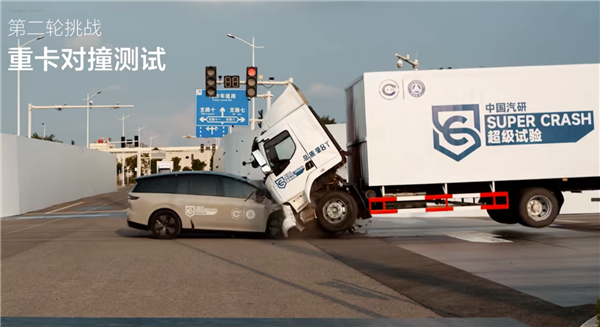
On August 1, reports emerged that Li Auto’s first pure electric SUV, the Li Auto i8, became the center of heated debate after a promotional crash test video went viral. In the video, an 8-ton Chenglong heavy-duty truck collided head-on with the 2-ton+ Li Auto i8 SUV. Unexpectedly, the truck suffered substantial deformation, while the i8 appeared to retain structural integrity—an outcome that triggered skepticism and controversy.
Although Li Auto and the truck manufacturer, Dongfeng Liuzhou Automobile Co., both issued public statements, many vehicle owners and online commentators remain unconvinced. Some truck owners even challenged Li Auto to conduct a new crash test under public scrutiny—with no liability on either side if problems arise.
The Crash Test That Sparked It All
On July 29, during the official launch event for the Li Auto i8, the company showcased an elaborate crash test scenario, where a fully loaded heavy truck was shown failing to overpower the electric SUV in a frontal collision. The crash test was presented as a high-fidelity simulation of real-life traffic conditions.
In the video, the truck’s front cabin deformed significantly, with even its wheels lifting off the ground—while the i8’s passenger cell remained largely intact. This raised eyebrows, especially given the significant mass difference between the two vehicles. Many questioned whether the test conditions had been manipulated.
Truck Manufacturer Responds: Accusations of Infringement and Misrepresentation
In response to the viral video, the official WeChat account of Chenglong Trucks published a statement on July 31, accusing Li Auto of unauthorized use of its brand and misleading the public. The manufacturer alleged that Li Auto’s video:
- Used non-standard testing conditions
- Failed to disclose if the vehicles were modified or properly inspected
- Did not clarify vehicle speed, terrain, or driver behavior
- Created a misleading perception of safety outcomes
The statement claimed that such conduct violates commercial competition ethics and severely damages the Chenglong brand’s reputation. Legal proceedings are reportedly underway to address what the company called a “serious infringement.”
Li Auto’s Response: Trust in Third-Party Validation
In the wake of mounting backlash, Li Auto’s product line director—known online as @老汤哥Tango—issued a detailed response defending the test’s legitimacy. He clarified that:
“The entire crash test was conducted by a fully independent third-party testing organization. We did not intervene in the vehicle selection, test procedures, or collision parameters. All test vehicles—including the Chenglong truck—were randomly sourced from the market and provided by the testing agency.”
Tango emphasized that Li Auto invests millions in each round of crash testing. The manufacturing of a single prototype vehicle alone can cost over 1 million RMB, with additional costs for molds, setup, and simulation. He added:
“Precision in crash simulation is essential. It’s difficult, but also simple—if you think about who’s sitting in the car. No matter how hard it is, their safety must come first.”
He also proudly claimed that Li Auto is the only Chinese automaker whose entire lineup has received the highest safety rating from C-IASI (China Insurance Automotive Safety Index) since its founding.
Calls for a Live Re-Test: Transparency in the Spotlight
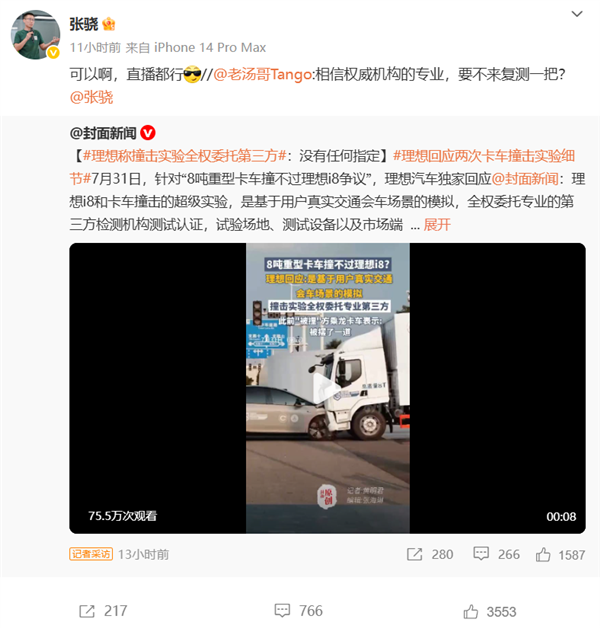
After the heated online debate, @Tango suggested conducting a public, live-streamed crash test under the supervision of a third party. He tagged colleague Zhang Xiao, who quickly agreed: “Let’s do it—live stream included.”
This proposal has been well received by many vehicle owners and industry watchers who believe transparent, repeatable testing is essential to maintain public trust—especially when the results challenge common expectations.
Truck owners have also voiced their support, stating that they welcome another test, provided both sides agree not to pursue legal action if failures occur during testing.
The Stakes: Brand Reputation, Public Trust, and Engineering Credibility
The ongoing dispute between Li Auto and Chenglong Trucks is more than a marketing scuffle—it has opened up broader questions around:
- Transparency in crash testing
- Brand accountability when safety claims are contested
- The role of independent testing bodies in verifying automotive performance
- Whether real-world driving conditions are being faithfully simulated
For Li Auto, the stakes are high. The i8 is their flagship EV SUV, positioned to compete with both domestic rivals like BYD and global players like Tesla. A successful re-test could reinforce Li Auto’s reputation as a safety-first innovator. A failed one—or refusal to test—could cast long shadows.
Inside the i8: Crashworthiness by Design?
Li Auto claims that the i8 incorporates advanced energy-absorbing structures in the front crash zone, including multi-path load dispersal, 11 energy absorption rings, and a reinforced A-B-C pillar structure. The battery pack is encased in a double-layer protective shell with independent fireproof separation.
In theory, these features could indeed allow the i8 to outperform expectations in frontal collisions. However, such outcomes must be verified in replicable, transparent environments—especially when involving comparisons to much heavier trucks.
The Road Ahead: Toward a New Industry Standard?
This case could become a defining moment in how EV safety is tested and promoted in China. By committing to transparency, open data, and third-party auditing, Li Auto has an opportunity to set a new standard for credibility and consumer trust.
Meanwhile, the auto industry—and regulators—will be watching closely to see how this unfolds. Will live crash testing become a new norm for safety marketing? Or will legal battles and media spin cloud the truth?
Conclusion: Collision of Claims, Not Just Vehicles
The Li Auto i8 crash test controversy reflects deeper tensions in a rapidly evolving EV market. As automakers race to outdo one another in performance, tech, and safety, consumer trust is the real battleground.
With both sides standing firm, and the public demanding proof, the proposed live re-test might be the only way forward. Whether it confirms Li Auto’s claims or uncovers inconsistencies, one thing is clear:
Crash tests don’t just test cars—they test credibility.