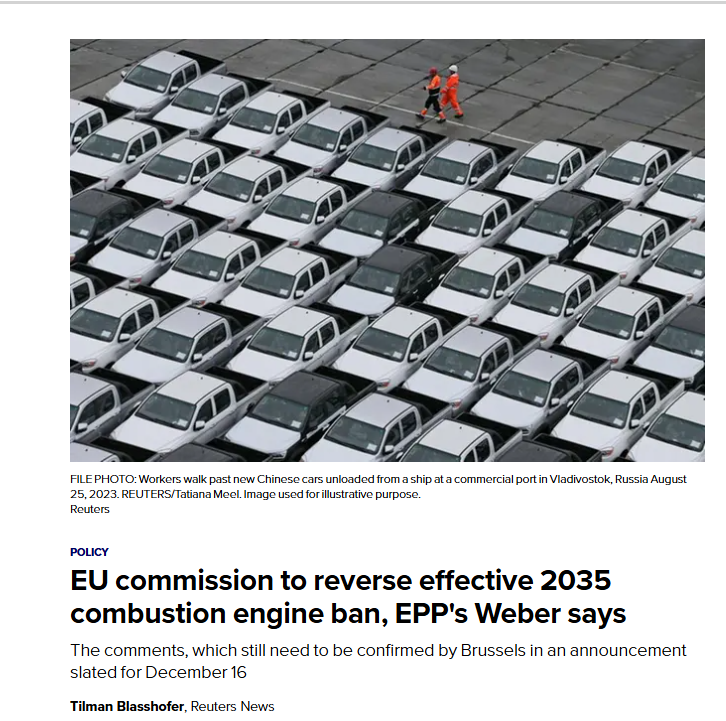
Manfred Weber, president of the largest party group in the European Parliament, announced at a press conference in Heidelberg, Germany on December 12 that the European Commission will present a clear proposal on December 16 to abolish the combustion engine sales ban originally scheduled to take effect in 2035. This marks a major policy shift in the EU’s electrification transition and signifies that under intense competitive pressure from China, the European automotive industry has chosen to slow its pace.
Policy Shift Background: German-Led Lobbying Campaign
According to Weber, the new policy will require automakers to achieve a 90% reduction in fleet-wide CO2 emissions from 2035 onwards, rather than the previous 100% ban. Additionally, the 100% reduction target originally planned for 2040 onwards will also be scrapped.
This policy reversal is the result of prolonged lobbying by Germany to protect its automotive industry. As the EU’s largest economy, Germany’s automotive manufacturing sector faces dual pressures from fierce competition from Chinese electric vehicles and trade barriers. German Chancellor Friedrich Merz had previously written to EU Commission President Ursula von der Leyen, calling for permission to continue selling hybrid and highly efficient combustion engine vehicles beyond 2035.
Market Reaction: Automaker Stocks Rise
Following the announcement, European automotive stocks rallied. The STOXX Europe 600 Automobiles and Parts index rose 0.8% on Friday, with Renault, Porsche, Stellantis, and Volkswagen posting gains between 1.3% and 3%.
However, this decision has sparked clear division within the automotive industry. Volvo Cars Chief Commercial Officer Erik Severinson told Reuters that any about-face would undermine confidence in future regulation, and that the company is “ready to go” with electric alternatives.
Chinese Competition Pressure Highlighted
The underlying reason for the policy adjustment lies in the challenges European automakers face in their electrification transition. After the EU imposed anti-subsidy tariffs of up to 35.3% on Chinese electric vehicles in 2024, Chinese automakers have maintained their competitiveness in the European market. Data shows that in April 2025, Chinese automotive brand sales in Europe increased 121% year-over-year, exceeding 53,000 units, with market share rising from 2.4% in the same period of 2024 to 4.9%.
Chinese automakers have circumvented tariff impacts by increasing their supply of plug-in hybrid vehicles, while European domestic automakers encounter multiple challenges including declining sales and rising costs during their electrification transition. In the first quarter of 2024, China’s electric vehicle market share is expected to reach 45%, compared to 25% in Europe and only 11% in the United States.
Industry Division Intensifies
Polestar CEO Michael Lohscheller warned that “pausing 2035 is just a bad, bad idea,” and that if Europe doesn’t lead this transformation, “the Chinese won’t stop, they will take over everything.” Companies like Volvo and Polestar that have already invested heavily in electrification believe the policy change will disadvantage companies that are already prepared.
In contrast, traditional German automakers like Volkswagen, BMW, and Mercedes face greater compliance pressure. According to Dataforce data, based on current sales proportions in Europe, only Tesla and Geely Group have emissions below the EU’s 2025 CO2 emissions target of 93.6 grams per kilometer. Industry forecasts suggest that if penalized for non-compliance with emission reductions in 2025, European automakers’ total losses could reach €16 billion.
Uncertain Transition Prospects
Although the mandatory ban has been removed, the EU has retained the 90% emissions reduction target, which represents important progress for climate goals. However, environmental organizations and some automakers worry that regulatory relaxation may weaken Europe’s position in global electric vehicle competition, causing Europe to fall further behind China in technological innovation and market share.
CITIC Futures analysts believe that Chinese electric vehicles have shifted toward Latin American and Southeast Asian markets due to trade war impacts, reducing dependence on the European market. Meanwhile, Chinese automakers like BYD have established factories in Europe to circumvent tariff effects, and in the medium to long term, Chinese electric vehicles’ competitive advantages in Europe are expected to expand further.
This policy reversal reflects the contradictions in European automotive industry’s electrification transition: protecting traditional automakers from elimination while maintaining technological leadership in global competition. Ultimately, the EU has chosen to give automakers more buffer time, but whether this can truly help European automakers win the future remains to be seen.