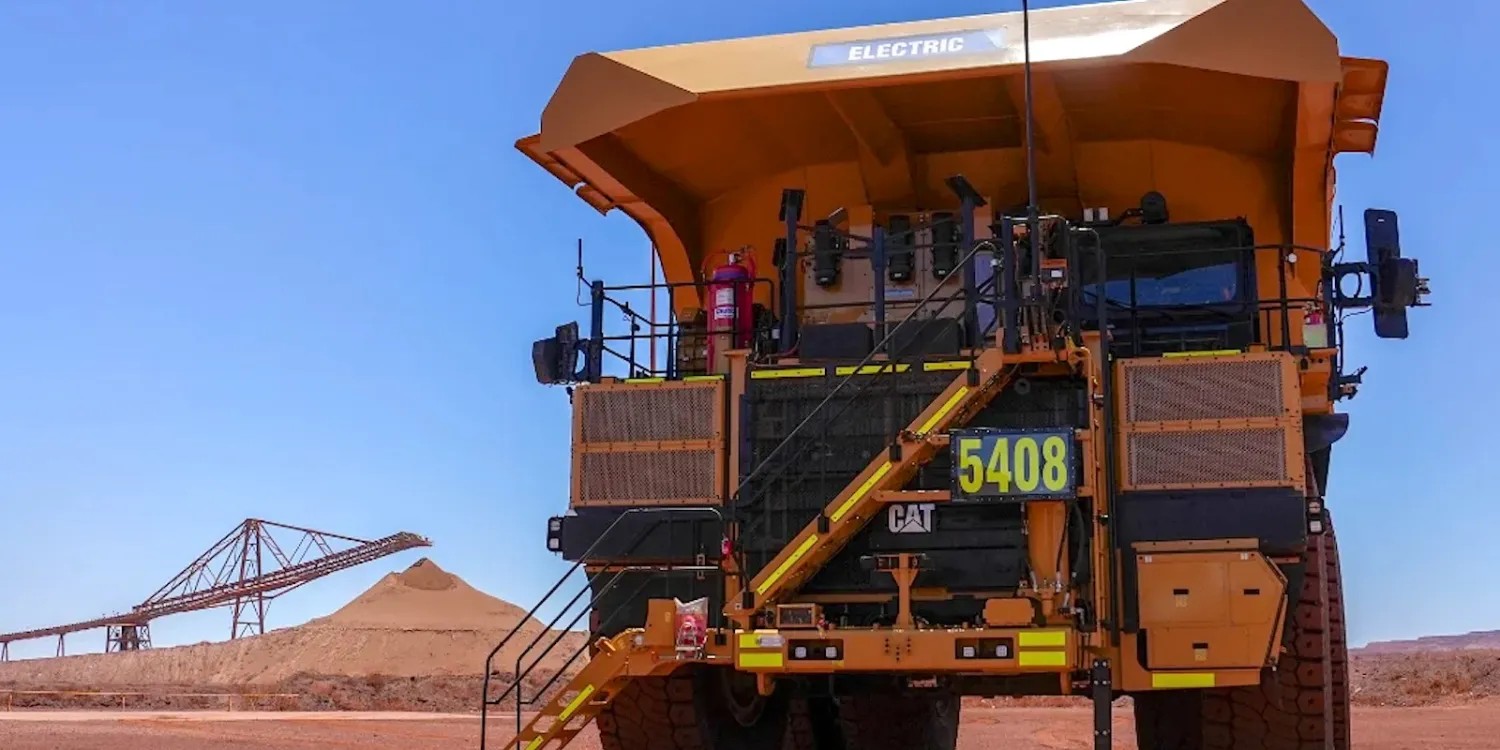
Australia’s first Cat 793 XE Early Learner battery-electric haul trucks have arrived at BHP’s Jimblebar iron ore mine in the Pilbara, marking a significant milestone in the mining industry’s decarbonization journey. This deployment represents an industry-first collaboration between BHP, Rio Tinto, and Caterpillar, aimed at validating whether battery-electric technology can replace traditional diesel power in large-scale iron ore mining operations.
Three Giants Unite for Mining Electrification
The two electric haul trucks deployed are part of Caterpillar’s Early Learner program, representing a major step toward a more sustainable future in mining. “Powering up our first battery-electric haul trucks in the Pilbara is an important step forward on the mining industry’s road to decarbonization,” says BHP Western Australia Iron Ore Asset President Tim Day. “Replacing diesel isn’t just about changing energy sources, it’s about reimagining how we operate and creating the technologies, infrastructure, and supply chains to transform mining operations.”
These 240-ton electric haul trucks are powered by a 564 kWh lithium iron phosphate (LFP) battery pack that delivers power to a 480 kW (645 hp) electric motor. While torque figures remain undisclosed, the vehicles are capable of hauling 250 tons of truck and payload at the same 38 mph top speed as their 2,650 hp diesel-powered counterparts. Notably, under the right conditions, heavily-loaded haul trucks can rely on regenerative braking to maintain charge levels, enabling round-the-clock operation without the need to stop and charge—a capability diesel trucks simply cannot match.
Far-Reaching Trial Implications
The trials will evaluate the integration of battery technologies, charging infrastructure, power management, and supply chains. Rio Tinto stated that the testing will inform future technology development, processes, infrastructure, and workforce capabilities required to support lower-emission mining operations.
In preparation for the electric trucks’ arrival, BHP’s Jimblebar mine completed upgrades to site electrical transmission and distribution systems to enable high-power charging infrastructure. This forms part of BHP’s strategy to reduce Scope 1 and 2 greenhouse gas emissions through three key approaches: diesel displacement, fugitive emissions elimination, and electrification.
Competitive Pressure and First-Mover Advantage
The BHP and Rio Tinto initiative is partly driven by competitor Fortescue’s electrification progress. Industry analysis indicates Fortescue is saving between $300 million and $400 million annually in fuel costs by deploying Liebherr T264 electric haul trucks. The company has ordered 360 electric trucks as part of a $4 billion electrification program, targeting zero emissions from its Pilbara iron ore operations by 2030.
Despite competitive pressures, BHP and Rio Tinto are proceeding cautiously. “A significant shift like this demands a strong commitment to research and development, coupled with collaboration across the industry,” Tim Day emphasized. “This is going to take time to get right, which is why trials like this one with Rio Tinto and Caterpillar are so critical.”
Deep Integration with Autonomous Technology
Another key objective of the Early Learner program is validating the integration of multiple electrified trucks at a single site with remote operators, including integration with Caterpillar’s existing MineStar autonomous haulage and fleet management systems. Caterpillar has extensive experience in autonomy, with over 500 autonomous trucks currently operating globally, having hauled more than 4 billion tonnes cumulatively.
“Through this industry-first collaboration to test Cat 793 XE Early Learner battery-electric haul trucks in Pilbara conditions, we hope to meet our shared goals as quickly and efficiently as we can,” said Marc Cameron, Senior Vice President of Resource Industries Sales, Services and Technology at Caterpillar.
Harbinger of Industry Transformation
This trial holds significance not only for the participants but also as a demonstration for the entire mining industry. With mounting global pressure for carbon reduction and maturing electric equipment technology, mining electrification has become an irreversible trend. Data shows that fuel and energy costs represent mining companies’ largest operating expenses and emission sources. Electrification not only significantly reduces greenhouse gas emissions but also delivers substantial economic benefits.
The collaborative trial between BHP and Rio Tinto will provide invaluable practical experience and data support for mining industry electrification transformation, charting the course for future industry development.