On the eve of a crucial policy announcement by the European Commission, Europe’s electric vehicle industry has launched an important campaign to defend existing climate targets. Led by industry organizations E-Mobility Europe and ChargeUp Europe, nearly 200 business leaders have sent an open letter to EU Commission President Ursula von der Leyen, firmly demanding that the 2035 zero-emission target for new car sales be maintained.
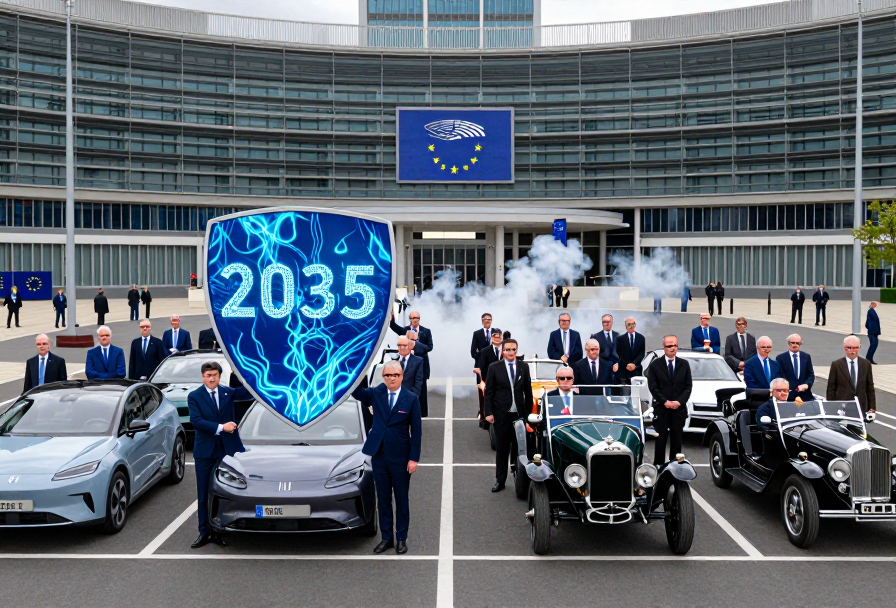
Powerful Industry Coalition Speaks Out
The open letter boasts an impressive list of signatories, including Swedish automakers Volvo and Polestar, both of which have fully committed to electrification. The more than 200 signatory companies span the entire electric vehicle value chain, from vehicle manufacturers and battery producers to charging infrastructure operators and grid operators, forming a broad coalition called “#TakeChargeEU.”
The core message of the open letter is clear and urgent: when the European Commission unveils its automotive package on December 16, it must preserve the full integrity of the 2035 zero-emission target. The signatories emphasize that this target, agreed under von der Leyen’s leadership in 2023, is not just a climate milestone but a signal of Europe’s intent to lead in clean mobility, energy security, and industrial innovation.
German Pressure Creates Policy Uncertainty
The timing of the open letter is critical. According to draft plans seen by Reuters, the Commission’s upcoming automotive package could offer carmakers greater flexibility in meeting fleet CO₂ limits and adjust the effective ban on the sale of new CO₂-emitting cars from 2035, an outcome backed by German manufacturers and the European Automobile Manufacturers’ Association (ACEA).
German Chancellor Friedrich Merz has sent a formal letter to von der Leyen requesting exemptions to allow plug-in hybrids and “highly efficient” combustion engines to continue beyond 2035. At a press conference in Berlin, Merz stated that the German government wants to protect the climate in a “technology-neutral way,” emphasizing that all technological options should remain open.
Additionally, six member states—Bulgaria, the Czech Republic, Hungary, Italy, Poland, and Slovakia—have formally asked the Commission to allow hybrids and low-carbon fuels to continue after 2035, citing industrial competitiveness concerns.
“Every Delay in Europe Only Widens the Gap with China”
In response to pressure to weaken the ban, the EV industry coalition has issued a stern warning. The open letter clearly states that reopening the legislation would inject uncertainty into long-term product and supply-chain planning, slow the scale-up of charging networks, and weaken the bloc’s position against Chinese rivals that are expanding rapidly in global markets.
The letter’s most striking statement reads: “Every delay in Europe only widens the gap with China.” This sentence directly addresses the core challenge facing the European automotive industry—Chinese EV manufacturers are rapidly expanding their market share in Europe with cheaper models, strong domestic production capacity, and an integrated battery supply chain.
The signatories emphasize that allowing transitional technologies such as plug-in hybrids and so-called CO₂-neutral fuels (such as synthetic e-fuels and advanced biofuels) to continue beyond 2035 would risk weakening Europe’s regulatory credibility. They point out that the 2035 zero-emission target was only adopted in 2023 following lengthy negotiations between member states and the European Parliament, and forms a central part of the bloc’s pathway to climate neutrality by 2050.
Industry Division and Employment Debate
Notably, Europe’s automotive industry is clearly divided on this issue. Companies like Volvo and Polestar, which have invested heavily in electrification, firmly oppose easing the 2035 deadline, warning that such changes could undercut firms that have already committed to full electrification.
Traditional German automakers, however, face different challenges. Germany’s automotive sector has shed nearly 50,000 jobs in the past 12 months alone, facing low sales, increasing Chinese competition, U.S. tariffs, and the costs of transitioning to electric vehicles.
EU Commissioner for Sustainable Transport and Tourism Apostolos Tzitzikostas has said the Commission will be “open to all technologies” when reviewing car and van CO₂ standards. According to German business newspaper Handelsblatt, Merz’s letter has been received “very positively” in Brussels, and the Commission may allow new combustion engine cars running on biofuels or synthetic e-fuels to be registered after 2035.
Critical Decision on December 16
As December 16 approaches, the future direction of Europe’s automotive industry will become clearer. This decision concerns not only Europe’s climate goals but will also profoundly impact hundreds of thousands of jobs across the automotive value chain, hundreds of billions of euros in investment direction, and Europe’s position in global electric vehicle competition.
Environmental groups and the industry coalition warn that questioning the phase-out will create new uncertainty for customers, investors, and employees. Attempts to artificially keep old technologies alive will come at the expense of innovation, competitiveness, and sustainability, ultimately jeopardizing jobs in Germany and across Europe.
Supporters of a looser approach argue that allowing these transitional technologies beyond 2035 would ease the shift for manufacturers and consumers at a time of slower-than-expected battery-electric sales, high purchase costs, and uneven charging infrastructure.
Whatever the outcome, this battle over the 2035 target has become a defining moment for Europe as it seeks to balance climate ambition with industrial reality.