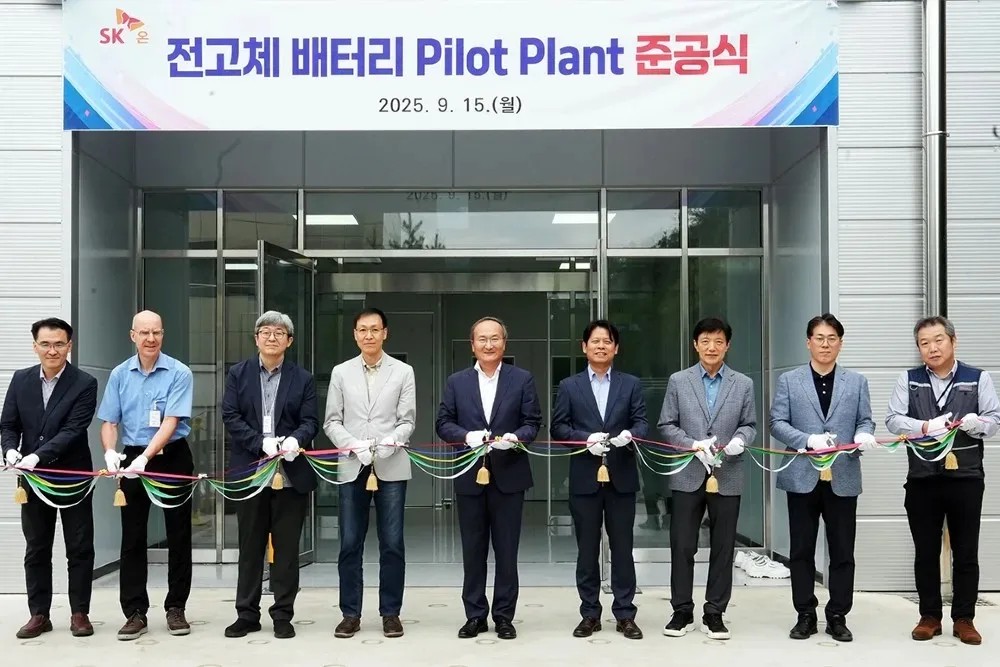
On September 15, 2025, SK On, a leading global battery manufacturer under South Korea’s second-largest conglomerate SK Group, held the completion ceremony for its all-solid-state battery (ASSB) pilot plant at the SK On Institute of Future Technology in Daejeon. This milestone marks a crucial step forward in the company’s push to commercialize next-generation battery technology. The ceremony was attended by SK On CEO & President Seok-hee Lee, Head of the Institute of Future Technology Ki-soo Park, and Andrea Maier, head of Solid Power Korea.
Technological Breakthrough: Dual-Track Development Strategy
SK On is currently developing two distinct types of solid-state batteries. The first variant uses polymer-oxide composites and is expected to reach commercialization by 2028, while the second employs sulfide-based technology with a target commercialization date of 2029. The newly completed pilot facility in Daejeon will primarily focus on developing sulfide-based cells, with some production lines configured specifically for lithium-metal anode batteries.
The 4,600-square-meter (50,000 sq. ft.) pilot plant employs SK On’s proprietary “Warm Isostatic Press (WIP)-free” technology for ASSB development, making it the first facility in South Korea to implement such solutions. WIP technology is a next-generation pressing process that applies uniform pressure to electrodes at elevated temperatures (25–100°C) to improve density and performance. While this technology minimizes battery heat generation and extends lifespan, it requires a cell-sealing process and is difficult to implement in continuous automated production lines, resulting in lower productivity.
To retain the advantages of the WIP process while addressing its productivity shortcomings, SK On leveraged its unique cell design and conventional pressing methods. The company optimized the mixing of battery materials, including active materials and conductive additives, as well as electrode composition, thereby reducing internal resistance within the electrodes. Additionally, SK On improved the bonding between electrodes and solid electrolytes and optimized pressing conditions to reduce interfacial resistance, enabling smoother ion transport, more stable charging and discharging, and longer cycle life.
Industry-Academia Collaboration Drives Innovation
Beyond its internal R&D efforts, SK On has been advancing next-generation battery technologies through strategic partnerships. In early 2024, the Korean firm acquired licenses from its US partner Solid Power to use the company’s cell technology for its own research and development and to produce similar prototypes in Daejeon. Solid Power has developed a proprietary sulfide-based solid electrolyte material and counts BMW and Ford among its partners.
In May 2025, SK On and South Korea’s Hanyang University reported a significant technological breakthrough: a threefold increase in cycle life for sulfide-based ASSBs by applying protective-film technology to lithium-metal anodes. Patent applications for the underlying technologies have been filed both domestically and internationally.
Over the past year, SK On has achieved multiple technical advances in solid-state battery R&D. In summer 2024, the company announced it had created a solid polymer electrolyte for lithium-metal batteries that operates at room temperature. In early 2025, the firm reported a new manufacturing method for solid electrolytes based on light energy technology. In May 2025, SK On presented advances in the cycle life of sulfide-based batteries using lithium-metal anodes, as well as new findings on the relationship between the curing time of gel-polymer electrolytes and battery service life.
Technical Targets and Market Outlook
SK On has set ambitious performance targets for its solid-state battery technology: achieving an energy density of 800Wh/L in the medium term and 1,000Wh/L in the long term. For comparison, Solid Power disclosed details of its solid-state platform back in May 2021. The company uses conventional NMC cathodes, so existing production processes do not need significant adaptation. Combined with a silicon anode and solid electrolyte, Solid Power claims its cells can reach a gravimetric energy density of 390Wh/kg. Using a lithium-metal anode instead, while retaining an NCM-811 cathode, raises the figure to 440Wh/kg.
The primary function of the Daejeon pilot plant is to produce prototypes and assess and validate their quality and performance before full-scale production. “This pilot plant will serve as a cornerstone for SK to leap forward as a strong and resilient company in addressing any changes in business environment,” said SK On CEO & President Seok-hee Lee at the completion ceremony. “We aim to remain at the forefront of commercializing all-solid-state batteries to accelerate electrification.”
Industry Impact and Future Prospects
All-solid-state batteries are widely regarded as a crucial development direction for next-generation battery technology, offering superior safety, energy density, and cycle life compared to conventional lithium-ion batteries. As one of the world’s major battery manufacturers, SK On’s technological progress holds significant implications for the entire electric vehicle industry.
Through its dual approach of technical collaboration with Solid Power and independent R&D, SK On is building a technological moat in the solid-state battery sector. The company’s plan to achieve commercialization by 2029—one year ahead of its original target—demonstrates confidence in both technology maturity and market demand.
With the global acceleration of automotive electrification and growing demand for higher-performance batteries, SK On’s solid-state battery technology is poised to provide the company with a crucial competitive advantage in the coming years. The launch of the Daejeon pilot plant represents an important step from laboratory R&D toward industrial application, contributing significant momentum to the global development of solid-state battery technology.
The completion of this facility marks not only a technological milestone for SK On but also a significant contribution to South Korea’s position as a leader in advanced battery manufacturing. As the industry moves toward the next generation of energy storage solutions, SK On’s investments in solid-state technology position the company at the forefront of this critical transition, potentially reshaping the landscape of electric mobility in the years to come.