On the afternoon of September 16, 2024, an aircraft safety incident occurred at the Changchun Air Show. Two XPeng HT eVTOL (electric Vertical Take-Off and Landing) aircraft collided during dual-aircraft formation training, with one aircraft crashing and catching fire.
Incident Details
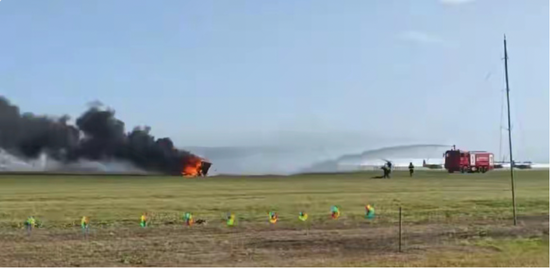
According to XPeng HT’s official response, after the conclusion of the Changchun Air Show rehearsal, two aircraft participating in dual-aircraft formation training made contact due to insufficient flight spacing. Following the accident, one aircraft landed normally, while the other sustained fuselage damage during landing and caught fire.
On-site video footage shows the crashed aircraft bursting into flames and producing thick smoke, with fire trucks immediately arriving at the scene to conduct firefighting operations. It is understood that relevant departments have completed the on-site disposal work in an orderly manner.
Conflicting Reports on Casualties
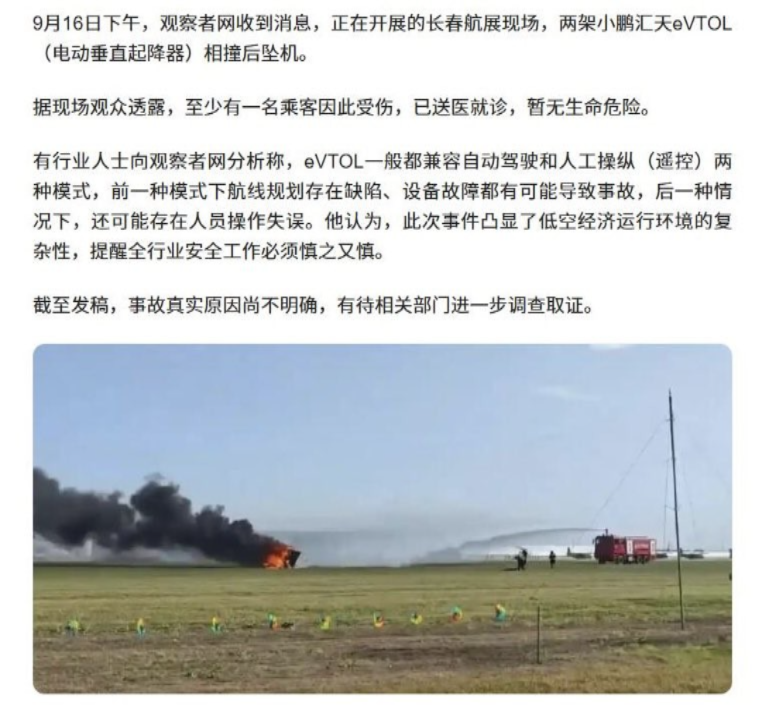
Regarding the casualties from this incident, different information sources have emerged. XPeng HT officially stated in their response that “on-site personnel are safe,” without mentioning any casualties.
However, according to on-site witnesses, at least one passenger was injured in the incident and has been sent to the hospital for treatment, with no life-threatening conditions reported. This information contradicts the official response significantly, and the specific casualty situation awaits further confirmation and clarification from authoritative departments.
Relevant departments are currently conducting further investigations into the specific causes of the accident, and a more detailed accident report is expected to be released subsequently.
Environmental Factors
According to on-site observations, wind conditions were relatively strong at the Changchun Air Show venue that day, and adverse weather conditions may have had some impact on flight safety. Reports indicate that due to weather conditions, some professional helicopters and fighter jets were unable to take off to complete their scheduled low-altitude flyby performances that day.
Technical Background Analysis
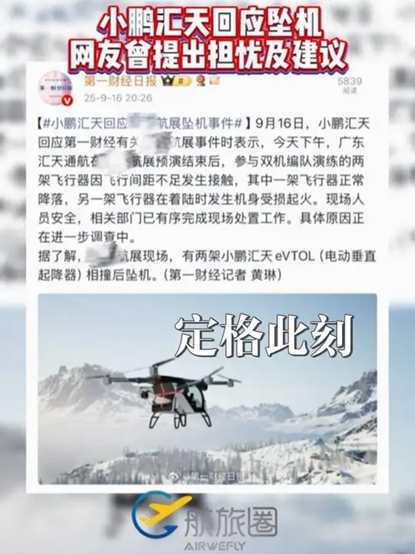
XPeng HT’s Voyager X2 is the company’s main eVTOL product, featuring a six-rotor, six-axis dual-ducted design with a 270-degree panoramic dual-seat cockpit. The aircraft’s main structure and rotors are manufactured using carbon fiber materials, with a foldable portable design feature.
eVTOL, as an electric vertical takeoff and landing aircraft, represents an important development direction in the low-altitude economy sector. These aircraft achieve vertical takeoff and landing capabilities through distributed electric propulsion systems and have broad application prospects in scenarios such as urban air transportation and emergency rescue.
Industry Development Status
XPeng HT, as a major participant in China’s low-altitude economy sector, plans to mass-produce and deliver its “Land Aircraft Carrier” flying car project in 2025. In March this year, the Civil Aviation Administration of China released the “Draft for Comments on Special Conditions for X3-F Aircraft,” providing a policy foundation for type certification of similar aircraft.
In June, XPeng HT signed cooperation agreements with three enterprises in Shandong Province, planning to build 2 flying car application demonstration sites and no fewer than 10 takeoff and landing points, marking the entry of low-altitude economy applications into a substantial implementation phase.
Safety Considerations
This accident serves as a reminder to the industry that while eVTOL technology is developing rapidly, safety standards for manned flight applications are extremely high. Aviation experts point out that the accident rate for manned aircraft needs to be controlled at extremely low levels, requiring the establishment of comprehensive safety assurance systems across the entire chain of aircraft design, manufacturing, and operation.
Flight safety in complex meteorological conditions, airspace management for multi-aircraft formations, and the reliability of flight control systems are all important aspects that the industry needs to continuously monitor and improve.
Future Development
Currently, the specific causes of the accident are still under investigation. For the entire eVTOL industry, this accident serves both as a safety warning and provides important reference for technological improvement and standard formulation. As low-altitude economy policies continue to improve and technology advances, relevant companies need to always prioritize safety while pursuing innovation.
The investigation results and lessons learned from this accident will provide important reference for the industry’s future safe development, promoting the healthy development of eVTOL technology with safety as the prerequisite.
Industry Impact and Reflection
This incident highlights the challenges facing the emerging eVTOL sector as it transitions from experimental technology to commercial operations. The contradiction between official statements and eyewitness accounts underscores the importance of transparent communication in aviation safety incidents.
For XPeng HT, this accident may impact public confidence in their flying car technology and could potentially affect their planned 2025 commercial launch timeline. The company will likely need to conduct thorough safety reviews and possibly implement additional safety measures before proceeding with commercial operations.
The incident also raises questions about safety protocols for eVTOL demonstrations at public events, particularly regarding weather conditions and multi-aircraft operations. Industry regulators may need to review and strengthen safety requirements for such exhibitions to prevent similar incidents in the future.