1 | A Routine Voyage Turns Critical
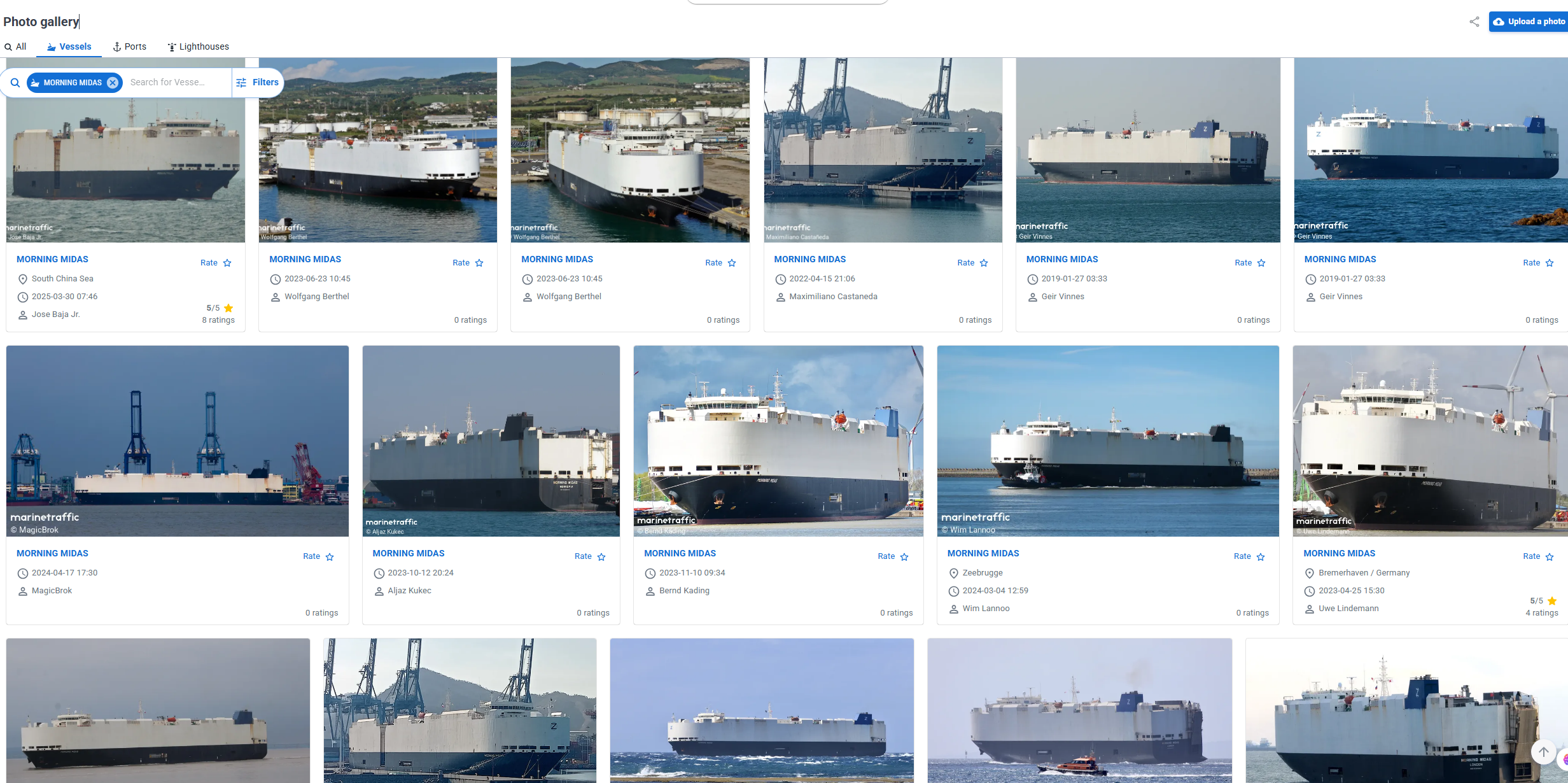
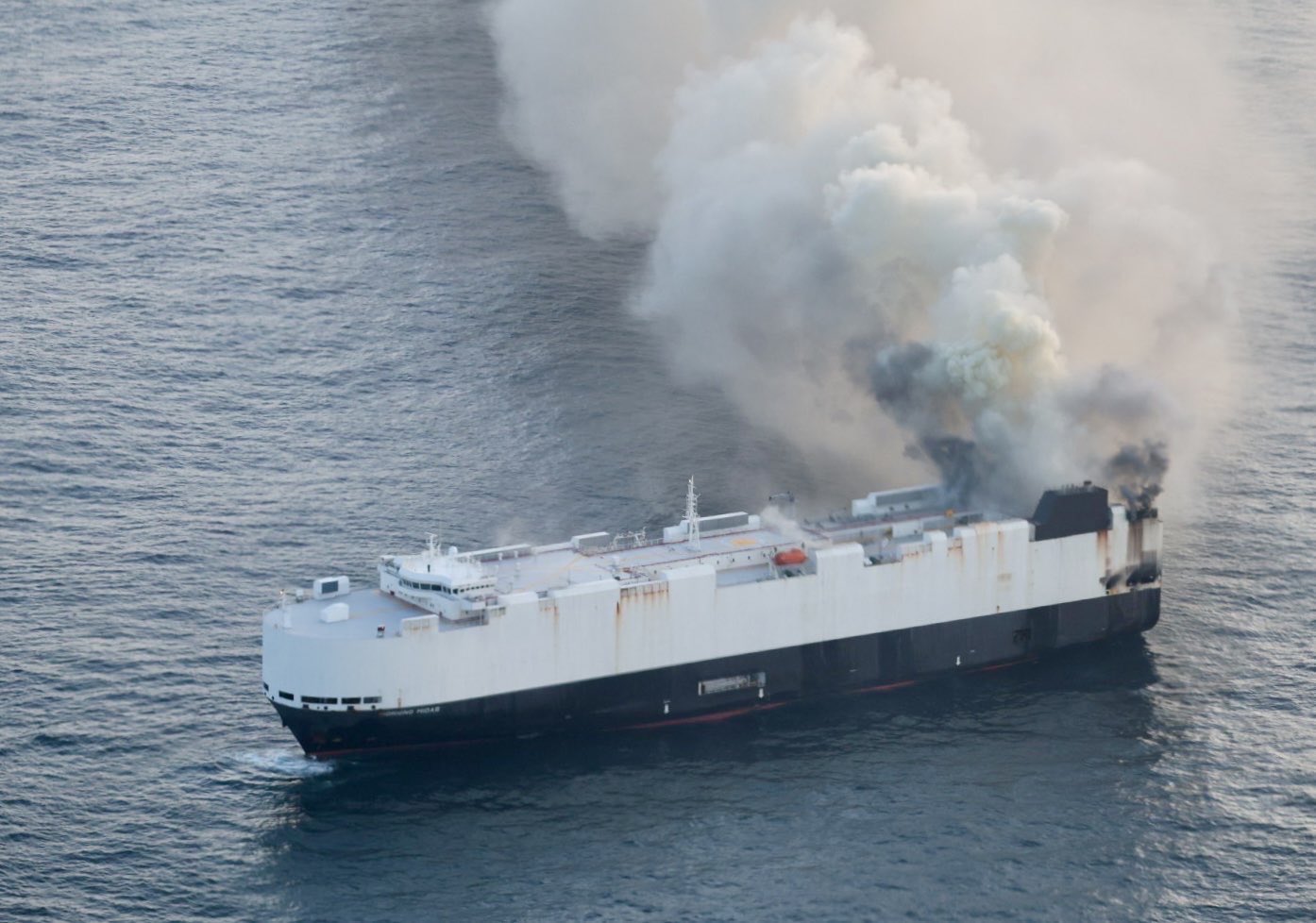
When the 600-foot, Liberian-flagged car carrier Morning Midas departed Yantai, China, in late May 2025, its manifest listed 3,159 vehicles—65 fully electric and 681 hybrid—bound for Lázaro Cárdenas, Mexico. On 3 June, about 260 miles southwest of Adak Island in the North Pacific, crew members spotted smoke wafting from the deck loaded with electric cars, triggering what would become a three-week maritime crisis.
2 | Emergency Response and Abandon Ship
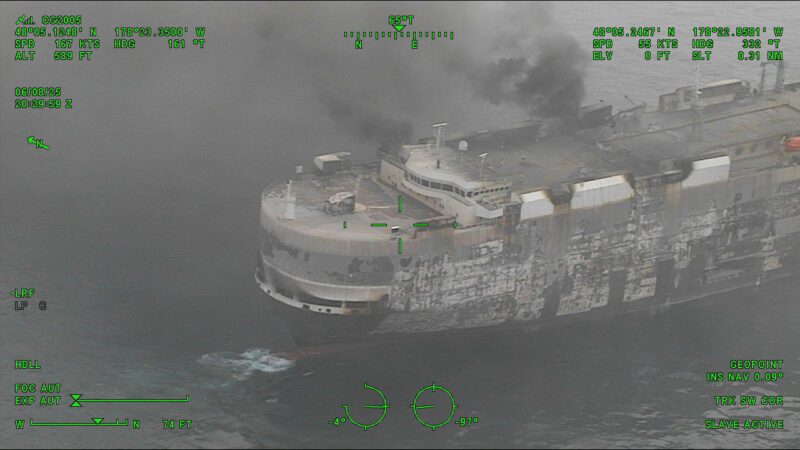
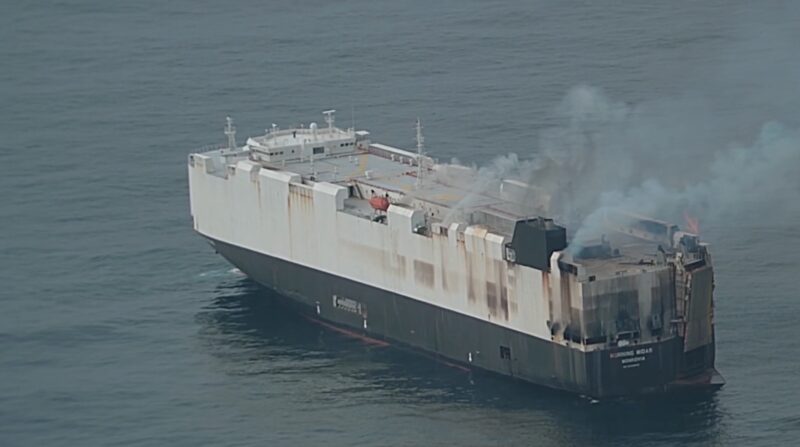
The crew activated fixed CO₂ suppression, closed ventilation dampers, and mustered on deck, but heat and toxic fumes forced a full abandonment. All 22 mariners boarded lifeboats and were rescued unharmed by the passing containership Cosco Hellas. The vessel was left adrift with roughly 350 t of marine gas oil and 1,530 t of very-low-sulphur fuel oil still in its tanks—an environmental time bomb should the hull fail.
3 | The Salvage Begins
Resolve Marine mobilised two tugs—the Gretchen Dunlap (on scene 9 June) and the more capable Garth Foss (15 June)—equipped with external fire monitors, foam systems and oil-recovery gear. Daily Coast Guard C-130J overflights tracked the vessel’s condition; by 16 June salvors reported no open flames but noted extensive structural compromise and progressive flooding in hold spaces.
4 | Why EV Fires Are Different
Lithium-ion battery packs can enter “thermal runaway,” a self-propagating fire that re-ignites even after initial suppression. In confined Ro-Ro decks, heat spreads through vehicles parked inches apart, while burning plastics generate dense smoke that impedes firefighting access. The Morning Midas blaze is the fourth major car-carrier fire since 2018 and the second—after the Felicity Ace—to end in total loss, sharpening focus on EV-specific hazards.
5 | Weather, Water Ingress and the Final Hours
By late June a strong Aleutian low spun 30-knot winds and five-meter seas across the casualty. Hull plating already heat-weakened now flexed under wave impact; cracks near the starboard quarter admitted seawater faster than portable pumps could expel it. At 16:35 local time (UTC-9) on 23 June, the bow pitched skyward, the stern flooded, and the ship slipped beneath 5,000 m of water roughly 360 nm from land—too deep for practical wreck intervention.
6 | Immediate Pollution Control
Both salvage tugs stayed on station with skimmers, sorbent booms and dispersant spray systems. Initial overflights showed no sheen, suggesting bunker tanks remained largely intact during the plunge—likely aided by rapid equalisation of internal and external pressures that limited rupture. A specialised pollution-response vessel is steaming to the site to conduct satellite-assisted monitoring for delayed leaks or floating debris.
7 | Regulatory and Insurance Repercussions
The International Union of Marine Insurance (IUMI) has warned that EV-driven fire losses could see premiums rise 20 % for Ro-Ro operators lacking enhanced detection, fixed-foam upgrades, or dedicated EV decks. Meanwhile, IMO’s Sub-Committee on Ship Systems & Equipment is reviewing amendments to SOLAS Chapter II-2 that would require:
- Lithium-ion gas-early-warning sensors at car-deck level
- Fire insulation on internal bulkheads separating engines from cargo holds
- Dedicated drainage and containment to prevent water buildup during firefighting
Morning Midas will likely be a case study cited when the revised code is tabled at MSC 109 in 2026.
8 | Patterns in Recent Car-Carrier Fires
| Vessel (Year) | Cargo | Fire Origin | Outcome |
|---|---|---|---|
| Sincerity Ace (2018) | 3,500 cars | Unknown | Total constructive loss, scuttled |
| Felicity Ace (2022) | 4,000 cars incl. EVs | Vehicle deck | Sank mid-Atlantic |
| Fremantle Highway (2023) | 3,783 cars, 498 EVs | EV deck | Towed to Dutch port |
| Morning Midas (2025) | 3,159 cars, 65 EVs | EV deck | Sank North Pacific |
The trend underscores how even a minority share of EVs can elevate risk on ships designed decades before lithium-ion propulsion.
9 | Salvors’ Toolbox: What Worked, What Didn’t
Successes
- Early crew evacuation prevented fatalities.
- External water cooling contained flame spread to lower holds.
- Continuous air reconnaissance provided thermal imaging and drift modeling.
Limitations
- Fixed CO₂ systems are less effective on high-temperature battery fires.
- Structural heat damage outpaced dewatering capacity once rough weather set in.
- Towing gear could not be safely connected until flames subsided—by then watertight integrity was beyond recovery.
Resolve Marine has called for purpose-built “battery-deck encapsulation blankets” that smother EV clusters before they ignite adjacent vehicles.
10 | Environmental Fate of the Wreck
At 5,000 m the site lies below the oxygen-rich photic zone; cold, high-pressure conditions slow microbial oil degradation but also limit immediate ecological exposure. Modeling from the Felicity Ace case suggests most light fractions will dissolve before reaching surface, yet heavier bunker molecules can persist on the seabed for decades. NOAA and the U.S. Coast Guard are coordinating a remote-sensing plan and may deploy an AUV later this year to survey the wreck’s condition.
11 | Industry Lessons and Next Steps
- Compartmentation upgrades: Future Ro-Ro new-builds should feature EV-specific zones with higher fire-rating bulkheads and independent ventilation shut-offs.
- Real-time cargo data: Shippers must share battery SOC, chemistry and VIN lists before loading to enable risk zoning.
- Training and drills: Crews need scenario plans for runaway lithium-ion fires, including EV-deck isolation and evac decision triggers.
- Salvage readiness: Coastal states along major EV-car-trade lanes should pre-position foam, high-capacity pumps and battery-fire blankets.
- Insurance incentives: Underwriters could discount premiums for vessels retrofitted with water-mist cannons or embedded thermal cameras.
Zodiac Maritime has pledged to collaborate with class societies to embed these lessons into its remaining fleet of ten car carriers.
12 | Human Dimension: Voices From the Bridge
Chief officer Alejandro Ruiz, rescued on 3 June, told investigators that “temperature alarms spiked in minutes; we couldn’t reach the ignition point because smoke cut visibility to zero.” He praised the Cosco Hellas crew, noting that “their fast rescue launch reached us within 40 minutes—it saved lives.” Such firsthand accounts will inform upcoming ISM Code amendments on EV-cargo muster procedures. (Interview courtesy of Maritime Log.)
13 | Closing Reflections
Morning Midas is now a silent hull on the abyssal plain, but its loss resonates at the surface: a warning that the green-transport revolution brings new maritime hazards that legacy safety regimes are only beginning to confront. As electric vehicles multiply on global trade routes, ship designers, regulators and insurers must act swiftly—otherwise fires like the one that doomed Morning Midas could shift from extraordinary to routine.