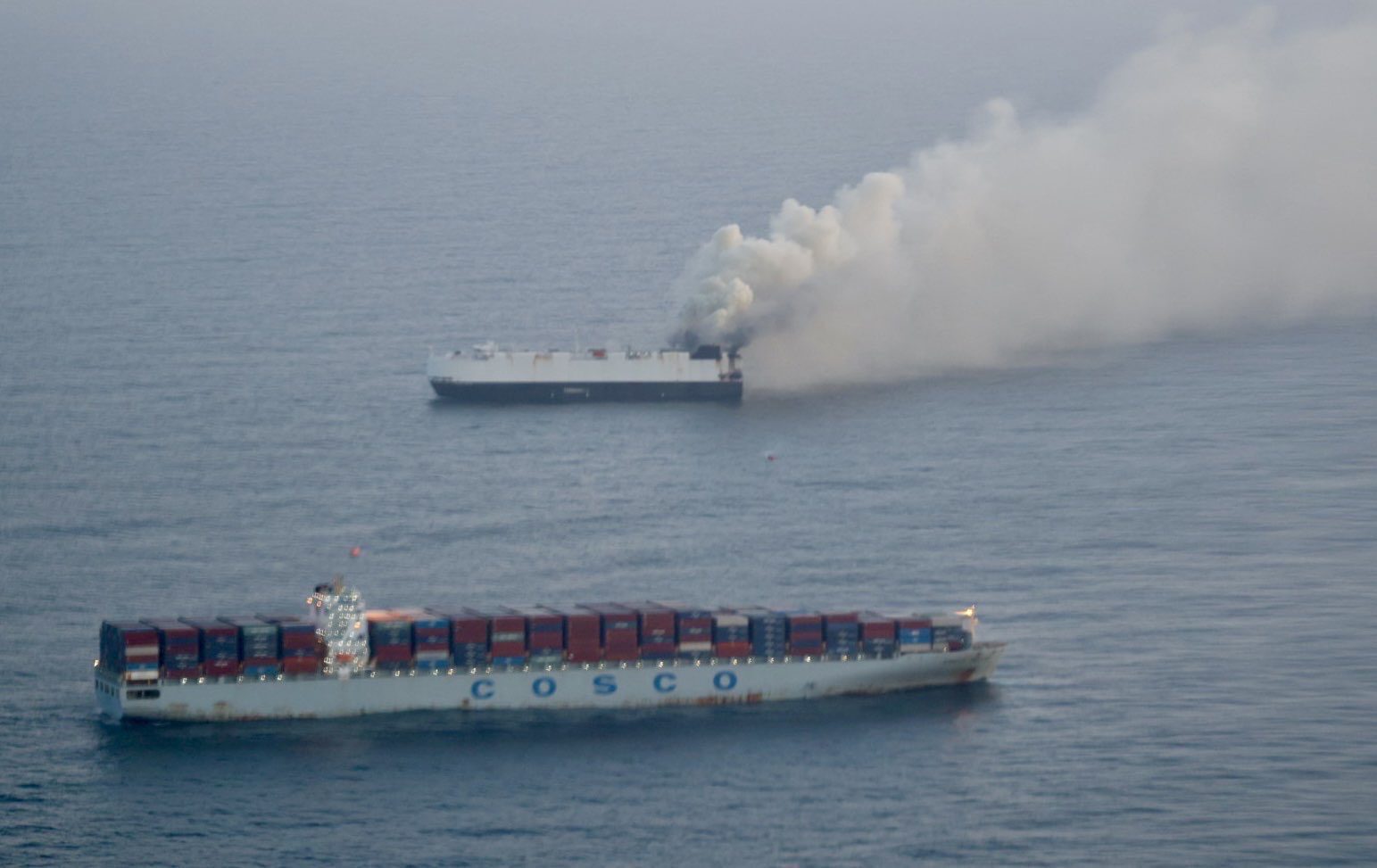
A cargo ship named Morning Midas, carrying approximately 3,000 vehicles — including 800 electric vehicles (EVs) — caught fire while sailing through the central Pacific Ocean on Tuesday, leading to the complete evacuation of its 22-member crew. The vessel was en route from China to Mexico when the fire broke out.
The incident has once again brought the spotlight to the growing risk associated with transporting EVs at sea, particularly those equipped with lithium-ion batteries prone to thermal runaway.
Route and Incident Overview
According to vessel tracking data reported by Bloomberg, the Morning Midas departed from Yantai Port in China on May 26, with stops in Nansha and Shanghai before heading toward Mexico. The fire reportedly began on an upper deck where a large number of electric vehicles were parked. Zodiac Maritime, the ship’s management company, stated that initial smoke was detected on deck and that crew members initiated fire suppression procedures — but the flames quickly became uncontrollable.
The U.S. Coast Guard responded promptly and coordinated a rescue operation, safely evacuating all 22 crew members to a nearby commercial vessel. No injuries were reported. Zodiac Maritime has since deployed recovery teams to handle salvage and fire containment efforts. The company declined to name the owners of the cars onboard.
EV-Related Fire Risks and Thermal Runaway
This incident underscores the unique hazards associated with electric vehicles in maritime transport. According to a recent Allianz Global report, the increasing demand for lithium batteries — especially in EVs — presents mounting risks for global shipping.
EV battery fires are particularly difficult to extinguish due to:
- Thermal runaway, where one battery cell overheats and causes adjacent cells to ignite in a chain reaction;
- Extended burn time, requiring as much as 8,000 gallons of water to cool a single battery pack;
- Enclosed steel compartments aboard car carriers, which create poor ventilation and high heat concentration;
- Tightly packed cargo, which accelerates fire spread and limits accessibility for firefighters.
Previous Maritime Fire Incidents Involving EVs
The Morning Midas case is not an isolated event. It follows several recent maritime disasters involving vehicle carriers:
- In 2022, a car carrier with approximately 4,000 vehicles caught fire in the Atlantic and ultimately sank despite recovery efforts.
- In 2023, another vessel carrying nearly 3,000 vehicles caught fire off the Dutch coast, again involving EVs.
These events have raised serious concerns about whether current shipping protocols are adequate for EV cargo, given the increased likelihood and severity of battery fires.
Insurance, Shipping, and Automotive Implications
1. Shipping Operators’ Precautions
Zodiac Maritime confirmed that emergency protocols were followed, and response teams are now evaluating the vessel’s condition. While no brand has claimed the EVs onboard, the scale and nature of the cargo suggest involvement of major automakers.
Some shipping companies have begun limiting the number of EVs per shipment or redesigning vessel layouts to include dedicated battery compartments with fire-resistant barriers.
2. Automakers’ Supply Chain Risks
The incident comes amid booming EV exports from China, which saw over 1.8 million units shipped globally in the first five months of 2024 — a 110% year-over-year increase. As exports to Latin America, Europe, and Southeast Asia expand, supply chain safety has become a critical factor for automakers.
Manufacturers may be forced to invest in advanced battery disconnect features, reinforced packaging, and standardized SOC (state of charge) limits during transport.
3. Insurance Industry Alert
Allianz and other insurers have expressed growing concern over the high-value risk profile of car carriers filled with EVs. The complexity of fire suppression and scale of potential loss could lead to higher premiums, stricter underwriting, and new clauses excluding battery-related incidents.
Global Call for Regulatory Reform and Best Practices
Maritime experts are urging international regulatory bodies like the IMO (International Maritime Organization) to:
- Establish mandatory EV fire safety protocols;
- Enforce battery chemistry classification and dedicated stowage requirements;
- Mandate onboard fire detection, CO₂ suppression, and lithium-specific fire suppression systems;
- Require shipping crews to receive EV-specific fire and rescue training.
Conclusion
The Morning Midas fire is yet another wake-up call for the maritime, automotive, and insurance sectors. As EV exports surge worldwide, the systems that support their global delivery must evolve at the same pace — or risk severe financial and environmental consequences.
Shipping lithium-powered vehicles across oceans safely demands new standards, international cooperation, and significant investment in both infrastructure and knowledge. The alternative may be a future where similar disasters become more common — and far more costly.