By Reuters
Seoul, South Korea – February 20, 2024
South Korea has introduced stringent new rules for carrying lithium batteries on planes, effective immediately, in response to growing concerns over their potential to cause fires and smoke during flights. The move follows a series of incidents involving malfunctioning lithium batteries, including a recent fire that broke out on an Air Busan aircraft while it was waiting to take off.
The updated regulations, implemented from Saturday, February 17, 2024, ban passengers from storing power banks, e-cigarettes, and other lithium-powered devices in overhead cabin bins. These items must now be kept within arm’s reach at all times. Additionally, charging such devices on board has been prohibited, and there are new limits on the quantity and strength of batteries that can be carried.
The changes come after a harrowing incident involving an Air Busan plane in January, where a fire broke out in the cabin shortly before departure. All 170 passengers and six crew members were safely evacuated, but the aircraft was destroyed. Although investigators have yet to determine the exact cause of the fire, early findings suggest it originated in an overhead locker.
“Existing cabin crew firefighting procedures have proven effective for lithium battery incidents that occur in-flight,” said a spokesperson for the International Air Transport Association (IATA). “However, if such an incident occurs while on the ground, the safest course of action is to evacuate the aircraft.”
The new rules reflect a global trend toward tightening regulations on lithium batteries, which are found in everyday items like smartphones, laptops, tablets, and e-cigarettes. These batteries pose significant risks when they malfunction, as they can overheat, produce smoke, or even catch fire. In extreme cases, they can explode, releasing molten material and fragments that act as shrapnel.
A Growing Safety Challenge
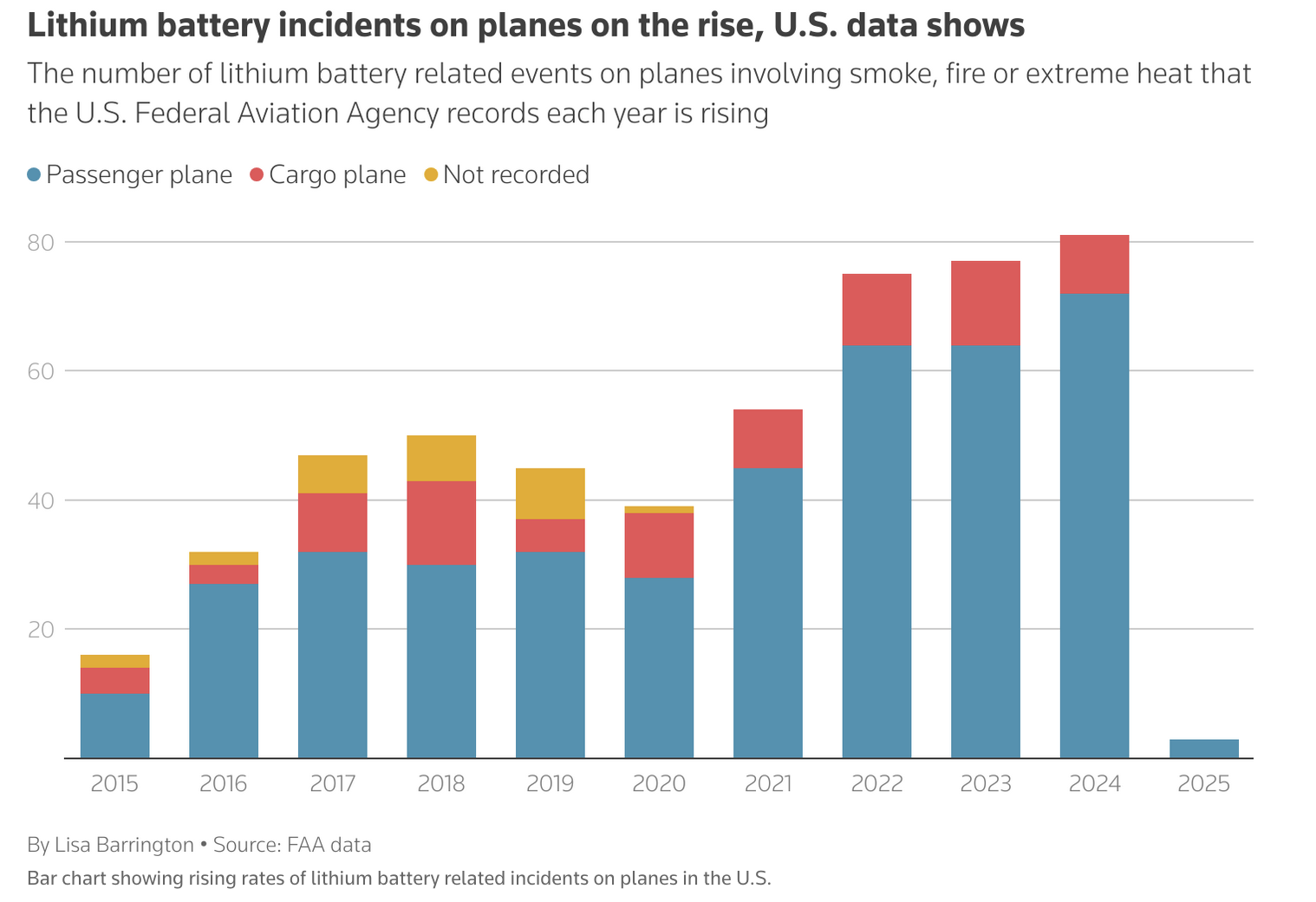
Lithium batteries have become a critical concern for the aviation industry. Between 2018 and last year, global reports of lithium battery malfunctions on flights nearly doubled, with incidents occurring at a rate of three per fortnight in 2023 compared to just under one per week in 2018.
The risks are exacerbated by the sheer number of batteries carried by passengers. On a full flight, hundreds of lithium batteries could be traveling in carry-on bags or checked luggage. Manufacturing defects, damage, or exposure to extreme temperatures can cause short circuits and rapid overheating.
In 2016, the United Nations’ International Civil Aviation Organization (ICAO) banned the transport of lithium-ion batteries as cargo after several high-profile incidents, including a fire that destroyed a Boeing 747 in 2015. However, the dangers remain significant for devices carried by passengers.
Historical Precedents
The aviation industry has faced numerous challenges with lithium batteries over the years. In 2010, a UPS cargo plane crashed near Dubai due to a battery fire, and an Asiana Airlines flight suffered a similar fate in 2011. These incidents have underscored the need for stricter regulations and better safety protocols.
In response, airlines and regulators have implemented training programs for cabin crew to handle lithium battery fires effectively. However, the root cause of the problem lies in the inherent risks of these energy-dense batteries.
Future of Lithium Battery Safety
While new regulations aim to mitigate risks, experts agree that a long-term solution requires innovation in battery technology. Safer alternatives, such as solid-state batteries, are being developed but are not yet widely available.
In the meantime, governments and airlines are focusing on improving detection methods. For instance, some airports have begun testing scent-detection dogs trained to identify lithium batteries hidden in luggage.
Conclusion
South Korea’s new regulations mark a significant step forward in addressing the risks posed by lithium batteries on flights. As other countries follow suit, the aviation industry must continue to balance innovation with safety, ensuring that passengers can travel safely despite the growing reliance on lithium-powered devices.