1) Event Overview: First Cross-OEM Energy Storage Collaboration
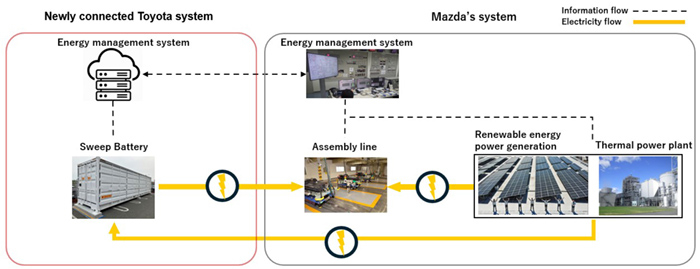
Toyota and Mazda have launched joint field tests of Toyota’s Sweep Energy Storage System at Mazda’s Hiroshima factory. The project connects Mazda’s on-site power generation and microgrid with Toyota’s storage system built from electrified vehicle batteries. The aim is to verify stable, high-quality, and efficient charging and discharging, while preparing the system to act as a buffer for fluctuating renewable energy. The collaboration is positioned as a key milestone in building Japan’s “battery ecosystem,” one of the seven industrial issues highlighted by the Japan Automobile Manufacturers Association (JAMA).
2) Why Hiroshima? The Perfect Test Ground
Mazda’s Hiroshima headquarters is unique in Japan: it is the only automaker that operates its own independent power generation system combined with a campus-level microgrid. With a mix of conventional sources and solar, plus advanced energy management infrastructure, the site provides ideal conditions to test how storage can stabilize renewable integration and support industrial power quality.
3) What is Sweep? Microsecond Bypass and Inverter Reuse
The heart of Sweep is Toyota’s proprietary “sweep device.” It enables microsecond-level switching of current flow across series-connected batteries. Key advantages include:
- Enabling batteries of different capacities, chemistries (lithium-ion, nickel-metal hydride, lead-acid), and states of health to work together in a single system.
- Bypassing degraded units while keeping the rest of the pack online, reducing strict consistency requirements for second-life batteries.
- Reusing the original vehicle inverters, minimizing additional PCS (power conversion system) costs and efficiency losses.
In short, Sweep is designed to transform inconsistent second-life batteries into a coherent, industrial-grade power asset.
4) From Pilot to Factory: Lessons from the 485kW/1,260kWh Project
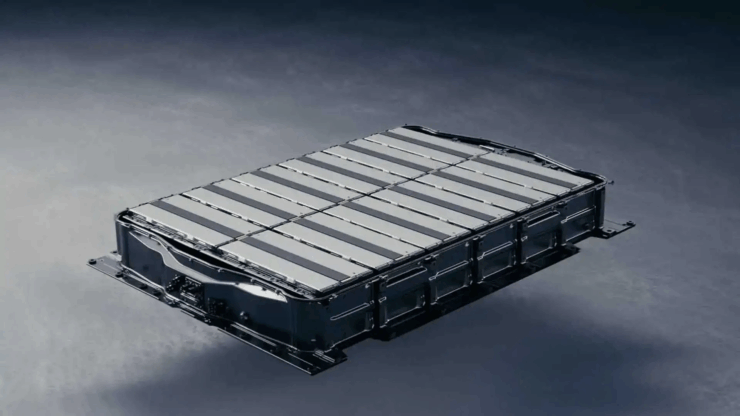
Toyota and Japan’s largest utility JERA built the first Sweep demonstration in 2022. That system delivered 485kW of output and 1,260kWh of capacity by combining multiple types of second-life batteries. Its success laid the engineering foundation for applying Sweep at Mazda’s production site. Potential applications include:
- Peak shaving and smoothing solar generation for factory loads.
- Improving power quality and avoiding voltage/frequency disruptions for assembly lines.
- Providing backup during blackouts or natural disasters.
- Participating in ancillary grid services such as frequency regulation and reserve capacity.
5) What Does “Battery Ecosystem” Mean?
JAMA’s “battery ecosystem” vision extends beyond recycling. It covers stable procurement of raw materials, extending the value of batteries through reuse, and building a closed-loop system. The Toyota-Mazda collaboration demonstrates how cross-company partnerships can elevate second-life use from isolated projects to integrated industrial infrastructure.
6) Engineering Challenges: From Prototype to Scalable Product
Several hurdles must be cleared before second-life storage becomes mainstream:
- Accurate State-of-Health (SoH) assessment: Determines usable capacity and safe power ranges.
- Multi-level control (BMS + EMS): From cell-level bypass to pack management and site-wide energy routing.
- Safety and fire protection: Different chemistries require tailored isolation and thermal management.
- Grid compliance: Systems must meet strict power quality standards on harmonics, voltage, and reactive support.
- Cost and business model: Savings from inverter reuse and reduced PCS must outweigh logistics and refurbishment costs.
7) Business Models: From “Cost Burden” to “Revenue Asset”
Possible pathways for Sweep commercialization include:
- EPC + O&M integration: OEMs and utilities deliver turnkey solutions with long-term service contracts.
- Power-as-a-Service: Factories pay for reliable capacity and quality as an ongoing service.
- Green finance and securitization: Standardizing second-life assets with insurance backing to attract investment.
These models shift automakers from battery suppliers to active participants in energy infrastructure.
8) Global Comparisons
- Japan (Toyota-led): Prioritizes compatibility across mixed chemistries and lifespans, aiming for resilience and power quality.
- US/EU: Focus on standardized packs and chemistries for easier scaling but limited flexibility.
- China: Strong in large-scale second-life storage projects, but less emphasis on integrating mixed systems and reusing original inverters.
Toyota-Mazda’s demonstration could set a new benchmark by proving that heterogenous second-life systems can deliver industrial-grade reliability.
9) Key Metrics: Proving the Economics and Reliability
Success will hinge on three measurable dimensions:
- Levelized Cost of Energy (LCOE) vs. equivalent full cycles.
- Power quality KPIs: Frequency response, harmonic distortion, voltage stability.
- Degradation curve stability across mixed batteries.
The Hiroshima trials will be critical in validating Sweep’s performance under real-world industrial loads.
10) Implications for Industry and Policy
- Supply chain resilience: Turning “end-of-life” batteries into strategic energy assets.
- Standards and insurance: Establishing frameworks for SoH assessment and warranty coverage.
- Grid markets: Aligning Sweep with ancillary services and capacity market participation.
- Cross-industry collaboration: Expanding beyond OEMs to include battery makers, utilities, EPCs, and financiers.
Conclusion
The Sweep system’s breakthrough lies in converting variability into controllable redundancy. By bypassing weak cells and reusing inverters, it allows mixed-chemistry, mixed-lifespan batteries to function as a unified energy storage asset. Mazda’s Hiroshima plant provides a demanding testbed, where renewable fluctuations and sensitive industrial loads will stress the system. If successful, Sweep could transform second-life batteries from an environmental narrative into a bankable, large-scale energy infrastructure solution.