Tokyo, Japan – June 2025 — Toshiba Corporation has officially begun sample shipments of its latest battery innovation, the SCiB™Nb, a groundbreaking lithium-ion battery that uses a niobium titanium oxide (NTO) anode—a global first. With its commercial debut targeting the high-demand sectors of electric buses, trucks, and other commercial electric vehicles (EVs), the SCiB™Nb is poised to redefine rapid charging, longevity, and safety in the lithium-ion battery market.
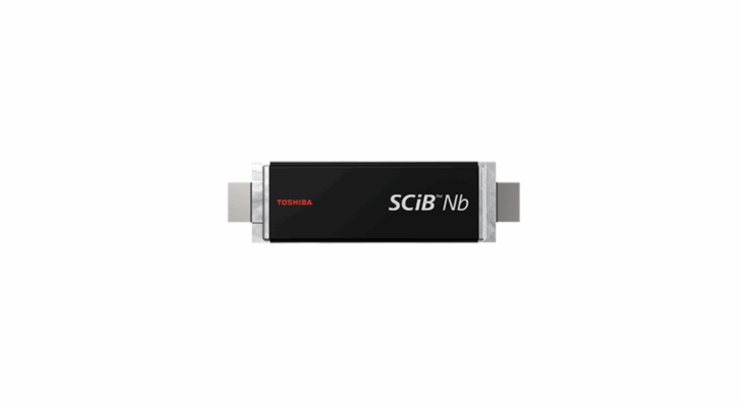
Developed in partnership with CBMM, the world’s largest niobium supplier based in Brazil, and Sojitz Corporation, CBMM’s strategic Japanese partner, Toshiba’s SCiB™Nb battery has been designed from the ground up to solve critical limitations in current EV battery technology. The battery’s unique properties, including ultra-fast 10-minute charging, 15,000-cycle durability, and enhanced safety under repeated rapid-charging conditions, position it as a next-generation solution for high-utilization commercial fleets.
What Makes SCiB™Nb Revolutionary?
At the heart of the SCiB™Nb’s innovation is its niobium titanium oxide (NTO) anode, which significantly alters the performance profile of traditional lithium-ion batteries. While lithium iron phosphate (LFP) batteries—a common choice for EVs—offer stable energy density and safety, they suffer from limited lifespan and potential lithium plating during fast charging. The SCiB™Nb avoids these issues by completely eliminating lithium metal deposition, a key cause of short circuits and thermal instability in conventional anode designs.
Key advantages of the SCiB™Nb battery include:
- Rapid charging: Reaches 80% charge in just 10 minutes, ideal for high-frequency transit systems.
- Exceptional cycle life: Capable of 15,000 partial rapid-charge cycles, significantly reducing the need for battery replacements and cutting total cost of ownership.
- High volumetric energy density: Comparable to carbon-based LFP batteries, offering compact, efficient design with no compromise in capacity.
- Safe long-term use: The NTO anode maintains stability even after extensive rapid charging, ensuring long-term operational safety.
Strategic Collaborations and Field Testing
The development and commercialization of SCiB™Nb has been supported by a strategic three-way alliance between Toshiba, CBMM, and Sojitz Corporation. This collaboration not only secures a stable niobium titanate supply chain, particularly for the Japanese market, but also accelerates R&D, prototyping, and deployment of this new battery technology.
In real-world demonstration trials, a prototype electric bus equipped with SCiB™Nb cells has been tested at CBMM’s industrial plant in Araxá, Brazil. These trials validated the battery’s performance under the operational conditions faced by public transportation fleets—frequent stops, high charge/discharge rates, and continuous use.
The initial product entering the market is a 50Ah laminate cell, designed for scalability across various platforms. Toshiba anticipates wide application in:
- Electric buses and trucks with frequent-route operations
- Marine vessels requiring safe, compact energy storage
- Stationary energy systems for grid and commercial backup
Optimizing Electrification for Commercial Use
Toshiba’s SCiB™Nb directly addresses a central challenge in commercial EV fleet operations: the need for high availability and minimal downtime. Traditional batteries often require long recharge times or carry safety risks when charged rapidly. The SCiB™Nb changes that paradigm.
Because it can be charged quickly at designated stops along a vehicle’s route, fleet operators can reduce the total number of batteries needed per vehicle—freeing up space, reducing weight, and improving system design efficiency. Meanwhile, the 15,000-cycle lifespan means that battery replacements—often a major cost driver in fleet operations—can be drastically reduced.
A Safer Future for Rapid Charging
One of the most critical breakthroughs with SCiB™Nb is its immunity to lithium plating, even under high-speed charging conditions. In conventional carbon-based batteries, rapid charging can cause metallic lithium to deposit on the anode, increasing the risk of short circuits and reducing battery life.
By using a niobium titanium oxide anode, Toshiba has developed a battery chemistry that is not only safer but also more reliable over time. It delivers the speed of ultra-fast charging without compromising the structural integrity or chemical stability of the cell—a key differentiator in markets like public transit, logistics, and high-demand mobility applications.
Looking Ahead: SCiB™ and SCiB™Nb Product Lines
The SCiB™Nb is a major extension of Toshiba’s SCiB™ battery portfolio, which has long focused on safety, fast charging, and long life. With the commercial release of SCiB™Nb samples, Toshiba is doubling down on its goal of enabling carbon-neutral transportation and low-maintenance energy systems across multiple sectors.
The company has launched a dedicated website for sample reservation and customer evaluation, inviting OEMs, energy providers, and transportation authorities to trial the technology.
Conclusion
As the world moves toward a fully electrified and carbon-neutral future, the demands on battery technology will only grow. Toshiba’s SCiB™Nb battery—combining unmatched rapid charging, durability, and safety—offers a powerful new tool for commercial fleets, stationary storage, and beyond.
This innovation demonstrates not just technical excellence, but a practical, scalable pathway for clean, efficient, and resilient electrification—where performance and safety are no longer trade-offs, but dual guarantees.