The ever-growing demand for batteries that are not only powerful but also sustainable and safe has driven researchers to explore innovative materials and technologies. One such initiative is the RESTINA project, a European research endeavor aimed at creating high-performance, environmentally friendly anode materials for the next generation of lithium-ion batteries. Led by the AIT Austrian Institute of Technology (AIT), the project involves a collaboration between various research and industry partners to develop nanocomposites using recycled silicon and tin sulfide. This initiative could pave the way for a more sustainable battery technology, marking a significant step in addressing the environmental challenges of today’s energy storage systems.
Sustainable Materials for a Greener Future
Lithium-ion batteries are the cornerstone of many modern technologies, from electric vehicles (EVs) to portable electronics. However, their performance, sustainability, and environmental impact remain key concerns. RESTINA focuses on developing anode materials that can improve the energy density and long-term stability of lithium-ion batteries while maintaining a strong commitment to sustainability. The core of the project is to develop nanocomposites made from recycled silicon, sourced from end-of-life photovoltaic modules, combined with tin sulfide (SnS₂).
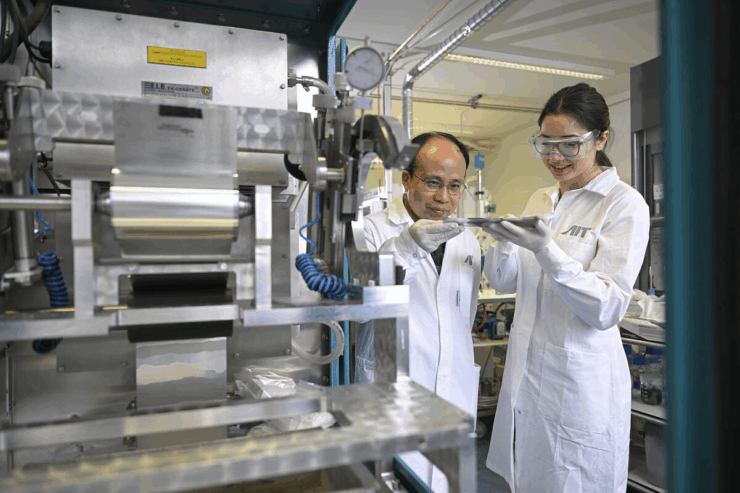
The project’s goal is to take advantage of silicon’s high specific capacity while overcoming the material’s traditional drawbacks, such as particle breakage and low conductivity. By pairing silicon with tin sulfide, RESTINA aims to create a more stable and durable anode that can withstand the mechanical stresses that occur during the charging process, particularly the volume expansion of silicon particles. This approach addresses key weaknesses of conventional silicon-based anodes, such as instability of the solid electrolyte interface (SEI) layer and poor long-term performance.
Innovation through Recycling
A cornerstone of the RESTINA project is the innovative use of recycled silicon, a material that traditionally presents challenges in battery applications due to its expansion and contraction during charging cycles. By using silicon derived from end-of-life photovoltaic modules, the project not only promotes the concept of material recycling but also contributes to reducing waste and improving the overall environmental footprint of the battery industry.
The combination of recycled silicon and tin sulfide not only enhances the battery’s performance but also offers a more sustainable approach to battery production. The use of tin sulfide helps improve electrical conductivity, addressing one of the common challenges associated with silicon-based anodes. The project also explores the synthesis of these nanocomposites using environmentally friendly, scalable processes such as solvothermal synthesis and high-energy ball milling, ensuring that the technology can be adopted on an industrial scale.
A Holistic Approach to Battery Development
The RESTINA project takes a comprehensive approach to material development, which includes the synthesis, surface modification, structural characterization, and scaling-up of the anode materials. This multifaceted strategy ensures that the final products not only meet high-performance standards but are also environmentally compatible.
To further enhance the sustainability of the materials, the project is working on the development of carbon-based protective layers that can stabilize the particle surfaces. These coatings are crucial for preventing the release of toxic gases such as hydrogen sulfide (H₂S) during the production process, ensuring that the materials can be safely handled in the air. Moreover, these protective layers enable the electrodes to be processed with water-based techniques, significantly reducing the environmental impact compared to traditional solvents.
From Material to Cell
As the project’s coordinator, AIT Austrian Institute of Technology plays a pivotal role in advancing the RESTINA project, particularly in the scaling-up and production of battery cells. At AIT, the Si/SnS₂ nanocomposites are not only developed but also optimized for large-scale manufacturing. The project aims to produce Generation 3b pouch cells with capacities between 2 and 5 Ah using the newly developed anode materials. A crucial aspect of these cells is the use of environmentally friendly, water-based processing methods for electrode fabrication, which significantly reduces the use of harmful solvents.
Furthermore, the project collaborates with the University of Liège to investigate the electrochemical aging mechanisms of the anode materials, while the University of Vienna provides insights into the phase diagrams, crystal structures, and thermodynamic properties of the Si/SnS₂ system. Industry partner FRIMECO Produktions GmbH is contributing to the scaling-up of the synthesis and coating processes, ensuring that the developed materials are viable for industrial production.
Paving the Way for Sustainable Battery Technology
RESTINA’s aim is to achieve a technology readiness level (TRL) of 4 by 2025, a critical milestone that demonstrates the feasibility of these innovative materials for industrial applications. The project’s success could lead to the development of a new generation of high-performance, sustainable batteries that are made with environmentally friendly materials and processes. This would represent a significant advancement in the pursuit of greener, more efficient energy storage technologies.
Dr. Damian Cupid, Senior Scientist at AIT and Project Manager of RESTINA, emphasizes the importance of integrating material performance, industrial scalability, and environmental responsibility. According to Dr. Cupid, the RESTINA project embodies a new approach to battery research: “We combine recycled silicon with innovative materials chemistry and sustainable processing to develop a new class of high-performance anode materials for future battery generations. The project shows how materials research can make a concrete contribution to the energy transition – from the idea to the pilot cell.”
Conclusion
As the world moves toward a more sustainable energy future, projects like RESTINA offer a glimpse into how battery technology can evolve to meet the growing demand for energy storage solutions. By focusing on recycling, innovation in materials, and environmentally friendly processing techniques, RESTINA is helping to shape the batteries of tomorrow. These efforts not only promise to improve the performance and longevity of lithium-ion batteries but also contribute to the global push for greener and more sustainable technologies.
In the coming years, it will be exciting to see how the RESTINA project influences the development of next-generation battery materials and helps drive the energy transition forward.