A Midnight Blaze in Guangzhou Destroys Mercedes EV
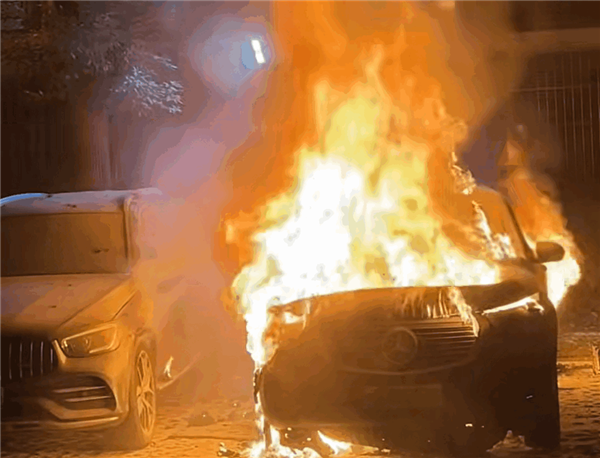
On the evening of June 23, 2025, an electric vehicle parked along Daxin Road in Guangzhou’s Yuexiu District suddenly caught fire.
Dramatic video footage taken by witnesses shows the car engulfed in flames within moments. Thick black smoke billowed as the fire rapidly consumed the entire vehicle. Although firefighters arrived quickly to contain the blaze, the car was completely gutted, reduced to a burned-out shell.
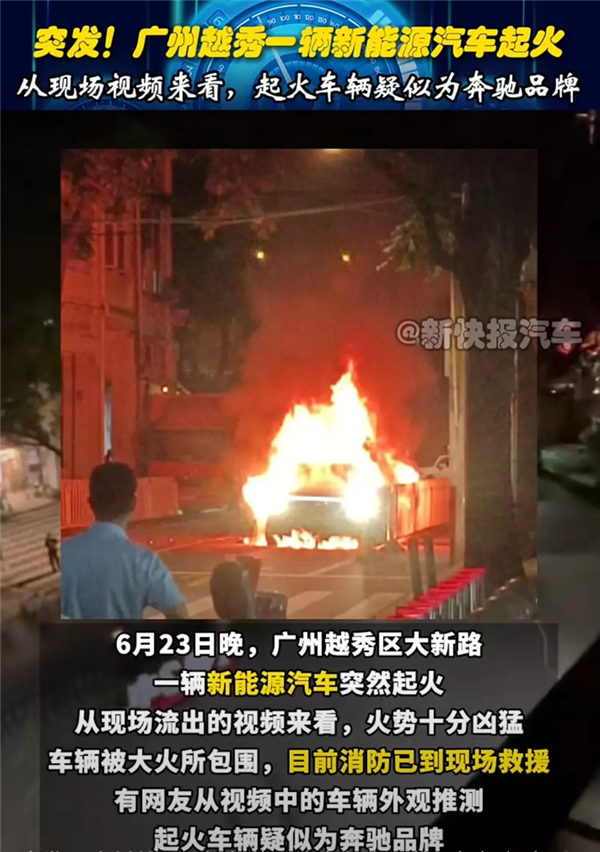
Observers noted that the vehicle bore the Mercedes-Benz logo, and its silhouette matched that of a Mercedes EQ series EV. As of now, Mercedes has not released an official statement regarding the incident, and the cause of the fire is under investigation.
A String of EQ Series Fires Raises Safety Concerns
The Guangzhou incident is not an isolated case. In the first half of 2025, the Mercedes EQ series has experienced multiple fire-related incidents, igniting widespread public concern:
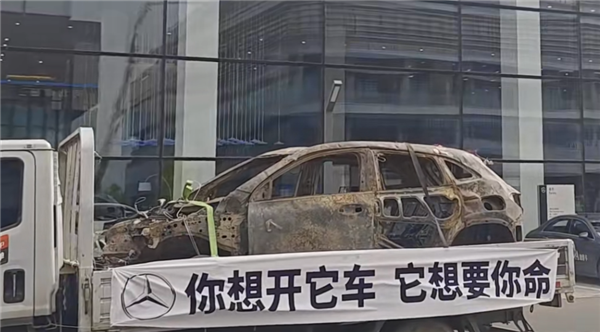
- April 2025: A Mercedes EQA owner in China posted a viral video alleging that their vehicle caught fire while charging at home. The owner towed the charred remains to a local dealership and displayed a banner reading: “You want to drive it. It wants your life.”
- January 2025: Another EQ series vehicle reportedly burst into flames in a Chinese residential area. Eyewitnesses heard explosions as the vehicle burned. A nearby gasoline car was also damaged by the spreading fire.
- August 1, 2024: In Incheon, South Korea, a Mercedes EQE 350 parked in an underground garage spontaneously caught fire without any collision or ignition. The fire raged for over six hours, damaging 140 vehicles and forcing the emergency evacuation of over 100 residents. It was among South Korea’s most damaging EV fire incidents to date.
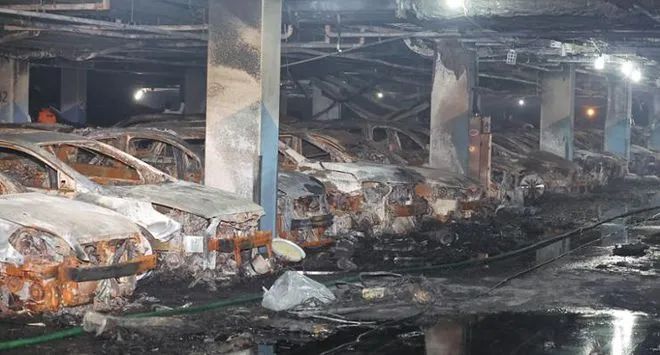
Following public pressure, Mercedes-Benz confirmed that the EQE 350 in the Incheon fire was equipped with a battery supplied by Chinese manufacturer Farasis Energy. This disclosure has shifted global scrutiny toward Farasis and the broader EQ series battery supply chain.
Mercedes EQ Series: Battery Supplier Landscape
Mercedes’ EQ lineup relies on a multi-supplier battery ecosystem, with the three primary providers being:
- CATL (Contemporary Amperex Technology Limited) – China
- SK On – South Korea
- Farasis Energy – China
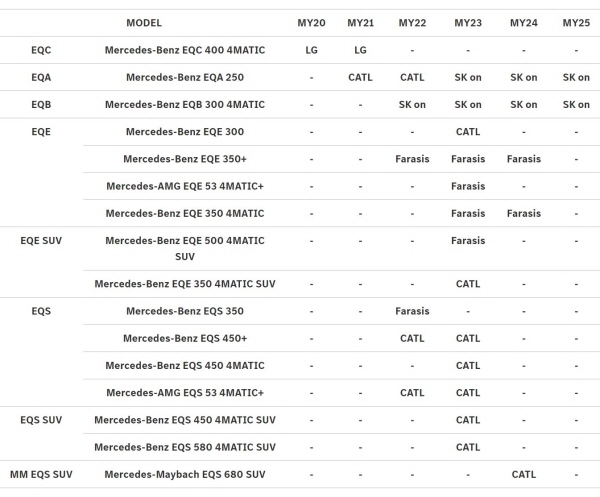
Below is a breakdown of EQ models and their typical battery suppliers:
| EQ Model | Battery Supplier | Notes |
|---|---|---|
| EQA 250 (2021 China model) | CATL | Early domestic units |
| EQA / EQB (2022–2025 models) | SK On | Mainly export to Europe and Korea |
| EQE 300 / 350 / 350 4MATIC+ | Farasis Energy | EQE 350 involved in Incheon fire |
| EQE SUV series | Farasis Energy | High-end platform |
| EQS 450+ / EQS 580 SUV | CATL | Premium flagship lineup |
Farasis Energy, Mercedes’ strategic partner since 2018, supplies battery packs to core platforms like EQE and EQS. SK On handles mid-range EQA/EQB units, while CATL dominates local China variants and high-end products.
Repeated Safety Incidents Raise Transparency Questions
With the August 2024 Incheon EQE fire and the June 2025 Guangzhou incident both involving Mercedes EQ models, many are asking whether there’s a systemic safety flaw—not just isolated battery defects.
The use of multiple battery suppliers for identical models means customers often don’t know which battery brand their vehicle uses. In such cases, when fires or recalls occur, the public faces ambiguity over responsibility, and automakers often delay disclosing critical supplier details.
Moreover, the EQE and EQE SUV models typically utilize high-energy-density NCM (Nickel Cobalt Manganese) lithium-ion cells, which are more susceptible to thermal runaway if improperly managed. That raises the bar for robust battery thermal management, advanced BMS (Battery Management System) algorithms, and manufacturing consistency.
When an EV catches fire, and neither the battery origin nor recall plan is immediately clarified, the public perception of brand integrity and product safety suffers. In an era where transparency defines trust, such silence can be costly.
Conclusion: Safety and Transparency Are the Real Luxury
The Guangzhou fire did more than destroy a car. It reignited a debate over electric vehicle safety, supplier responsibility, and consumer rights.
As EV adoption accelerates, automakers must realize that true luxury in the electric age isn’t just quiet cabins and long range—it’s proven safety, data transparency, and swift accountability when things go wrong.
The fact that two high-profile fires occurred within a year—one in South Korea and one in China—points to an urgent need for clearer supply chain disclosures, rapid root cause analysis, and a uniform global safety protocol for battery-powered vehicles.
For Mercedes and its battery partners, now is not the time for silence. It’s time to respond—with facts, with action, and with accountability.