On July 18, U.S.-based shipping giant Matson Navigation Company issued an industry-shaking announcement: it would immediately suspend the transportation of electric vehicles (EVs) and plug-in hybrid electric vehicles (PHEVs) across all its routes due to growing safety concerns over lithium-ion battery fires.
The decision, detailed in a customer letter posted on Matson’s official website, cited the increasing frequency and intensity of EV-related fires at sea as the primary motivation behind the move. The company emphasized that no new bookings for EVs or PHEVs—whether new or used—will be accepted for any of its maritime routes until further notice.
A Response to Mounting Maritime Fire Incidents
According to Matson, the abrupt halt in service stems from heightened global awareness of the fire risks associated with large-format lithium-ion batteries used in electric vehicles.
In recent years, several high-profile maritime disasters involving EV fires have highlighted the catastrophic consequences such incidents can have:
- In February 2022, the Felicity Ace, a car carrier loaded with 3,965 Volkswagen Group vehicles—including Porsches, Bentleys, and Lamborghinis—caught fire in the Atlantic Ocean. The blaze raged uncontrollably for days before the ship sank, incurring an estimated $335 million in losses. Lithium-ion batteries on board were suspected of intensifying the fire.
- In July 2023, the Fremantle Highway, carrying nearly 500 EVs among its 3,000 vehicles, caught fire en route from Germany to Singapore. The fire lasted over a week, killing one crew member and injuring several others.
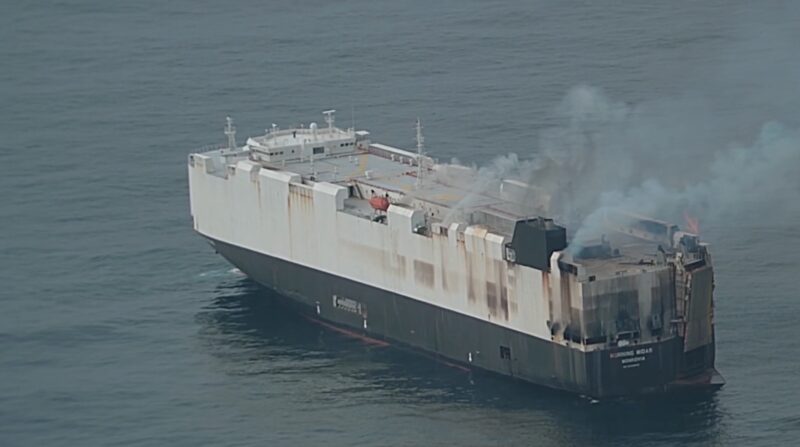
- Most recently, on June 3, 2025, the Morning Midas, a roll-on/roll-off (RoRo) vehicle carrier, caught fire off the coast of Alaska while transporting 3,000 vehicles, including 70 electric and 680 hybrid cars. The crew had to abandon ship, and the vessel eventually sank due to structural damage and harsh sea conditions.
These alarming incidents underscore the challenges of managing EV fire hazards in enclosed maritime environments, especially when response time and access are limited.
A Blow to Island Markets Like Hawaii and Guam
Matson’s decision carries significant implications for vehicle logistics between the U.S. mainland and remote regions like Hawaii, Guam, and Alaska—locations heavily dependent on maritime shipping.
According to the Hawaii Electric Vehicle Association, the island state now has over 37,000 registered electric vehicles. With limited local manufacturing, EVs are typically imported via Matson’s services from the continental U.S. or overseas markets.
Local dealers and EV advocates expressed disappointment, warning that the suspension could delay deliveries, impact consumer choices, and hinder the state’s clean transportation goals. In Guam, although exact EV ownership data is unavailable, local auto retailers similarly voiced concern, noting that EVs are particularly well-suited to island driving conditions due to short travel distances and stable weather.
Matson’s Prior Efforts in Safety and Preparedness
Despite the sudden suspension, Matson made it clear that the decision was not taken lightly. Over the past few years, the company has invested in developing safety protocols specifically for transporting battery-electric vehicles.
Matson had formed an Electric Vehicle Safety Task Force, collaborating with external experts to evaluate risks and improve shipping standards. Among the initiatives launched were:
- A comprehensive checklist for the transport of used and second-life batteries
- Thermal imaging systems for real-time monitoring of on-board battery temperatures
- Modified storage strategies on board to isolate high-risk cargo
- Deployment of Viking HydroPen units—specialized tools capable of drilling into sealed containers to suppress fires with high-pressure water or foam
These advanced measures aimed to enhance fire detection and mitigation capabilities, especially since Matson operates containerized shipments, which present additional challenges compared to RoRo ships in terms of ventilation and direct access.
The Challenge of Lithium-Ion Battery Shipping
Lithium-ion batteries are now classified as hazardous materials (HAZMAT) under international maritime safety codes. Their tendency to enter thermal runaway when damaged, overcharged, or exposed to heat makes them inherently risky during long-haul shipping.
The difficulty in extinguishing such fires—often requiring days to cool and reignite easily—has prompted insurers, regulators, and carriers to reassess safety procedures and legal liabilities. Container ships, in particular, are seen as vulnerable due to their dense storage configurations and limited fire suppression systems.
As the global EV market continues to expand, with millions of electric cars shipped across oceans annually, stakeholders are calling for the standardization of fire mitigation strategies, better training for crews, and third-party inspections prior to departure.
Matson’s Position and Path Forward
In its customer advisory, Matson reiterated its long-term support for clean energy and EV adoption, but stressed that safety must remain the top priority. The company committed to resuming EV shipments only once enhanced safety solutions are implemented and validated.
“Matson remains committed to supporting industry-wide efforts to establish comprehensive safety standards and operating procedures,” the letter stated. “We aim to resume EV and PHEV shipments once the necessary protocols are in place and aligned with our operational requirements.”
In the meantime, shipments of traditional internal combustion engine vehicles (ICEVs) will continue, and Matson will maintain its barge services and inter-island transport operations within Hawaii and other territories.
Industry-Wide Repercussions
Matson’s move is likely to influence other carriers, especially those that also rely on container-based vehicle shipping models. While RoRo ships can more easily accommodate ventilation and early fire detection systems, container ships face greater difficulty in identifying and responding to battery fires.
Experts predict the industry will see:
- Stricter documentation and battery certification requirements
- Increased use of container fire suppression tools
- Development of EV-specific shipping containers with fire-retardant linings
- More collaboration between battery manufacturers, carmakers, and carriers
Governments and regulatory agencies such as the International Maritime Organization (IMO) are also expected to accelerate efforts to issue updated guidelines for lithium battery maritime transport, possibly by 2026.
Conclusion: Safety Over Speed
Matson’s bold decision highlights a difficult truth: the infrastructure supporting the clean energy transition must evolve as rapidly as the technologies it aims to enable.
EV shipping, once seen as a routine logistical task, has become a critical safety issue demanding attention from engineers, regulators, and policymakers alike. The industry now faces a clear imperative—to develop robust, standardized frameworks for transporting electric vehicles safely across oceans.
For consumers, dealers, and environmental advocates, this is a temporary setback. But for the shipping industry, it is a turning point—one that will shape the future of sustainable, secure global logistics in an electric era.