[Kuala Lumpur, June 2025] — In a bold move to power its fast-growing artificial intelligence and data center industries, Malaysian Prime Minister Anwar Ibrahim announced that Tenaga Nasional Berhad (TNB) will invest 43 billion ringgit ($10.1 billion) in modernizing and expanding the country’s national grid—with a heavy emphasis on battery energy storage systems (BESS).
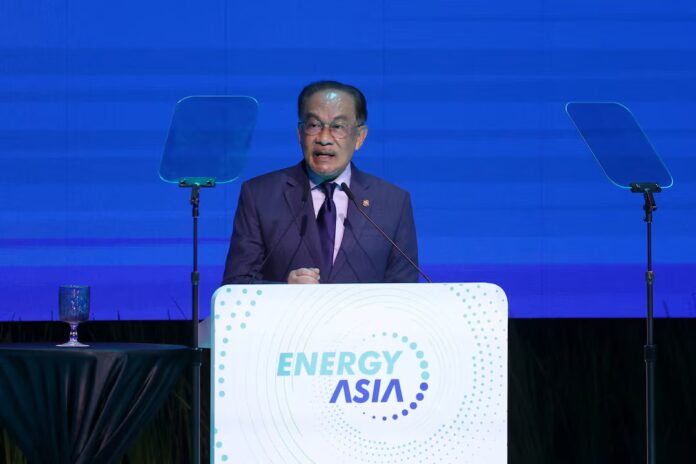
Speaking at the Energy Asia conference, Anwar stated that this massive investment is not just about grid reliability but about enabling a smart, flexible power system capable of supporting emerging industries such as AI computing, hyperscale data centers, and high-performance cloud platforms.
“Upgrading the national grid is central to Malaysia’s digital economy and energy transition strategy,” said Anwar. “Our grid must be smart, adaptive, and supported by robust battery storage to ensure 24/7 reliability and resilience.”
Battery energy storage systems have rapidly become a critical enabler of smart grids. With renewable energy growing in Malaysia’s energy mix, BESS allows for the capture and distribution of electricity during peak demand and unexpected surges—exactly the kind of demand profile associated with AI compute clusters and cloud infrastructure.
Malaysia’s rising ambitions in the digital sector—driven by investments from Microsoft, Google, Amazon, Nvidia, and Oracle—require not just high bandwidth, but ultra-reliable power delivery. Hyperscale data centers must operate with near-perfect uptime and zero tolerance for power fluctuation, making grid-tied storage capacity non-negotiable.
Tenaga Nasional’s RM43 billion investment plan includes upgrading transmission lines, building battery energy storage nodes, and developing advanced digital controls that can optimize energy distribution in real time. The BESS installations will serve as shock absorbers, stabilizing the grid against load imbalances and renewable intermittency.
“Malaysia is no longer just an energy consumer—it’s becoming an energy innovator,” said a senior advisor at the Ministry of Energy Transition and Water Transformation. “BESS will be as critical as fiber optics for Malaysia’s digital economy.”
Petronas: Pioneering Offshore Carbon Capture & Storage (CCS)
While TNB leads on the battery storage and grid front, state-owned energy giant Petronas is spearheading Malaysia’s carbon capture and storage (CCS) ambitions.
Petronas plans to develop three CCS facilities off Malaysia’s coastline that will serve not only the oil and gas industry, but also power generation, steel, cement, and chemical sectors. The goal is to enable decarbonization of hard-to-abate industries while opening a new revenue stream through carbon transport and sequestration services.
“CCS is not only a vital decarbonisation tool,” said Anwar, “it is also a promising new revenue stream for Malaysia and the broader ASEAN region.”
Malaysia’s CCS ecosystem is already taking shape under international cooperation. Over 10 global partners, including TotalEnergies, Shell, ENEOS, Mitsubishi, and JX Nippon, are working with Petronas on projects to transport and store CO₂ from the Tokyo Bay area to Malaysia—transforming the country into a regional carbon storage hub.
An AI and Energy Superhub in the Making
Malaysia’s dual focus—smart grid development with energy storage and carbon mitigation through CCS—is part of a comprehensive strategy to become a sustainable digital and industrial hub in Southeast Asia.
With hyperscale data centers consuming megawatts of power and generating enormous waste heat, grid efficiency and energy management have become national imperatives. Battery storage allows Malaysia to integrate more renewable energy (solar, hydro) into the grid without compromising stability—a core requirement for AI training clusters and real-time analytics platforms.
According to Petronas CEO Tengku Muhammad Taufik, the company is realigning its energy portfolio to serve this explosion in AI and data demand, from building energy-efficient power plants to enabling green hydrogen and storage-based solutions.
“Malaysia is fast becoming a digital energy nexus,” said Tengku. “We are aligning our assets to ensure that AI infrastructure has the clean, stable, and scalable energy it demands.”
Balancing Innovation with Sustainability
While Malaysia’s vision is ambitious, leaders remain cognizant of the sustainability and safety challenges associated with large-scale BESS and CCS deployment. The government is currently reviewing new battery safety protocols, especially for urban storage units, while also crafting policies to regulate carbon injection into geological formations.
Malaysia’s approach contrasts with some other nations by emphasizing parallel development of both green innovation and regulatory safeguards—a strategy praised by international observers.
The government’s focus on economic inclusivity is also evident. Anwar emphasized that grid and storage upgrades must also improve power access for rural and remote communities, ensuring that Malaysia’s energy transition benefits all socioeconomic groups.
Conclusion: A Powerhouse for the New Economy
With over RM43 billion in grid modernization led by TNB, the deployment of battery energy storage systems, and the parallel development of carbon capture infrastructure, Malaysia is positioning itself as the most advanced energy-digital economy convergence zone in ASEAN.
From powering AI factories to becoming a CO₂ sink for Asia, Malaysia is rewriting its role in the regional energy landscape. This is not merely an infrastructure upgrade—it’s a national transformation strategy.
As global energy demands become more intelligent, interconnected, and sustainable, Malaysia’s blueprint—anchored in storage, intelligence, and decarbonization—is one that many developing economies are likely to emulate.