Introduction
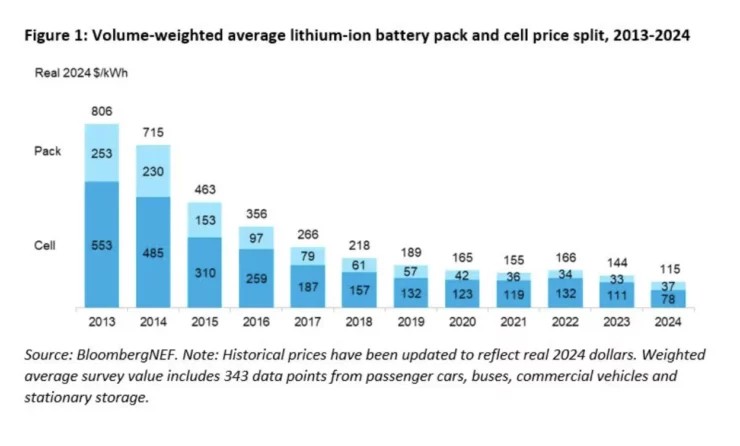
In 2024, the lithium-ion battery industry witnessed a significant milestone: the average global price of battery packs dropped to $115 per kilowatt-hour (kWh), representing a 20% decline from 2023, according to BloombergNEF (BNEF). This dramatic price decrease, the largest annual reduction since 2017, signals a transformative moment for the battery industry and its role in advancing electric vehicles (EVs) and stationary energy storage. This article delves into the factors behind this development, regional disparities, and the future trajectory of battery technology.
Key Drivers Behind the Price Decline
Several interrelated factors contributed to the substantial drop in lithium-ion battery prices:
- Overcapacity in Cell Manufacturing
Over the past two years, battery manufacturers have expanded their production capabilities in anticipation of growing demand from the EV and energy storage markets. However, the industry now faces significant overcapacity. As of 2024, the global fully commissioned battery-cell manufacturing capacity has reached 3.1 terawatt-hours—more than 2.5 times the annual demand for batteries. - Economies of Scale and Competition
The growing scale of production has driven cost efficiencies, while fierce competition among manufacturers, particularly in China, has exerted downward pressure on prices. Smaller manufacturers have been compelled to lower prices further to maintain market share. - Low Raw Material and Component Costs
Falling prices for battery metals, including lithium, cobalt, and nickel, have played a pivotal role. Additionally, advancements in material processing and the adoption of low-cost battery chemistries, such as lithium iron phosphate (LFP), have reduced manufacturing costs. - Shifting Demand Patterns
While demand for batteries has grown year-over-year, the growth rate of the EV market, the largest demand driver, has slowed compared to prior years. On the other hand, the stationary energy storage market has experienced accelerated growth, especially in China, adding complexity to the supply-demand dynamics.
Regional Variations in Battery Prices
While the $115/kWh figure represents a global average, significant regional differences remain.
- China Leads with the Lowest Prices
China’s battery pack prices averaged $94/kWh in 2024, making it the most cost-competitive market globally. The country’s dominance stems from its mature supply chain, lower production costs, and fierce domestic competition. - Higher Costs in the U.S. and Europe
Battery pack prices in the United States and Europe were 31% and 48% higher than in China, respectively. This disparity reflects the relative immaturity of these markets, higher labor and energy costs, and lower production volumes. Moreover, geopolitical tensions and tariffs have exacerbated cost differences in these regions. - Implications for Market Dynamics
The widening price gap between China and Western markets is pushing Chinese manufacturers to explore international markets, particularly in energy storage and regions with higher willingness to pay for batteries. This trend underscores the global nature of the competition and the importance of cost efficiency.
Technological and Market Outlook
The price drop marks a critical step towards the widespread adoption of EVs and renewable energy systems. However, the path forward includes both opportunities and challenges.
- Technological Innovations
Next-generation technologies are poised to further reduce costs and improve performance. These include:- Silicon and Lithium Metal Anodes: These materials promise higher energy densities.
- Solid-State Electrolytes: Solid-state batteries could enhance safety and energy storage capabilities.
- New Cathode Materials: Advancements in cathode chemistry could unlock better durability and efficiency.
- Innovative Manufacturing Processes: Automation and process optimization will continue to lower production costs.
- Challenges from Raw Material Supply
While low raw material prices have been advantageous, future supply chain risks loom large. Geopolitical tensions, tariffs, and low commodity prices could stall the development of new mining and refining projects, potentially driving up costs in the coming years. - Policy and Market Forces
Government policies, such as tariffs on finished battery products, could distort pricing dynamics and dampen end-user demand. Nonetheless, the growing adoption of LFP chemistries and competition among manufacturers are expected to maintain downward pressure on prices.
Electric Vehicle Market Implications
For the EV market, battery prices below $100/kWh represent a critical threshold for achieving cost parity with internal combustion engine vehicles. In 2024, the average price for batteries used in EVs fell to $97/kWh.
- Progress in China
China has already achieved cost parity for EVs, driven by its cost-efficient supply chain. - Challenges in Other Markets
In many global markets, EVs remain more expensive than their combustion-engine counterparts. However, as battery prices continue to fall and manufacturing scales up, price parity is expected to be achieved across more segments in the near future.
Future Price Trends
BNEF projects that battery pack prices will decrease by an additional $3/kWh in 2025. Over the next decade, continued investment in research and development, manufacturing improvements, and supply chain expansion will play pivotal roles in reducing costs further.
Conclusion
The 2024 decline in lithium-ion battery prices represents a watershed moment for the industry, signaling the beginning of a new era of affordability and innovation. As manufacturers continue to scale up production, adopt new technologies, and navigate global market dynamics, the promise of widespread EV adoption and renewable energy integration is becoming increasingly attainable.