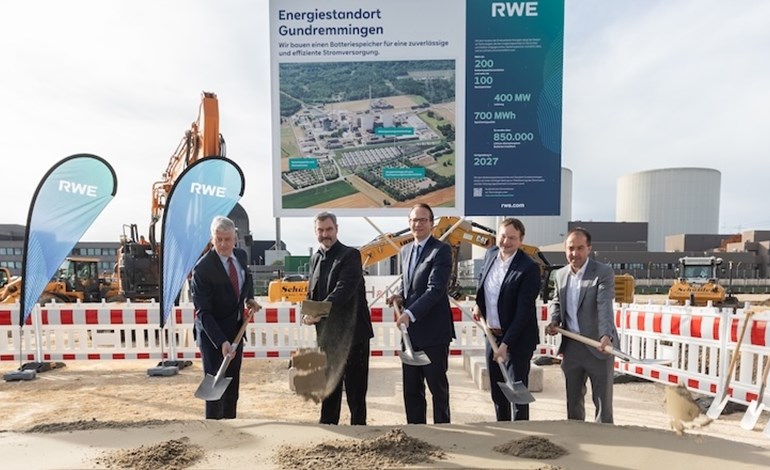
On October 29, 2025, German energy giant RWE held a groundbreaking ceremony for Germany’s largest battery storage project at the Gundremmingen energy site in Bavaria. Bavaria’s Minister President Markus Söder and RWE CEO Markus Krebber jointly attended this historic moment. Just four days earlier, the site witnessed the demolition of the 160-meter-high nuclear power plant cooling towers, and today, this land is about to embark on a new energy mission.
From Nuclear to Storage: A Symbolic Shift in Germany’s Energy Landscape
The Gundremmingen nuclear power plant was once Germany’s last operating boiling water reactor facility. Unit C was permanently shut down on December 31, 2021, marking the end of Germany’s nuclear era. Now, this site that provided decades of electricity to Bavaria is transforming into Germany’s largest battery storage facility.
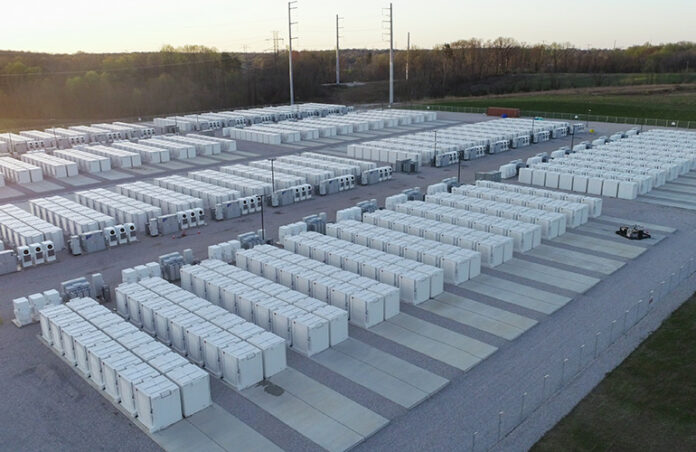
According to official information from RWE, the project represents a total investment of approximately €230 million and will build a large-scale battery storage system with 400 megawatts of power capacity and 700 megawatt-hours of energy storage capacity. The project will fully utilize the existing grid connection infrastructure from the former nuclear plant and is expected to enter commercial operation in early 2028.
Technical Specifications: Precision Layout of 850,000 Battery Cells
The storage project employs lithium iron phosphate (LFP) battery technology, which is renowned for its high safety and long cycle life, making it the mainstream choice for large-scale storage applications. The project will install approximately 850,000 LFP battery cells across more than 200 containers, equipped with over 100 ultra-fast inverters.
According to technical parameters, the system can deliver continuous power at 400 megawatts for nearly two hours and can respond to grid fluctuations within milliseconds, enabling rapid absorption or release of electricity. This fast response capability is crucial for balancing the intermittency of renewable energy generation.
Bavaria’s Minister President Söder stated at the groundbreaking ceremony: “Gundremmingen will remain central to Bavaria’s energy supply. In addition to this new battery storage facility, a large 55-hectare solar power plant and a new gas-fired power plant will be built here. This 400-megawatt power, over 700-megawatt-hour capacity battery storage facility will help stabilize the grid when there is no wind or sun.”
The Battery Supplier Mystery: CATL’s Shadow
Notably, RWE has not yet publicly disclosed specific battery supplier information for the Gundremmingen project. However, based on RWE’s previous energy storage projects in Germany, reasonable speculation is possible.
According to public information, RWE’s 117MW battery storage projects built in Lingen and Werne, Germany, between 2022 and 2023, utilized lithium-ion battery cells from China’s CATL (Contemporary Amperex Technology Co. Limited). These two projects included 420 battery racks distributed across 47 shipping containers.
Considering that CATL is the world’s largest manufacturer of electric vehicle and energy storage batteries, with a global market share of approximately 38% in 2024, and possesses technological advantages and cost competitiveness in the LFP battery field, industry insiders widely speculate that the Gundremmingen project may also use CATL battery products.
Besides CATL, the global energy storage battery market includes several major suppliers, including BYD with approximately 17% market share, LG Energy Solution with about 13%, as well as international manufacturers like Panasonic and Samsung SDI. However, considering the complexity of large-scale storage projects, supplier selection often requires comprehensive consideration of technological maturity, supply chain stability, project experience, and compliance factors.
Of course, the possibility of RWE choosing European local battery manufacturers cannot be ruled out, especially in the context of Europe strengthening its domestic battery industry chain. However, from the perspective of cost-effectiveness and technological maturity, Chinese battery manufacturers currently still dominate large-scale storage projects.
RWE’s Global Storage Layout
The Gundremmingen project is just part of RWE’s global storage strategy. According to company data, RWE currently operates battery storage systems with a total installed capacity of approximately 1.2 gigawatts in the United States, Europe, and Australia, with an additional 2.7 gigawatts of storage capacity under construction.
In February 2025, RWE commissioned battery storage systems totaling 220MW at two sites in Hamm and Neurath, Germany. These facilities can reach rated capacity within seconds and provide continuous power for approximately one hour. In March 2025, RWE launched a 35MW/41MWh battery storage system at the Eemshaven power plant in the Netherlands, incorporating 110 LFP battery racks.
RWE CEO Krebber stated: “The energy system of the future needs strong storage facilities. By building Germany’s largest battery storage facility at this highly attractive energy location in Bavaria, we are sending a strong signal. Gundremmingen shows: we will continue to utilize existing sites—this new storage facility is just the beginning.”
A Critical Component of Energy Transition
Against the backdrop of Germany’s push for energy transition, large-scale storage facilities are playing an increasingly important role. Germany plans to increase the share of renewable energy in electricity consumption to 80% by 2030, but the intermittency of wind and solar power generation poses challenges to grid stability.
Battery storage systems can store electricity during peak solar and wind generation periods and release it during peak demand or generation lulls, thereby smoothing the power supply curve and maintaining grid frequency stability. The 400MW power capacity of the Gundremmingen project is sufficient to meet the electricity needs of tens of thousands of households.
In addition to the battery storage project, RWE also plans to build a 55-hectare solar park at the Gundremmingen site, with an annual generation capacity of 70 million kilowatt-hours, sufficient to supply approximately 20,000 households. Additionally, a gas-fired power plant is planned to provide supplementary power when wind and solar energy are insufficient.
The Long Journey of Nuclear Plant Decommissioning
Complete decommissioning of the Gundremmingen nuclear power plant is expected to continue into the 2030s. On October 25, approximately 30,000 spectators witnessed the controlled demolition of the plant’s two 160-meter-high cooling towers. These towers contained approximately 56,000 tons of reinforced concrete, with materials to be primarily recycled after demolition.
Unit B was shut down on December 31, 2017, and Unit C on December 31, 2021. Currently, about 400 RWE employees are still on site engaged in decommissioning and dismantling work. According to Germany’s nuclear phase-out plan, the country’s last three nuclear power plants (Brokdorf, Grohnde, and Gundremmingen C) were all closed by the end of 2021.
From nuclear energy to storage, from atomic fission to electrochemical reactions, Gundremmingen’s transformation encapsulates a microcosm of Germany’s and the world’s energy transition. This former nuclear powerhouse is redefining its role in the renewable energy era.
China’s Force in the Global Storage Market
It’s worth noting that regardless of which supplier the Gundremmingen project ultimately chooses, Chinese battery manufacturers’ dominance in the global large-scale storage market has been established. According to 2024 data, CATL holds first place globally with a 38% market share, BYD ranks second with 17%, and LG Energy Solution ranks third with approximately 13%.
Chinese companies’ advantages in the energy storage battery field are primarily reflected in: strong cost control capabilities, large production capacity, rapid technological iteration, and particularly rich application experience in LFP batteries. Taking CATL as an example, the company operates 13 battery manufacturing plants globally, including a European factory in Arnstadt, Thuringia, Germany.
As global energy transition accelerates and storage demand surges, the battery storage market is expected to maintain high-speed growth in the coming years. According to industry forecasts, global storage installed capacity could exceed 500 gigawatt-hours by 2030, and LFP batteries will continue to dominate large-scale storage applications due to their safety and cost advantages.
As Germany’s largest single energy storage project, the Gundremmingen project is not only an important milestone in RWE’s storage strategy but also a landmark project in Germany’s energy transition. From nuclear power to storage, this Bavarian town is writing a new chapter in the energy revolution.