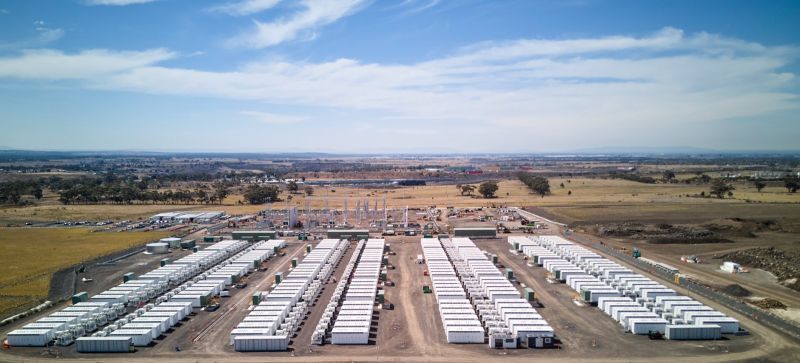
On December 6, 2024, the 600 MW / 1.6 GWh Melbourne Renewable Energy Hub (MREH), co-owned by Singapore-headquartered clean energy investor Equis and the Victoria government-owned State Electricity Commission (SEC), officially completed commissioning and commenced operations. This AUD 1.1 billion (USD 730 million) storage project, delivered on time and on budget, has become the largest battery energy storage system completed to date on Australia’s National Electricity Market (NEM).
World-Class Storage Facility Sets New Industry Benchmark
Located near Hillside, approximately 28 kilometers northwest of Melbourne’s central business district, the Melbourne Renewable Energy Hub features 444 Tesla Megapack battery units, three Toshiba 500 kV transformers, and a “world-first” underground 500 kV cable that directly connects the storage system to the National Electricity Market’s high-voltage transmission network.
“Melbourne Renewable Energy Hub is our first project to go live in Australia and the Equis team have delivered a world-leading project on schedule and on budget,” said Equis Managing Director David Russell. “It has been impressive to watch the project take shape from Notice to Proceed in December 2023. This shows that when industry and government work together, we can deliver complex, large-scale infrastructure that strengthens the grid, creates jobs, and helps reduce power prices for consumers.”
Three-in-One Storage Architecture Delivers Flexible Dispatch Capability
The project employs a unique three-in-one battery energy storage system design, all located at the same site. Two systems each have a capacity of 200 MW / 400 MWh (2-hour storage duration), while the third system has a capacity of 200 MW / 800 MWh (4-hour storage duration). This configuration enables the entire storage hub to provide a total capacity of 1.6 GWh, sufficient to supply electricity to up to 200,000 homes during Victoria’s evening peak demand period.
The project’s strategic location offers clear advantages, positioned at the confluence of several of Victoria’s major electricity transmission routes. This enables it to support not only Melbourne’s metropolitan load but also three of Victoria’s planned renewable energy zones, facilitating greater wind and solar project grid connections.
Advancing Victoria’s Energy Transition Goals
SEC Chief Executive Officer Chris Miller emphasized the project’s significance for the state’s energy transition: “We know storage is critical for Victoria’s energy transition, and this project adds significant storage capability to the grid. The Hub will soak up excess wind and solar power during the daytime and shift that energy to the evening peaks when we need it most.”
Miller also noted that the Melbourne Renewable Energy Hub will help unlock capacity for more renewable energy. According to state government estimates, the battery storage system will enable an additional 1.8 GW of new generation to connect to the grid. This storage project is crucial for achieving Victoria’s ambitious targets—installing at least 2.6 GW of energy storage capacity by 2030 and 6.3 GW by 2035.
From Syncline to SEC: A Development Journey
The Melbourne Renewable Energy Hub was initially developed by Australia’s Syncline Energy and was previously known as the Melton Renewable Energy Hub. The project represents the first investment from the SEC’s initial AUD 1 billion program targeting 4.5 GW of new renewable energy generation and storage projects.
Construction began in 2024 and was completed on schedule, creating work and training opportunities for more than 1,200 people, including over 70 trainees and apprentices. This demonstrates not only the economic benefits of large-scale storage projects but also delivers tangible employment opportunities and skills training to local communities.
Advanced Technology Supports Grid Stability
Tesla’s Megapack is an integrated solution that includes lithium-ion batteries, power conversion system, thermal management, and controls. With increased global demand for the technology, Tesla’s Megapack factory in Lathrop, California, has ramped up to 40 GWh annual production capacity, and the company’s equally sized Megafactory in Shanghai, China, has recently come online.
The 500 kV underground cable connection is an Australian first and represents the country’s first 500 kV battery connection project. This innovative design not only minimizes visual impact on the community but also demonstrates Equis and SEC’s technical capabilities in grid integration. The project’s inverter technology supports the transmission grid’s voltage and frequency, replacing “system inertia” lost when coal and gas-fired power stations retire.
Community Benefits Sharing
As the project’s commitment to the local community, the Melbourne Renewable Energy Hub has established a Community Benefit Fund totaling AUD 2.5 million, providing AUD 100,000 annually throughout the project’s operational life (25 years). The fund will support programs identified by the community as essential, such as encouraging participation in higher education through scholarships and improving community safety.
To ensure the Community Benefit Fund reflects local priorities, SEC and Equis engaged with the community throughout November and December 2025, giving local residents, businesses, and community organizations the opportunity to share their ideas on how and where the fund should be invested to deliver lasting value for the community.
Outlook for Australia’s Storage Market Future
The successful commissioning of the Melbourne Renewable Energy Hub sets a new benchmark for Australia’s storage market. Equis is currently developing a portfolio of 17 battery energy storage projects across Australia with a combined capacity of 4.4 GW, including the 300 MW / 600 MWh Calala battery project near Tamworth in New South Wales and the proposed 200 MW / 800 MWh Koolunga battery project near Brinkworth in South Australia.
The project’s on-time, on-budget delivery demonstrates the potential for collaboration between private developers and government entities in delivering critical energy infrastructure. “This provides a template for similar large-scale battery projects across Australia’s electricity system,” Russell emphasized.
As Victoria’s aging coal-fired power stations approach retirement and renewable energy penetration increases, the Melbourne Renewable Energy Hub’s strategic positioning offers critical advantages for grid operations. As the only battery energy storage system in Victoria capable of supporting three renewable energy zones, the project will play a central role in the state’s journey toward achieving its target of 95% renewable energy generation by 2035.
The commissioning of the Melbourne Renewable Energy Hub marks a new phase in Australia’s energy transition. As the largest battery project yet completed on the country’s main grid, it not only demonstrates the maturity of large-scale storage technology but also proves that with coordinated efforts between government and industry, clean energy infrastructure construction can be completed efficiently and with high quality, providing practical solutions to address climate change and energy security challenges.