Major Overhaul: Shifting from EV to LFP ESS Production
According to industry reports on the 26th, Samsung SDI has officially issued purchase orders (POs) for equipment to reconfigure production lines at its Indiana joint venture.
The facility, StarPlus Energy (a JV with Stellantis), will convert three of its four planned production lines at Plant 1 to manufacture prismatic Lithium Iron Phosphate (LFP) batteries specifically for Energy Storage Systems (ESS).
Mass Production Countdown: Targeting Q4 for North American Launch
This transition is moving at an aggressive pace, with mass production scheduled to begin in the fourth quarter of this year.
By repurposing existing EV battery lines for ESS use, Samsung SDI can significantly shorten the time-to-market compared to building a new facility, with specialized equipment installations for battery assembly expected to be completed within months.
Order-Driven Strategy: 2 Trillion Won Deal and Potential Tesla Partnership
The shift is backed by substantial commercial commitments, including a three-year LFP supply contract signed last December with a major U.S. energy firm, valued at over 2 trillion won.
Furthermore, Samsung SDI is reportedly in final negotiations with Tesla to supply approximately 10 GWh of ESS batteries, which would position the Indiana plant as a critical hub for Tesla’s Megapack supply chain.
Market Momentum: AI Data Centers and Renewable Energy Surging
The pivot addresses the current “EV Chasm” while capitalizing on the explosive growth of the U.S. ESS market, which is projected to reach 142 GWh by 2030.
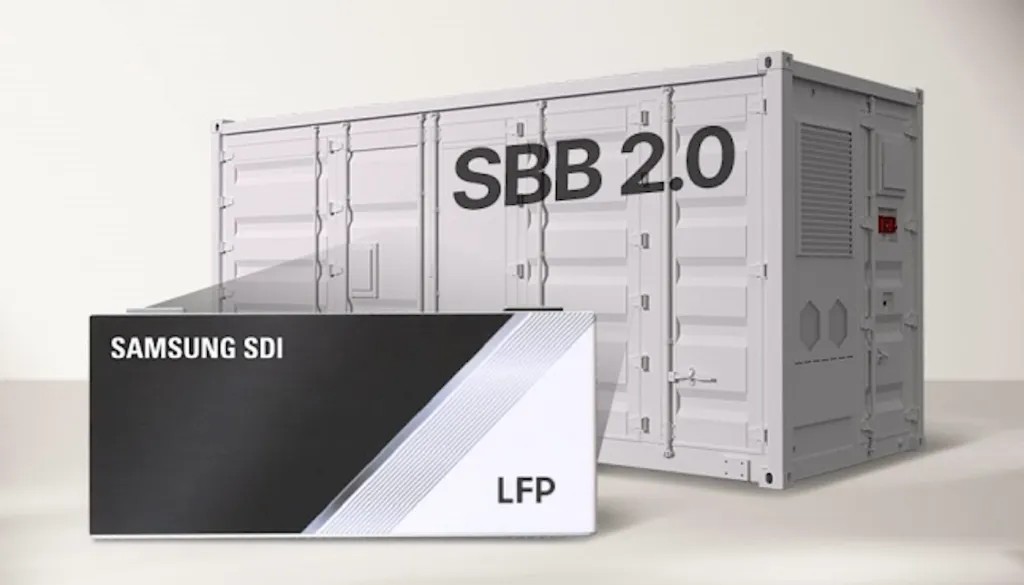
As the only non-Chinese manufacturer currently capable of supplying prismatic LFP cells in the U.S., Samsung SDI is leveraging its “Samsung Battery Box (SBB) 2.0” technology to provide high-safety, cost-competitive solutions for AI data centers and utility-scale grids.
Clash of Titans: Samsung SDI vs. LG Energy Solution in North America
As the U.S. Inflation Reduction Act (IRA) reshapes the supply chain, Korea’s two leading battery makers are engaged in a fierce competition to dominate the LFP ESS sector.
1. Comparison of North American LFP ESS Footprints
| Category | Samsung SDI | LG Energy Solution (LGES) |
| Form Factor | Prismatic (Square) LFP | Pouch-type LFP (Prismatic in R&D) |
| Key U.S. Hub | Indiana (StarPlus Energy Retrofit) | Michigan (Holland Plant) & Arizona (New) |
| Mass Production | Q4 2026 (Full-scale in 2027) | Started June 2025 (Michigan Plant) |
| Capacity Target | 30 GWh by end of 2026 | 50 GWh globally (80% in N. America) |
| Flagship Solution | SBB 2.0 (All-in-one Prismatic) | JF1 (Pouch LFP) & System Integration |
2. Strategic Divergence: Retrofitting vs. New Construction
- Samsung SDI’s “Agile Pivot”: Samsung is focusing on speed by converting existing EV lines. By utilizing the physical infrastructure of the StarPlus Energy plant, the company aims to achieve a massive capacity surge by late 2026 without the delays associated with greenfield construction.
- LGES’s “Direct Expansion”: LG has a first-mover advantage with its dedicated LFP line in Michigan already operational. It is doubling down on massive standalone investments, such as its $5.5 billion Arizona complex, to build a resilient, independent North American supply chain.
3. Differentiation: The Safety of Prismatic Cells
Samsung SDI holds a unique market position as the only non-Chinese supplier of prismatic LFP cells in the U.S. The aluminum-cased prismatic design offers superior durability and heat dissipation (No Thermal Propagation technology).
LG Energy Solution, while traditionally favoring pouch cells for energy density, is now diversifying into prismatic formats to meet the safety and standardization demands of utility-scale customers and EV giants like Tesla.