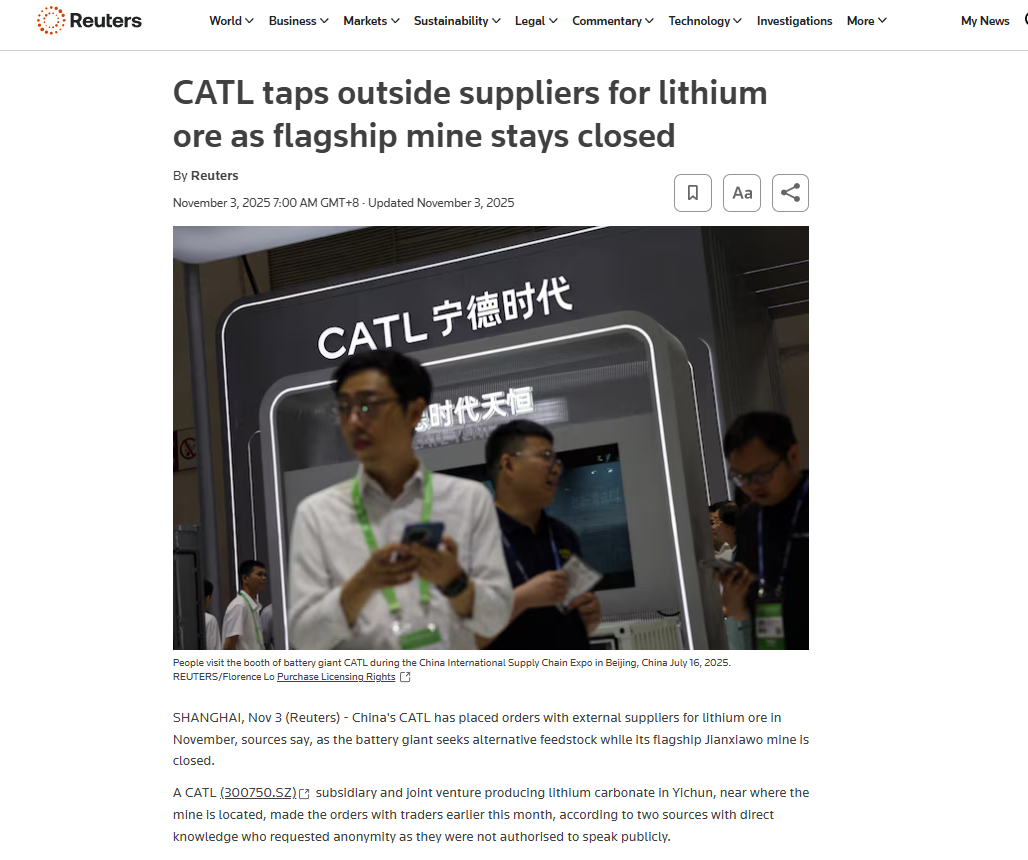
According to Reuters on November 3, CATL has placed orders for lithium ore with external traders in November to compensate for the raw material gap caused by the closure of its flagship Jianxiawo mine. This critical lithium mine located in Yichun, Jiangxi Province, has been shut down for more than three months since early August, with mining permit renewal progressing slowly.
Core Mine Trapped in Production Halt
The predicament of Jianxiawo mine began in August this year. Multiple media outlets confirmed that the mine’s mining permit expired on August 9. CATL confirmed through its interactive platform on August 11 that the company had suspended mining operations after the Yichun project’s mining permit expired and was handling the permit extension application according to relevant regulations.
This is not the first time Jianxiawo mine has been shut down. Public information shows that the mine was closed in 2023, reopened in February 2024, but was shut down again six months later. Each change in the mine’s status triggers dramatic fluctuations in lithium prices, highlighting its important position in the global lithium supply landscape.
The Jianxiawo mine area has an annual production capacity equivalent to approximately 46,000 tons of lithium carbonate. According to Australian government data, this capacity accounts for 3% of global lithium carbonate output in 2025. For China, the world’s largest lithium salt production base, the mine’s capacity accounts for approximately 20% of domestic lepidolite lithium extraction capacity.
Forced to Turn to External Procurement
Facing the prolonged mine closure, CATL had to adjust its procurement strategy. According to two sources with direct knowledge, CATL’s subsidiaries and joint ventures placed lithium ore orders with traders in early November. These companies are located in Yichun and primarily produce lithium carbonate products.
This shift means CATL temporarily loses the cost advantages brought by vertical integration. Industry insiders point out that the cost of procuring raw materials externally is typically higher than production from owned mines, which may impact the company’s profit margins.
It is worth noting that the Jianxiawo mine shutdown occurred against the backdrop of persistently weak lithium carbonate prices. According to industry data, lithium carbonate prices experienced continuous decline in 2024, with battery-grade lithium carbonate prices falling from approximately 75,000 yuan per ton at the beginning of the year to around 70,000 yuan at year-end, far below the historical high of over 500,000 yuan per ton in early 2023.
Industry Chain Reaction Emerges
CATL’s predicament is not an isolated case. On September 11, 2024, when CATL announced adjustments to its Yichun lithium carbonate production arrangements based on recent lithium carbonate market conditions, it triggered a strong market reaction. The main lithium carbonate futures contract surged 7.91% that day, and lithium mining sector stocks rose collectively.
Shanghai Securities News reported at the time that local Yichun lithium industry insiders stated that CATL’s mining, mineral processing, and smelting enterprises in Yichun, Jiangxi would fully cease production after September. This decision involved not only mining but also production adjustments in mineral processing and smelting operations.
Other lithium mining companies were also affected. Jiangxi lithium mining company Jiuling Lithium Industry announced production suspension for maintenance during the same period. Analysts pointed out that with lithium carbonate prices falling below most companies’ cost lines, reducing production to digest social inventory became the better choice for mining companies.
Deep Changes in Industry Structure
This crisis reflects the deep-seated challenges facing China’s lithium industry chain. Although China is the world’s major lithium salt production base, with capacity, output, and consumption all accounting for more than two-thirds of the global total, it remains highly dependent on imports at the resource end.
Data shows that China’s spodumene imports continued to grow in 2024, reaching 711,000 tons in September, equivalent to approximately 67,000 tons of lithium carbonate equivalent. This indicates that domestic lithium salt companies are increasingly relying on imported raw materials to maintain production.
As the core production area for China’s lepidolite lithium extraction, the importance of Yichun, Jiangxi is self-evident. Global lepidolite lithium extraction production in 2024 was approximately 124,000 tons of lithium carbonate equivalent, with Yichun, Jiangxi contributing over 90%. The prolonged shutdown of CATL’s Jianxiawo mine may have a demonstration effect on the entire Yichun lithium industry cluster.
Supply Chain Security Raises Concerns
From a strategic perspective, the Jianxiawo mine shutdown incident sounds an alarm for new energy industry supply chain security. Even industry giants with their own mineral resources may face supply interruption risks due to administrative factors such as permits.
Industry experts point out that as the global new energy vehicle industry continues to expand, the strategic value of lithium resources is becoming increasingly prominent. Companies need to seek balance among resource acquisition, supply chain diversification, and cost control. Strategies that rely solely on a single region or mine carry significant risks.
In the second half of 2024, multiple lithium mines globally announced production cuts or suspensions. Research reports from Soochow Securities show that under persistently weak lithium carbonate prices, 30% to 40% of global lithium mining capacity is operating at a loss, and Australian mines, lepidolite mines, and brine projects with cash costs above 65,000 yuan per ton all face pressure to reduce or suspend production.
Future Outlook Remains Uncertain
As of now, CATL has not announced a specific timeline for the renewal of the Jianxiawo mine’s mining permit. Although there were reports in September that the mine would reopen soon, three months have passed and the mine remains closed.
Meanwhile, CATL maintains active deployment in other lithium resource projects. In the second half of 2024, the company signed a battery-grade lithium hydroxide and lithium carbonate procurement agreement with Yahua Group for the period from January 2026 to December 2028, showing that it is ensuring raw material supply through diversified procurement.
For the entire lithium industry, 2025 will still be a challenging year. Institutions generally predict that under the continuation of oversupply patterns, lithium carbonate prices still face downward pressure. This will force industry consolidation to accelerate, with high-cost capacity continuing to be eliminated, while companies with quality resources and cost advantages are expected to further increase their market share.
When will the Jianxiawo mine restart, and how will CATL adjust its resource strategy? The answers to these questions will have far-reaching impacts on the global lithium market landscape. In the wave of the new energy revolution, resource availability and stability have become key factors determining corporate competitiveness.