On November 3, 2025, the Suwon District Prosecutors Office in South Korea announced a major technology espionage case that sent shockwaves through the battery industry. Fifteen individuals and entities were indicted for allegedly stealing and leaking Samsung SDI’s core electric vehicle battery technology overseas, with four arrested and detained.
Core Technology Stolen Over Nearly Two Years
According to prosecutors, the suspects systematically stole design models for EV battery components developed by Samsung SDI and its partner companies between October 2022 and February 2024. These technologies have been designated as “national core protected technology” by the South Korean government, representing years of Samsung SDI’s research and development investment and technological accumulation in the battery field.
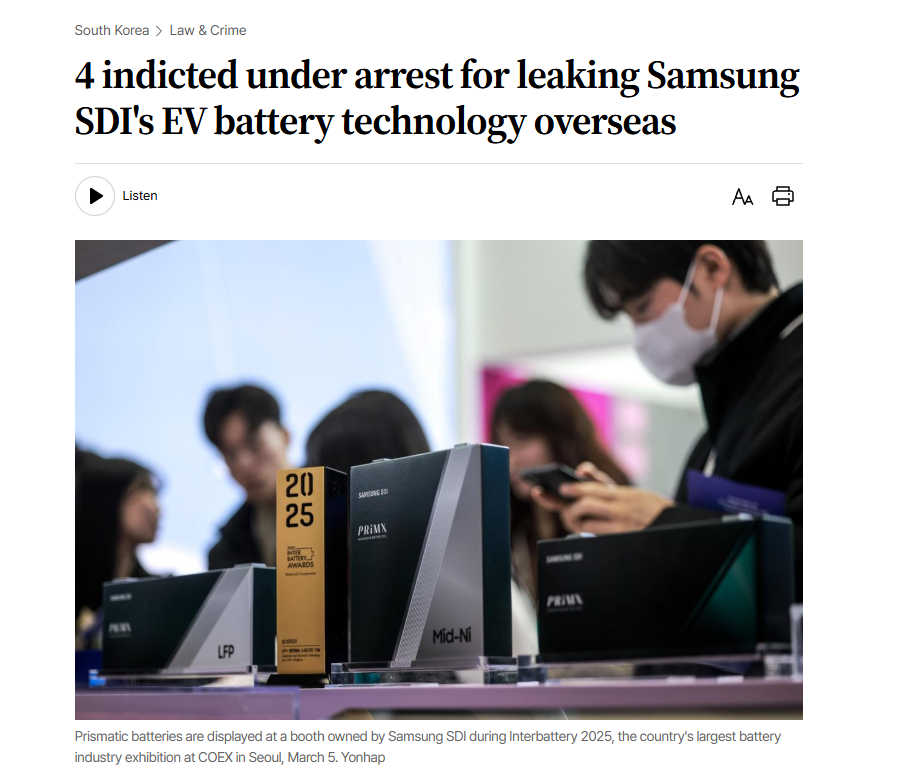
The stolen technology primarily includes two core components: first, the design of rectangular aluminum battery cases used to protect prismatic batteries from external damage, known in the industry as “cans”; second, the design of cap assembly parts that prevent explosions or fires during battery overheating by blocking the flow of electricity or gas to ensure battery safety.
Prosecutors stated that the suspects accessed these technologies using information gained while working for a Samsung SDI subcontractor, then illegally transferred the confidential data for commercial purposes.
Mastermind’s Capital Manipulation
Investigation revealed that 37-year-old Mr. B was the central figure in this case. As the de facto operator of the implicated Company A, Mr. B obtained illegal profits through a series of carefully planned capital operations.
He first secretly became the largest shareholder of a KOSDAQ-listed company whose trading had been suspended by purchasing shares through a shell company. Subsequently, Mr. B resumed trading of the company and promoted it as entering the EV battery market using “advanced technology.” Building on this, he also successfully listed another plastic injection company he operated on KOSDAQ.
Throughout this process, Mr. B lived in a luxury residence in Seoul while simultaneously running two listed companies. When prosecutors began their investigation, he even instructed his secretary to destroy relevant evidence.
$58 Million Contract and Timely Prevention
Even more alarming was the scale of money involved. The investigation found that Company A signed an 80 billion won (approximately $58 million) supply contract with a Chinese battery manufacturer using the stolen technology. According to the plan, battery components manufactured using the stolen technology were to be exported to China.
Fortunately, prosecutors quickly intervened after receiving a tip-off from the National Intelligence Service’s Industrial Security Center. Through search operations, they obtained key digital evidence, including mobile devices, electronic equipment, technical files, chat logs, and recorded calls. These timely actions enabled prosecutors to tackle the crime at an early stage and successfully prevent the export of battery components to China.
Technology Leak Targets: China and Vietnam
Although prosecutors clearly stated in their announcement that confidential data was leaked to secondary battery companies in Vietnam and China, the specific name of the Chinese company involved has not been publicly disclosed to date. This may be due to investigative confidentiality needs, diplomatic considerations, or legal procedural reasons.
Notably, this is not the first time Korean battery companies have encountered technology leaks. In January 2024, China’s Svolt Energy Technology and its parent company Great Wall Motor were investigated by Korean police for allegedly stealing technology from Samsung SDI and SK On, with five former and current employees of Korean battery companies referred to prosecutors at that time.
Composition of Indicted Individuals
Among the 15 individuals and entities indicted in this case, in addition to the four core suspects arrested and detained, 11 others were indicted without detention, including a former Samsung SDI employee and two KOSDAQ-listed corporate entities.
The four individuals arrested and detained include mastermind Mr. B and 34-year-old Mr. D, an employee of Samsung SDI’s partner Company C, among others. They were charged with violating the Industrial Technology Protection Act (leakage of national core technology), the Unfair Competition Prevention Act (leakage of trade secrets abroad), and breach of duty, among other charges.
Context of Intensifying Global Battery Competition
This case occurred against the backdrop of increasingly fierce competition in the global electric vehicle battery industry. South Korean prosecutors stated that the leaked materials were used for contract negotiation purposes with foreign companies but were not actually utilized by the foreign companies. Nevertheless, the leak of these core technologies still posed a potential threat to Samsung SDI’s competitive advantage.
As one of the world’s major electric vehicle battery manufacturers, Samsung SDI’s technology is viewed as an important asset for South Korea in global battery industry competition. In recent years, with the rapid growth of the electric vehicle market, competition among countries for core power battery technology has intensified, and technology security issues have become increasingly prominent.
Calls for Stronger Penalties
In response to the increasing number of industrial espionage cases, the Supreme Court’s Sentencing Commission held a plenary meeting in 2024 to discuss implementing stricter penalties for leaking the nation’s core technologies, with plans to finalize the revision of sentencing guidelines in March 2024.
This case once again reminds us that in today’s increasingly fierce global technological competition, the protection of core technologies has become an important component of corporate and national security. How to find a balance between open cooperation and technology protection will be a common challenge faced by governments and enterprises worldwide.
Prosecutors stated that due to timely intervention and action, the stolen technology in this case did not actually enter the production processes of foreign enterprises, minimizing losses to a certain extent. However, the technology security vulnerabilities exposed by this case still deserve deep reflection and vigilance from the entire industry.