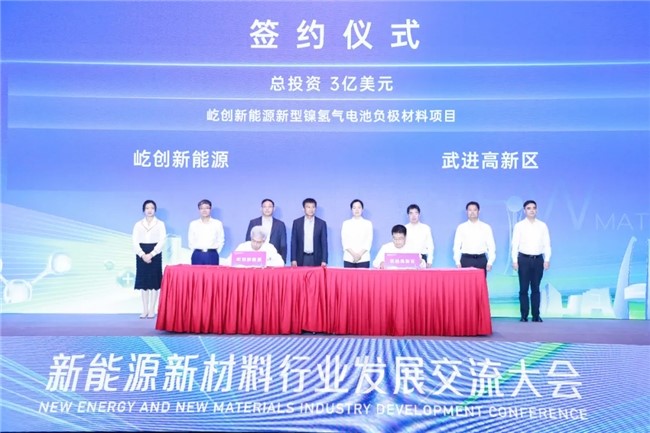
On September 27, the New Energy and New Materials Industry Development Exchange Conference took place in Wujin National High-tech Zone, marking a significant milestone for the energy sector. At the conference, the $300 million nickel-hydrogen battery anode material project by Yichuang Innovation Energy was officially announced, set to establish a core research and manufacturing base for anode materials. Once operational, this facility will achieve an annual production capacity of 15 GWh. This project follows the successful implementation of Yichuang’s innovative energy storage project in 2023, further solidifying advancements in nickel-hydrogen battery technology.
Revolutionizing Energy Storage: The Promise of Nickel-Hydrogen Batteries
In recent years, the rapid development of new energy systems has led to exponential growth in electrochemical energy storage technologies, which have diversified significantly. Among these advancements, the new nickel-hydrogen battery has emerged as a leading contender in the renewable energy sector, boasting exceptional performance and broad application prospects. Developed by EnerVenue, this innovative battery offers an impressive lifespan of approximately 30 years and 30,000 cycles, with advantages such as minimal maintenance requirements and excellent performance in extreme temperatures. Its low lifecycle costs make it suitable for various energy storage applications, including renewable energy integration, grid stabilization, and building energy management, particularly for long-duration energy storage needs.
Founded in 2020 by Stanford University energy expert Professor Cui Yi, EnerVenue focuses on developing and manufacturing new nickel-hydrogen energy storage systems, along with the electrode materials needed for these systems. The company has attracted significant investment, securing Series A funding in 2021 from prominent investors, including Schlumberger New Energy, Saudi Aramco, IDG Capital, and Li Ka-shing’s son, Li Jia Jie. The funding aims to accelerate the development and mass production of their battery technologies and expand into the Chinese market.
On October 27, 2023, a signing and groundbreaking ceremony was held in Changzhou, Jiangsu Province, for the Yichuang innovative energy storage project funded by EnerVenue. Upon completion, this facility will produce 1 GWh of new nickel-hydrogen battery capacity. EnerVenue’s CEO expressed enthusiasm, stating, “The Changzhou factory will be our first large-scale facility. We are committed to creating the world’s most durable energy storage battery and aim to become a leading supplier for power plants, enterprises, and home energy systems.”
The ongoing establishment of new nickel-hydrogen battery projects in China reflects the market’s recognition of this technology and underscores EnerVenue’s proactive expansion strategy within the country.
Safety and Performance: A New Era for Energy Storage
New nickel-hydrogen batteries and traditional nickel-hydrogen batteries are both classified as aqueous batteries, sharing certain technological similarities. They are known for their high safety profiles and longevity, with no risk of fire or explosion. Additionally, both types utilize foam nickel as the substrate for their electrodes. Foam nickel serves as an excellent catalyst and electrode material, enhancing the electrochemical reaction efficiency at the positive electrode while facilitating hydrogen absorption and release at the negative electrode, thereby improving overall battery performance and lifespan.
Major global manufacturers of foam nickel include Sumitomo Electric, Kolyuan, Ailantian, Wuzhou Sanhe, and Heze Tianyu Technology. In the domestic market, Kolyuan stands as a leader in the niche of nickel-hydrogen batteries, boasting the largest civilian foam nickel production base globally and providing exclusive support services for Toyota’s hybrid vehicle battery systems. Since 2022, Kolyuan, through its subsidiary Changde Liyuan, has been developing new nickel-hydrogen battery materials for long-duration energy storage, forging deep collaborations with foreign enterprises based on its technological and industrial advantages. Producing 1 GWh of nickel-hydrogen batteries is estimated to require around 4 to 6 million square meters of foam nickel materials. If successful, this project will open up new application fields for the domestic foam nickel industry.
A Growing Market: The Future of Energy Storage
As technology advances and market demand expands, the energy storage sector is entering a period of rapid growth. By 2027, global energy storage capacity is projected to reach 544 GWh, reflecting a compound annual growth rate (CAGR) of 37.9% from 2022 to 2027. Long-duration energy storage technologies, represented by new nickel-hydrogen batteries, are expected to play a crucial role in the global energy landscape. This trend not only heralds new growth opportunities for relevant enterprises but also propels the entire energy storage industry toward greater efficiency, safety, and sustainability.
The development and implementation of new nickel-hydrogen battery projects illustrate the industry’s commitment to fostering innovation and meeting the energy challenges of the future. As investments continue to flow into this promising technology, stakeholders across the board—be it manufacturers, consumers, or policymakers—can look forward to a more resilient and sustainable energy ecosystem.