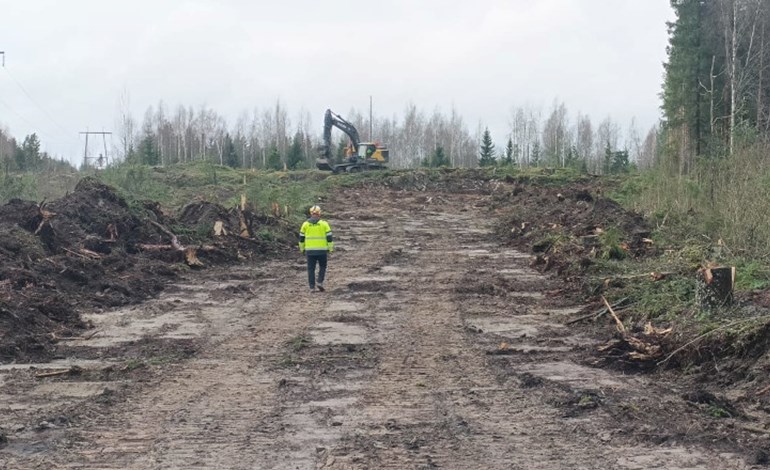
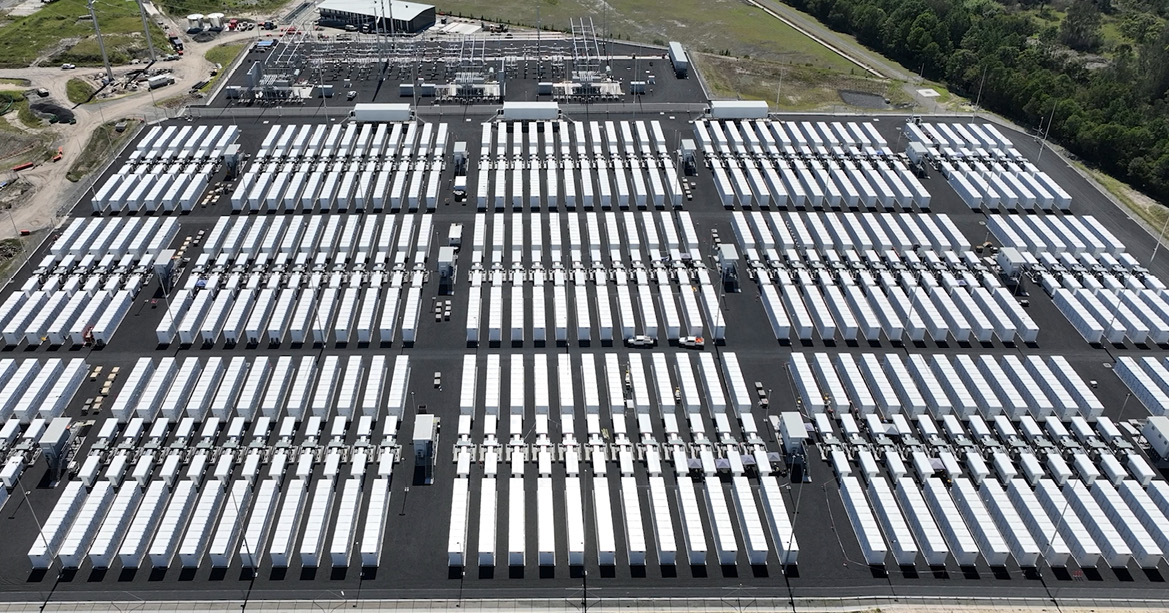
November 12, 2025 – Australia’s energy storage sector has suffered a major setback as the Waratah Super Battery project experienced a “catastrophic failure” of a high-voltage transformer. The project was set to become one of the world’s most powerful battery energy storage systems, with a capacity of 850MW/1,680MWh.
Sudden Incident: Just One Week from Completion
According to an internal memo obtained by the Australian Financial Review, one of three 350MVA high-voltage transformers supplied by Wilson Transformer Company failed during testing on Saturday, October 18, 2025. Akaysha Energy CEO Nick Carter acknowledged in the memo that the transformer suffered unspecified damage and was declared beyond repair.
Adding to concerns, a second of the three transformers has also been de-energized as a precautionary measure for further inspection. Fortunately, no one was injured in the incident, and investigations into the causes are ongoing.
The timing of the failure was particularly unfortunate—the facility, located at the site of the former Munmorah coal-fired power station on the Central Coast, was preparing to complete its final “hold point” tests and reach full commissioning. The project was only hours away from completing its fifth milestone and just about a week from final testing and full operational status.
Project Delayed Until May 2026
While few details have been made public, third-party tools show that in early November 2025, the Australian Energy Market Operator’s (AEMO) Medium Term Projected Assessment of System Adequacy (PASA) data for the battery’s dispatchable unit (coded as ‘WTAHB1’) was updated. The new data shows a long unplanned outage lasting through May 3, 2026.
Due to a series of factors including severe weather, the project had already been delayed by at least six months, and now faces another delay of six months or potentially longer if the transformer cannot be quickly replaced.
Transformer Supply Chain Bottleneck Highlighted
This incident highlights a significant problem: high-voltage transformers face long global lead times and are a key bottleneck for the industry. Order times for transformers needed on large battery storage projects have stretched out to more than a year due to surging demand.
A video released by Wilson Transformer Company showed the delivery of a 477-tonne 350MVA 330/33/33kV transformer from its Australian manufacturing hub in Victoria to the site, demonstrating the nine-day logistical challenge. Wilson was also selected to supply Waratah with 145 x 7.3MVA 33/0.77/0.77kV transformers for medium-voltage usage.
Maintaining Partial Operational Capacity
Despite the setback, in an official statement released on November 11, Akaysha Energy stated that the company recently notified the energy market of a temporary loss of capacity at the battery due to a transformer outage. The Waratah Super Battery is still operating at 350MW capacity and actively bolstering energy security for New South Wales’ grid.
The battery continues to meet its System Integrity Protection Scheme (SIPS) service requirements of 350MW, which is the interim commercial operating capacity. During ongoing hold point testing to transition the battery to full capacity, issues were identified with two transformers.
Akaysha says it is still able to provide the “interim” SIPS service, which requires 350MW and 700MWh of capacity, despite the loss of one transformer and issues with another. However, its next commissioning milestone—hold point 5—is on hold. At full capacity, Waratah is required to provide 700MW and 1,400MWh for the SIPS scheme at times, and lower amounts at others. The remaining capacity is traded in the market.
Local Manufacturing Advantage Aids Repair
Akaysha Energy confirmed that the transformers were manufactured by Australian-based company Wilson Transformer Company, providing advantages for the diagnostic and rectification process. All diagnostic, rectification, and re-commissioning activities can be undertaken locally, allowing faster turnaround times and close oversight of the repair process.
The engineering inspection process involves comprehensive testing to determine the exact nature of the transformer issues and the most appropriate solution. This may involve rectifying the existing transformers or replacing them with new units, depending on the findings of the detailed technical assessment.
Wilson Transformer Company was established in 1933 with a proud history and is Australia’s largest manufacturer of distribution and power transformer solutions, operating two state-of-the-art manufacturing facilities in regional Victoria and metropolitan Melbourne, with service facilities across Australia and in the UK.
Waratah Project Background and Operational History
The site was first energized in September 2024 and began partial active operations in August 2025 to support the NSW grid as part of the grid code’s System Integrity Protection Scheme (SIPS). Multiple reports suggest the site achieved its first full discharge for the entire battery energy storage system on Friday, October 10.
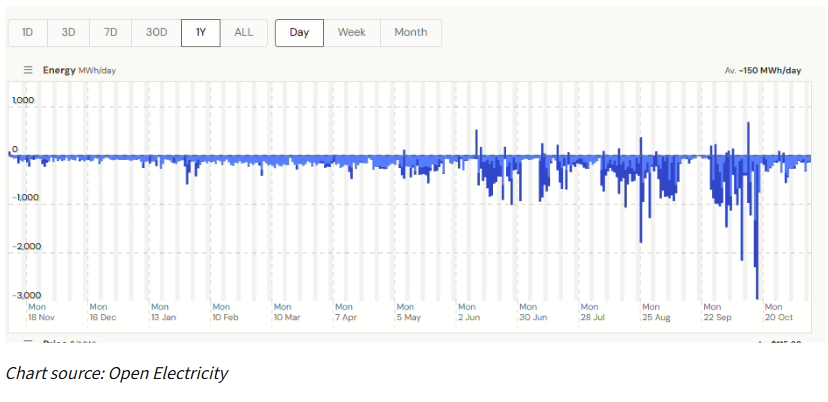
Following full output testing in mid-October, the Waratah battery showed a significant subsequent reduction in energy activity. It recorded a peak of 2,774MWh on Friday, October 17, from both charging and discharging activities. However, the site remains partially active, presumably through the one remaining unaffected high-voltage transformer.
In October, the Waratah Super Battery achieved a significant milestone when it discharged its first full output to Australia’s National Electricity Market (NEM), demonstrating its capability to provide large-scale grid services.
Akaysha Energy: Australia’s Largest Battery Operator
Akaysha recently overtook Neoen as the biggest operator of large-scale batteries in Australia, including those in operation, under construction, or contracted. Apart from Waratah, the company has completed or is nearing completion of the smaller Ulinda Park and Brendale batteries in Queensland and is also building the 415MW, 1,660MWh Orana battery in NSW.
The company has also signed a long-term off-take deal with Snowy Hydro, the largest of its type in the country, for the 300MW, 1,200MWh Elaine battery project in Victoria, and has won a federal underwriting agreement for the 275MW, 1,200MWh Deer Park battery project in Victoria.
Akaysha Energy was founded in 2021 and is headquartered in Cremorne, Australia, with 140 employees. The company has raised $780 million in funding, with investments from BlackRock. The company is supported by over A$3 billion in capital from global institutional investors, including BlackRock.
Akaysha Energy currently has a 4GWh portfolio of four mega-scale battery energy storage system (BESS) projects under construction, with an additional 20GWh in development across Australia. Beyond Australia, the company also has projects in the US, Japan, and Germany.
Other Projects Progress Well
On a more positive note, Akaysha Energy confirmed last week that it had closed a $300 million (AUD 460 million) finance facility for its Elaine BESS project in Victoria, underpinned by a 15-year virtual tolling agreement with Snowy Hydro, and had commenced construction on the 311MW/1,244MWh facility.
In February this year, Akaysha Energy signed a landmark offtake agreement with Gunvor Group for the Brendale battery energy storage project in Brisbane’s northern suburbs, Queensland, with a capacity of 205MW/410MWh. With this offtake agreement in place, Akaysha’s total contracted capacity across its portfolio of four assets under construction now exceeds 1.6 gigawatts.
Impact on Energy Transition
The Waratah transformer failure is the latest delay to affect the clean energy projects and transmission lines needed for the transition away from fossil fuels. The NSW government designated the project as critical infrastructure in 2022, saying it was “the most suitable solution that could be delivered in time to ensure the security of supply to Sydney, Wollongong and Newcastle” as coal generators close.
These delays mean the rate of renewable generation and storage construction is well below the rate needed to meet the federal government’s 2030 and 2035 emission reduction and clean power targets. Australia is aiming to reduce carbon emissions by 43% by 2030 from 2005 levels, underpinned by an 82% share for renewables in the electricity supply mix. By 2035, CO2 emissions are targeted to be between 62 and 70% lower than in 2005.
The Waratah Super Battery’s continued operation during the transformer issues demonstrates the redundancy built into large-scale battery storage systems. The project’s design as a giant shock absorber for Australia’s power grid enables it to respond rapidly to grid disturbances and maintain system stability even while operating at reduced capacity.
The transformer issues do not affect the project’s financing arrangements. The facility continues to generate revenue through its grid services contracts while operating at the interim capacity level.