On October 18, 2025, just hours away from full commissioning, Australia’s Waratah Super Battery project suffered a “catastrophic” equipment failure. This incident not only imposed a minimum six-month delay on the project but also sparked profound reflection across the global energy storage industry on equipment reliability, insurance coverage, and supply chain resilience.
Crisis Unfolds: World’s Most Powerful Battery Project in Trouble
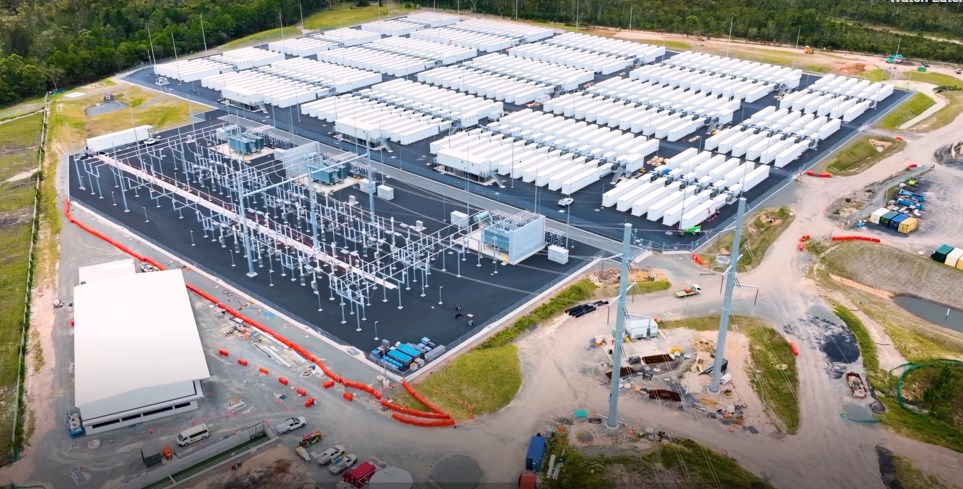
The Waratah Super Battery, located in Munmorah on the central coast of New South Wales, Australia, has an installed capacity of 850MW/1,680MWh, making it the most powerful battery energy storage system in terms of power output in Australia and globally. The project, developed and operated by Akaysha Energy under BlackRock, was originally scheduled to achieve full commercial operation by the end of 2025.
According to an internal memo from Akaysha Energy obtained by The Australian Financial Review, CEO Nick Carter confirmed that one of three 350MVA high-voltage transformers suffered a “catastrophic failure” during weekend testing. This critical equipment, supplied by Australian manufacturer Wilson Transformer Company, sustained unspecified damage and was declared beyond repair.
More concerning is that, as a precautionary measure, the second transformer has also been de-energized for detailed inspection, with its safe re-energization remaining uncertain. This means the “super battery” can currently operate at only 350MW capacity through the remaining unaffected transformer—just 41% of its design capacity.
Financial Impact: Insurance Claims Could Exceed AUD 90 Million
The financial implications of this incident are rapidly materializing. Tom Harries, Partner at NARDAC, an international insurance consulting firm, told ESS News that the claim amount will primarily depend on the duration of the outage.
“The claim could reasonably fall anywhere between AUD 10 million and AUD 50 million, depending on the extent of transformer damage and how much revenue loss is ultimately sustained,” Harries analyzed. “Repairability versus full replacement sits at the core of that spread.”
If the project developer has access to inventory from other projects, full rectification may be possible within six months. However, without that option, delivery timelines could extend to 12 months or more.
The situation could worsen significantly. If the second transformer also requires extended downtime, Waratah’s exposure would extend beyond the cost of replacing a single transformer to include a much longer delay in achieving full commissioning and revenue generation. “In that scenario, total claims under Delay in Start-Up cover could exceed AUD 90 million,” Harries warned. With transformer lead times of 24 to 36 months now common, this possibility is very real.
Supply Chain Dilemma: Physical Constraints Cannot Be Bypassed
This incident highlights a stark reality in the battery energy storage system (BESS) sector: physical manufacturing constraints cannot be bypassed by legal mechanisms.
“The project owner will not be able to contractually enforce a shorter replacement timeframe with the transformer supplier,” Harries noted. “High-voltage transformer supply remains one of the tightest areas in the global power equipment market.”
Even if Akaysha Energy attempts to accelerate the replacement process, it cannot compel Wilson Transformer Company to skip its existing order queue. The 2026 delay mentioned in project announcements reflects this unchangeable supply chain reality.
Harries also emphasized the importance of redundancy design: “If a project’s design allows other transformers to absorb the lost capacity and reroute power export, revenue losses can be reduced dramatically. Many BESS and solar projects, however, are designed with limited redundancy, so a single-point-of-failure event can quickly become a multi-million-dollar loss.”
Insurance Architecture: The Line Between Commissioning and Operation
In terms of insurance structure, the timing of the incident is crucial. Harries explained: “An incident like this would typically be covered under a Construction All Risks and Delay in Start-Up [DSU] policy if it occurred during commissioning. In operation, it would fall under an all risks property policy with business interruption cover.”
Most developers still buy 12-month indemnity periods because lenders specify that minimum, although 18- and 24-month periods are becoming more common as the transformer supply chain lengthens.
The incident is expected to trigger a complex claim across the London insurance market, where the risk is known to be shared or syndicated among underwriters holding majority or minority percentages. Even a modest percentage becomes meaningful when the affected asset is an 850 MW battery tied to grid stability services.
Revenue Impact: Financial Pressure Under Multiple Blows
Revenue losses for the Waratah Super Battery project did not begin with this transformer failure. Transgrid, the New South Wales transmission operator, confirmed that revenues had already been reduced due to earlier delays caused by severe weather and site flooding.
A Transgrid spokesperson stated: “The contract has appropriate mechanisms to ensure that payments reflect the actual SIPS Service provided. These are subject to annual adjustment processes with the Australian Energy Regulator (AER).” The spokesperson further revealed, “The AER’s original revenue determination for the Waratah Super Battery SIPS Service contract included a provision to update the approved schedule of payments in the event of a delay in achieving commercial operation. Transgrid submitted an application on this basis to the AER in March 2025.”
Now, the transformer failure will undoubtedly lead to further revenue cuts. While the project currently fulfills its 350MW interim SIPS service requirements, full capacity requires 700MW/1,400MWh to meet complete contractual obligations. The remaining capacity was originally planned for trading in the electricity market, generating additional revenue for the project.
Technical Analysis: Did High Cycling Intensity Exceed Equipment Capacity?
While the exact cause of the failure remains under investigation, industry experts have begun analyzing possible technical factors.
Common causes of transformer failures include aging, insufficient maintenance, overheating, overloading, and electrical stress such as sudden high-voltage surges. In Waratah’s case, aging and wear can be ruled out as these are brand-new equipment.
This has sparked speculation among some experts: Did the battery’s high cycling intensity and the project’s massive scale place excessive stress on the equipment?
As Australia’s most powerful battery, Waratah’s 850MW capacity makes it the largest single machine connected to the grid, exceeding the 750MW unit at Queensland’s Kogan Creek coal-fired power station. But batteries don’t just discharge; they also charge, and the power swing between charging and discharging can exceed 1.5GW.
According to Open Electricity data, the project recorded peak activity of 2,774MWh on Friday, October 17, representing the total of charging and discharging activities. Following completion of mid-term operational testing, battery activity dropped significantly—precisely when the failure occurred.
Supplier Response: Wilson Transformer Statement
As Australia’s largest transformer manufacturer, Wilson Transformer Company was established in 1933 and operates two advanced manufacturing facilities in Melbourne and regional Victoria, with service facilities across Australia and in the UK.
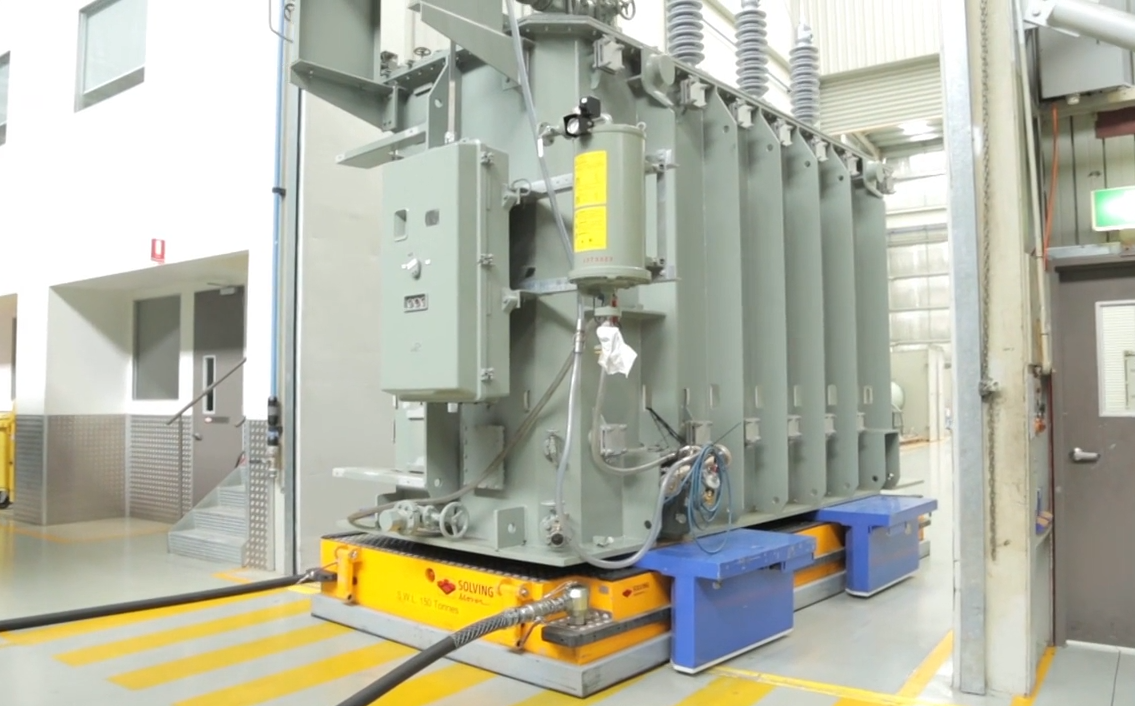
The company released a statement on its website: “Wilson Transformer Company is actively supporting an investigation into issues at the Waratah Super Battery site involving two transformers. We are working closely with our project partners to undertake a detailed inspection and analysis to determine the root cause.”
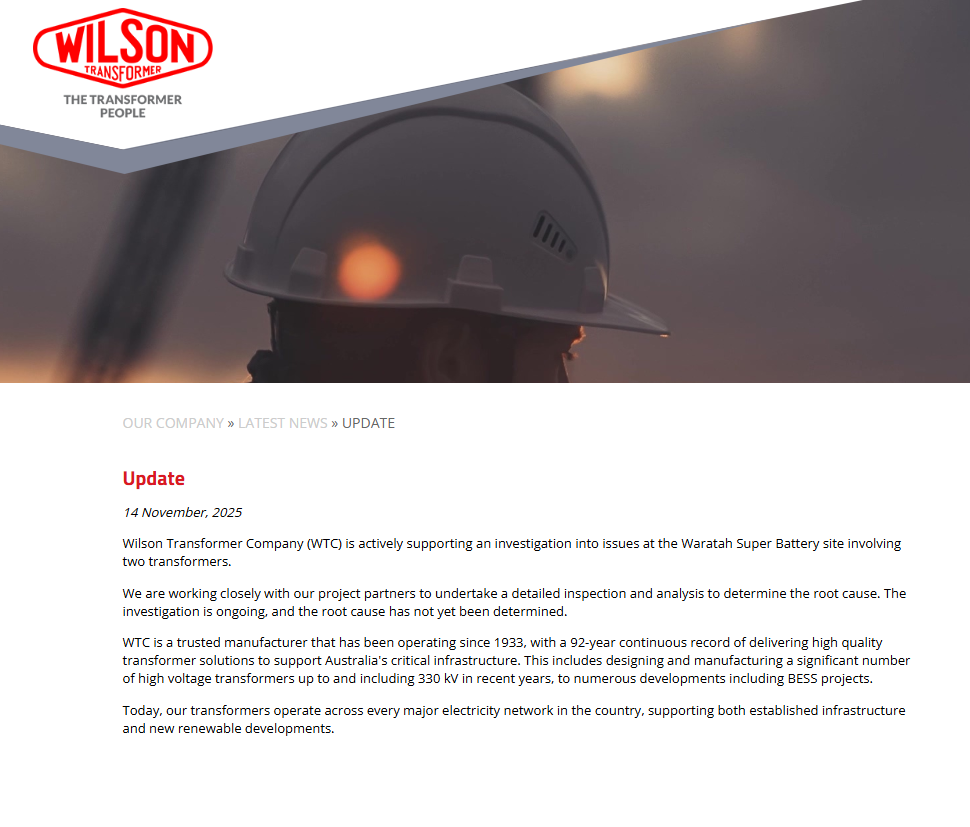
Notably, all three 350MVA transformers, as well as 145 7MVA medium-voltage transformers, were manufactured domestically in Australia, which should have been an advantage given current global supply chain tensions. However, even local manufacturers cannot significantly shorten delivery cycles when facing such large-scale replacement demands.
Project Background: From “Grid Insurance” to Risk Exposure
The Waratah Super Battery project itself was designed as an “insurance policy” for the grid. Jennifer Hughes, Transgrid’s Executive General Manager of Delivery, stated in August 2025 that the project was “like an insurance policy for NSW,” playing a key role as part of the grid’s System Integrity Protection Scheme (SIPS).
SIPS is Australia’s largest automated monitoring scheme, capable of monitoring 36 transmission lines in New South Wales in real-time, detecting overloads, and responding within seconds. During grid emergencies such as lightning strikes, SIPS acts as a “shock absorber,” restoring the grid to a stable state and maintaining supply continuity.
The scheme requires the Waratah battery to provide a guaranteed continuous active power capacity of at least 700MW and a guaranteed usable energy storage capacity of at least 1,400MWh. By operating as part of SIPS, the battery can increase existing grid transmission capacity, allowing more power to flow from existing generators to New South Wales households and businesses.
The project is located at the site of a former coal-fired power station in Munmorah, approximately 100 kilometers north of Sydney. This location is strategically significant as it can directly support transmission lines to the major load centers of Sydney, Newcastle, and Wollongong.
Industry Lessons: Systemic Risks of Single Points of Failure
This incident provides multi-layered warnings for the entire energy storage industry:
Importance of Equipment Redundancy Design
The Waratah project was originally equipped with three transformers, with design capacity allowing two transformers to meet the full 700MW SIPS requirement. This redundancy design enabled the project to maintain partial operations after one transformer failed. However, when the second transformer also required shutdown for inspection, the cost of lacking further redundancy immediately became apparent.
Matching Insurance Periods with Equipment Lead Times
As high-voltage transformer lead times have generally extended to 24-36 months, the traditional 12-month insurance indemnity period has become clearly insufficient. Developers need to re-evaluate insurance architecture and consider longer indemnity periods to cover replacement risks for critical long-lead equipment.
Supply Chain Risk Management
For large infrastructure projects, maintaining critical spare parts inventory or sharing spare parts pools with other projects may be effective strategies for reducing downtime risk. However, this requires balancing capital efficiency with risk mitigation.
Risk Identification During Commissioning
The incident occurred during “Hold Point Testing”—a critical phase transitioning from partial to full capacity. This reminds the industry that even when projects are near completion, heightened vigilance is necessary, as major technical risks may only emerge in the final stages.
Government and Regulatory Role
Notably, given the key role of the New South Wales government and the Australian Energy Regulator in the procurement and delivery of the Waratah Super Battery, investigations into the transformer failure may be made public and provide detailed analytical information for the industry.
The Waratah project is one of the flagship projects of the New South Wales government’s renewable energy infrastructure plan, which aims to build sufficient new wind, solar, and storage facilities to replace the state’s aging coal assets expected to retire by 2035 or earlier.
Akaysha Energy obtained the project contract through a competitive procurement process conducted by state-owned corporation EnergyCo in 2022. Such high-profile government involvement means that investigation results and lessons learned may become public record, helping the entire industry learn from the experience.
Investor and Operator Perspective
For the project’s investors, this incident is undoubtedly a stress test. Global investment giant BlackRock acquired Akaysha Energy in 2022, and the Waratah Super Battery is its flagship project entering the Australian energy storage market.
Following the incident, Rob Stewart, BlackRock investment partner and Akaysha Energy managing partner, described Waratah’s problems as “a hiccup” and “a bump in the road.” This relatively calm response partly reflects large infrastructure investors’ expectations and capacity to bear project risks.
Worth mentioning is that Akaysha Energy received assistance from external corporate communications advisors in responding to this crisis, indicating the company recognizes the importance of crisis communication. With limited information and numerous stakeholders, professional communication strategies are crucial for maintaining project credibility and investor confidence.
On the other hand, Akaysha Energy also had some good news. In the same week as the transformer failure was disclosed, the company announced completion of USD 300 million (AUD 460 million) financing for its Elaine BESS project in Victoria, underpinned by a 15-year virtual tolling agreement with Snowy Hydro, with construction beginning on the 311MW/1,244MWh facility.
Other Supply Chain Participants
The Waratah project involves multiple well-known suppliers and contractors, and the impact of this incident extends throughout the supply chain.
Powin Energy
This Oregon-based lithium iron phosphate (LFP) battery supplier provided battery hardware and software for Waratah. However, Powin filed for Chapter 11 bankruptcy protection in July 2025, admitting it struggled to compete with Chinese OEMs’ integrated BESS offerings. Despite facing financial difficulties, Powin continues to fulfill its commitments to the Waratah project, adding additional uncertainty to the project.
Consolidated Power Projects (CPP)
As the project’s engineering, procurement, and construction (EPC) contractor, CPP must coordinate response measures with Akaysha, Wilson Transformer, and other parties following the incident.
Fluence
This global leading energy storage technology and services company is responsible for optimizing Akaysha Energy’s battery assets. With the project partially operational, it needs to adjust optimization strategies to maximize the value of available capacity.
Grid Operation Continuity
Despite facing major setbacks, the Waratah Super Battery continues to fulfill its critical grid support function. Akaysha Energy emphasizes that the project remains operational at 350MW capacity and actively supports energy security for the New South Wales grid.
This 350MW interim capacity meets the basic requirements of SIPS services, meaning critical grid protection functions are maintained. With existing transmission infrastructure under pressure, particularly as coal-fired power stations gradually retire, even the partial capacity of the Waratah battery plays an indispensable role.
Notably, the Eraring Power Station in New South Wales was originally scheduled to close on August 19, 2025, nearly two months ago. The decision made in May 2024 to extend Eraring’s service life to at least 2027 now appears more prudent. If Eraring had closed as originally planned while Waratah encountered its current failure, New South Wales’ power supply security would face severe challenges.
Future Outlook: Legal Disputes and Industry Transformation
As investigations deepen, the next phase of the Waratah project will likely partially unfold in courts. Attribution of responsibility for delays and failures, as well as contractual obligations of various parties, may trigger complex legal proceedings.
Multiple stakeholders—Akaysha Energy, Wilson Transformer Company, Consolidated Power Projects, insurance companies, Transgrid, and the New South Wales government—all bear varying degrees of risk and responsibility in this incident. The ultimate allocation of responsibility will have far-reaching implications for contract structures and risk allocation in future similar projects.
From a broader industry perspective, this incident may prompt the energy storage sector to make changes in the following areas:
Equipment Testing Standards – Are stricter transformer testing and certification standards needed for high-cycling, high-power applications in large-scale energy storage projects?
Supply Chain Diversification – Should risks of over-reliance on single suppliers or regions be mitigated through supply chain diversification?
Project Timeline Planning – Should developers reserve more time buffers for critical equipment failures rather than pursuing aggressive commissioning schedules?
Insurance Product Innovation – Does the insurance market need to develop specialized products better suited to long-lead equipment risks?
Global Context: Growing Pains in Rapid Energy Storage Expansion
Waratah’s experience is not an isolated incident but rather a microcosm of challenges faced during the global energy storage industry’s rapid expansion.
Global grid-scale energy storage capacity is growing at an unprecedented rate. As one of the developed countries with the highest renewable energy penetration, Australia’s energy storage market is particularly active. The Commonwealth Scientific and Industrial Research Organisation (CSIRO) estimates that the country’s energy storage capacity may need to grow 10 to 14-fold to support energy transition goals.
Against this backdrop of rapid expansion, supply chain pressures, equipment reliability challenges, and technology maturity tests are inevitable. The Waratah project’s experience will provide valuable practical lessons for subsequent projects.
Also noteworthy is the overall state of the global transformer supply chain. As grid modernization, renewable energy integration, and electrification processes accelerate, demand for high-voltage transformers has surged, while manufacturing capacity expansion has been relatively slow. This supply-demand imbalance affects not only Australia but is a common challenge for the global power industry.
Conclusion
The Waratah Super Battery transformer failure is an important milestone in the energy storage industry’s development journey. It exposed technical risks, supply chain vulnerabilities, and risk management challenges during rapid expansion, but also demonstrated the resilience of modern large infrastructure projects—even in the face of major setbacks, the project continues to operate and fulfill critical functions.
For the global energy storage industry, this incident provides a rare learning opportunity. From equipment design and redundancy configuration to insurance architecture and supply chain management, every aspect deserves re-examination and optimization.
As investigations by the New South Wales government and the Australian Energy Regulator progress, the industry can expect detailed information on root causes and preventive measures. The dissemination and application of this knowledge will help improve the reliability and resilience of future projects.
The Waratah Super Battery story continues. Whether the project can restore full capacity as scheduled in 2026, the inspection results of the second transformer, how insurance claims are ultimately resolved, and the long-term impact of this incident on Australia’s and global energy storage markets—answers to these questions will gradually emerge in the coming months.
What is certain is that this 850MW “super battery” has transcended its physical existence to become an important case study in energy storage industry risk management and project governance. It reminds all participants: while pursuing scale and speed, the fundamental construction of reliability and resilience must never be neglected.