To meet the growing demand for high-performance batteries in modern electronics, researchers are constantly seeking innovative solutions to overcome the limitations of traditional lithium-ion (Li-ion) batteries. Among the most promising alternatives are lithium-metal batteries (LMBs), which offer significantly higher energy densities compared to their Li-ion counterparts. However, LMBs have long faced challenges related to slow redox kinetics and poor cycling reversibility, which hinder their charging speed and overall efficiency over time.
In a groundbreaking study published in Nature Energy, researchers at Stanford University have unveiled a novel approach to improving the performance of LMBs. The team has developed asymmetric ether-based solvents, which not only accelerate the charging process but also enhance the stability and reliability of lithium-metal batteries. This innovation marks a significant milestone in the quest for next-generation battery technology.
Breaking Down the Research
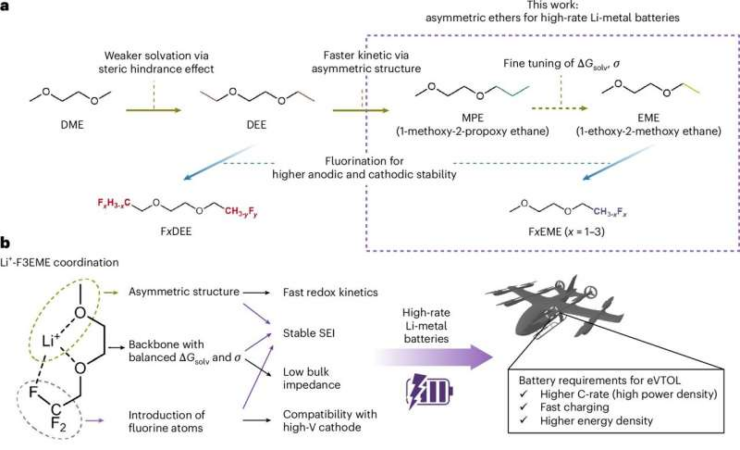
The research, led by Rok Choi, first author of the paper, aimed to address the critical issue of slow Li-ion exchange rates in LMBs. Traditional ether-based solvents used in batteries are often symmetric, meaning they have identical hydrocarbon groups on either side of the oxygen atom. These symmetric solvents tend to hinder the movement of lithium ions toward the anode during charging, which slows down charge transfer and reduces battery stability.
Choi and his colleagues drew inspiration from ethyl methyl carbonate (EMC), an asymmetric alkyl carbonate widely used in Li-ion batteries. They designed a new class of asymmetric ether solvents with molecules that have different side groups. This asymmetry was strategically engineered to minimize steric hindrance during the desolvation process, allowing lithium ions to move more freely and quickly toward the anode.
The researchers also optimized the dipole orientation of their custom-designed solvents. By aligning the positive and negative charges in a specific way, they were able to enhance charge transfer, promote the formation of a stable solid-electrolyte interphase (SEI), and achieve uniform lithium plating on the anode. These improvements collectively lead to faster charging speeds, better stability, and longer cycle life.
Experimental Results
In their experiments, the Stanford team tested their new asymmetric ether solvents in anode-free pouch cells, which were cycled under conditions mimicking electric vertical take-off and landing (eVTOL) applications. The results were remarkable: the batteries demonstrated over 600 cycles of stable performance, showcasing the durability and reliability of the new solvent design.
Choi highlighted the significance of their findings:
“We discovered that higher molecular asymmetry accelerates Li+ kinetics, leading to a more stable SEI and longer cycle life under high-rate conditions.”
The success of this approach suggests that asymmetric ether solvents could be a game-changer for LMBs, paving the way for batteries with higher energy densities and faster charging capabilities.
Future Directions
Building on this promising research, Choi and his team plan to expand their work in several key areas. First, they aim to develop a broader portfolio of electrolytes based on similar molecular design principles. These new solvents could be tailored for different battery systems, including LMBs, Li-ion batteries with silicon anodes, and lithium-sulfur (Li-S) batteries.
The researchers also intend to further investigate the potential applications of their asymmetric ether solvents in diverse energy storage scenarios. Their ultimate goal is to bridge the gap between laboratory innovation and real-world implementation, bringing next-generation battery technology closer to commercialization.
Conclusion
The development of asymmetric ether-based solvents by Stanford University researchers represents a major leap forward in lithium-metal battery technology. By addressing the long-standing challenges of slow charging and poor stability, this breakthrough could unlock new possibilities for high-energy-density batteries, enabling everything from electric vehicles to portable electronics to operate more efficiently and sustainably.
As the team continues to explore the full potential of their innovation, the future of energy storage looks brighter than ever.