The recent incident involving a Xiaomi SU7 vehicle fire in Zhanjiang, Guangdong province, has been the subject of intense online speculation and misinformation. Following widespread rumors circulating online, particularly a fabricated report claiming a preliminary analysis from a non-existent “National New Energy Vehicle Accident Identification Center,” Xiaomi’s official spokesperson issued a statement on April 11th, vehemently denying the claims and clarifying the sequence of events.
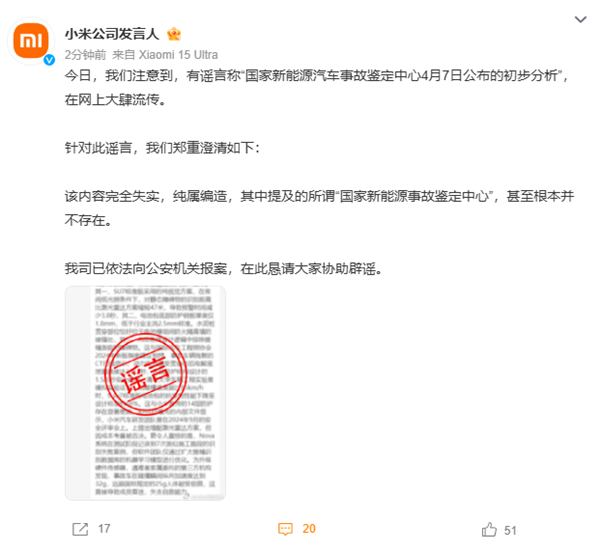
The initial reports, which gained significant traction on social media, alleged that the aforementioned center had released a preliminary analysis on April 7th, pointing to a potential fault within the SU7 vehicle. Xiaomi’s response was swift and unequivocal, labeling the information as entirely false and fabricated. The company emphasized that the purported “National New Energy Vehicle Accident Identification Center” simply does not exist, highlighting the blatant nature of the misinformation campaign. Xiaomi has formally reported the incident to the public security authorities and urged the public to assist in debunking the false narrative.
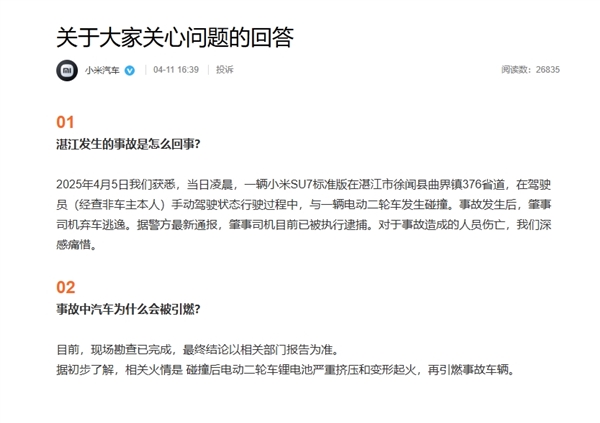
The incident occurred on the early morning of April 5th, when a Xiaomi SU7 standard version was involved in a collision with an electric two-wheeled vehicle on 376 Provincial Road in Qujie Town, Xuwen County, Zhanjiang. Crucially, the driver of the SU7 was not the vehicle’s owner. Following the collision, the driver fled the scene, further complicating the initial investigation.
A significant development in the case came with the apprehension of the suspect, identified as Chen, who surrendered to police under mounting pressure from law enforcement. Chen is now in custody, facing charges of traffic accident causing injury and death. The investigation is ongoing, with police actively pursuing all leads.
Xiaomi has confirmed that a thorough on-site examination has been completed, and the final conclusions will be based on the official report from relevant authorities. Preliminary findings suggest that the fire originated from the severe compression and deformation of the electric two-wheeled vehicle’s lithium battery, which subsequently ignited the accident vehicle. This points to a chain reaction initiated by the collision with the electric bike, rather than a fault within the SU7 itself.
The rapid spread of misinformation underscores the challenges of managing public perception in the age of social media. The fabricated report not only damaged Xiaomi’s reputation but also created unnecessary anxiety among potential customers. Xiaomi’s proactive response, including the formal report to the police and the public clarification, demonstrates a commitment to transparency and accountability.
The incident also raises broader questions about the safety of electric two-wheeled vehicles and the potential risks associated with their interaction with other vehicles on the road. The severity of the fire, attributed to the compromised lithium battery, highlights the importance of proper maintenance and safety protocols for all types of vehicles.
Looking ahead, Xiaomi is likely to focus on rebuilding trust and reinforcing its commitment to vehicle safety. This will involve ongoing communication with the public, collaboration with relevant authorities, and a continued focus on rigorous testing and quality control. The company will also need to address the underlying issues that allowed the misinformation campaign to gain traction, potentially through enhanced media relations and proactive social media monitoring. The incident serves as a stark reminder of the power of misinformation and the importance of verifying information before sharing it online. The swift action taken by Xiaomi to address the situation and the ongoing investigation into the driver’s actions are crucial steps in resolving the matter and restoring public confidence. The company’s commitment to transparency and its willingness to cooperate with authorities will be key to navigating this challenging situation and emerging stronger.