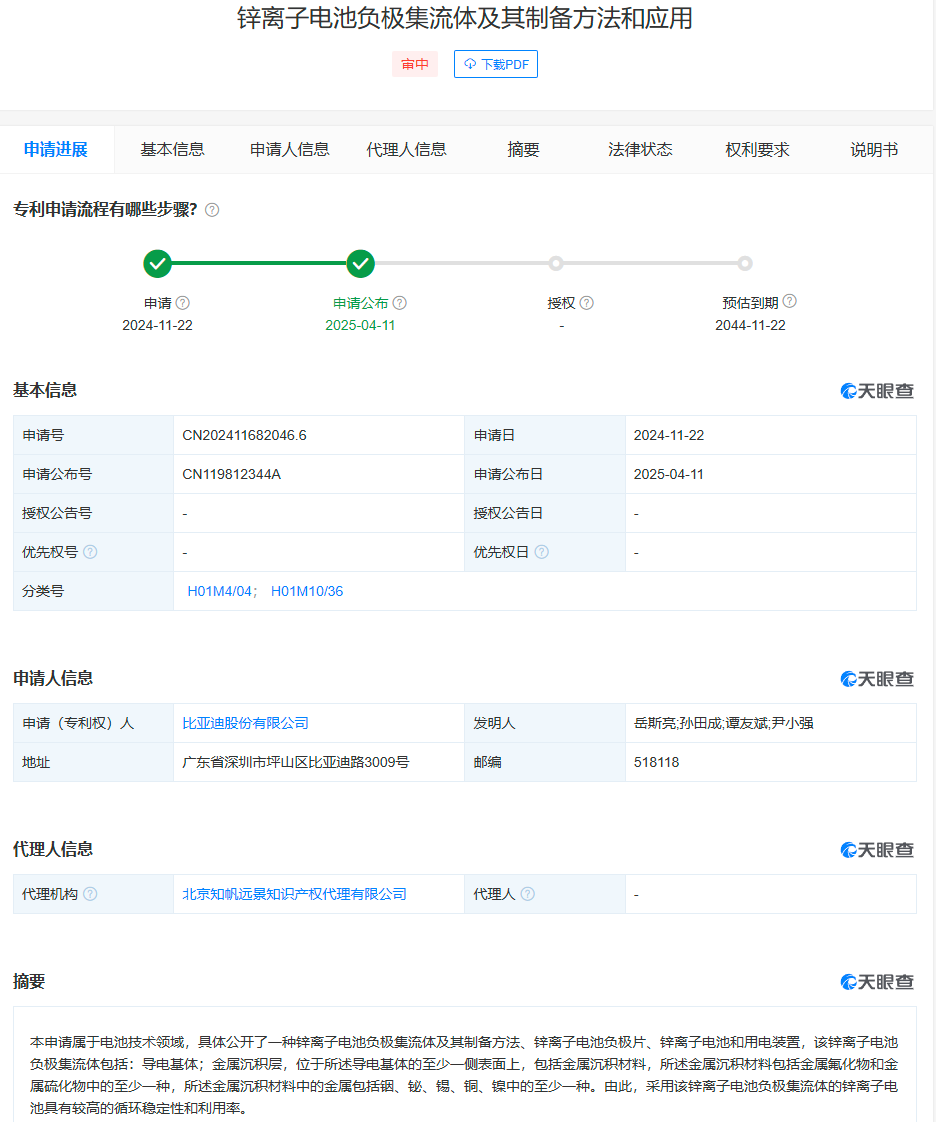
BYD, a leading global manufacturer of electric vehicles and energy storage solutions, has recently announced the publication of a patent for a new zinc-ion battery negative electrode collector design. This innovation represents a significant step forward in the development of zinc-ion batteries, addressing key challenges related to cycle stability and utilization rate – critical factors for widespread commercial adoption. The patent, revealed through information gleaned from Tianyancha intellectual property records, details a sophisticated approach to electrode construction that promises to enhance battery performance and longevity.
Zinc-ion batteries have emerged as a promising alternative to traditional lithium-ion batteries, offering potential advantages such as lower cost, improved safety, and greater abundance of raw materials. However, challenges remain in achieving comparable energy density and cycle life. BYD’s latest patent directly tackles these hurdles, demonstrating the company’s ongoing commitment to pushing the boundaries of battery technology.
Understanding the Innovation: The Negative Electrode Collector
The core of BYD’s innovation lies in the design of the negative electrode collector, a crucial component of the battery that serves as a current-collecting structure and influences the overall electrochemical performance. The patented design incorporates a layered approach, comprising two key elements: a conductive substrate and a metallic deposition layer.
The conductive substrate, while not explicitly detailed in the patent abstract, is understood to be a material possessing excellent electrical conductivity and mechanical strength, essential for efficient current collection and structural integrity during battery operation. The real breakthrough, however, resides in the metallic deposition layer applied to at least one side of the conductive substrate.
This deposition layer is a carefully engineered composite material, incorporating both metal fluorides and metal sulfides. The selection of these specific materials is not arbitrary; each contributes unique properties that synergistically enhance battery performance. The patent specifies that the metallic components within this layer include at least one of indium, bismuth, tin, copper, and nickel.
The inclusion of metal fluorides is believed to improve the electrical conductivity of the electrode material and enhance its electrochemical activity. Metal sulfides, on the other hand, are known to facilitate ion transport within the electrode, reducing internal resistance and improving overall efficiency. The strategic combination of indium, bismuth, tin, copper, and nickel further refines the electrode’s properties, optimizing cycle stability and utilization rate.
BYD’s Commitment to Battery Innovation: A Track Record of Excellence
This latest patent is indicative of BYD’s long-standing commitment to battery technology innovation. Established in 1995 and headquartered in Shenzhen, China, BYD has grown into a global powerhouse in the automotive and energy sectors. The company’s registered capital of 290926.5855 million RMB underscores its financial strength and ability to invest heavily in research and development.
According to Tianyancha data, BYD holds an impressive portfolio of over 5,000 patent records and possesses 134 administrative licenses, demonstrating its robust intellectual property protection and regulatory compliance. Furthermore, media reports highlight BYD’s substantial workforce of 100,000 engineers, contributing to a global patent application count exceeding 4.8 million and a granted patent count surpassing 3 million.
BYD’s battery technology portfolio extends beyond zinc-ion batteries, encompassing lithium iron phosphate (LFP) batteries, blade batteries, and semi-solid-state batteries. This diversified approach allows BYD to explore multiple technological pathways and adapt to evolving market demands. The company’s pioneering work in LFP battery technology, in particular, has been instrumental in driving down the cost of electric vehicles and making them more accessible to consumers.
The Future of Zinc-Ion Batteries and BYD’s Role
While zinc-ion batteries are still in a relatively early stage of development compared to lithium-ion technology, their potential advantages are undeniable. The lower cost of zinc, its greater abundance, and the inherent safety benefits associated with aqueous electrolytes make zinc-ion batteries an attractive alternative for a wide range of applications, including energy storage systems, electric vehicles, and consumer electronics.
BYD’s innovation in negative electrode collector design represents a significant step towards realizing the full potential of zinc-ion batteries. By addressing key challenges related to cycle stability and utilization rate, BYD is paving the way for the commercialization of this promising technology.
The company’s continued investment in research and development, coupled with its expertise in battery manufacturing, positions BYD as a leading player in the evolving landscape of energy storage solutions. As the demand for sustainable and affordable energy continues to grow, BYD’s zinc-ion battery technology is poised to play a crucial role in shaping the future of transportation and power generation. The company’s dedication to innovation ensures that it remains at the forefront of the battery technology revolution, contributing to a cleaner and more sustainable world.