Tesla’s Shanghai Gigafactory has achieved a significant manufacturing milestone, rolling out its 5-millionth battery pack since operations began in late 2019. The achievement underscores the facility’s critical role in Tesla’s global manufacturing strategy and its position as the company’s largest production hub worldwide.
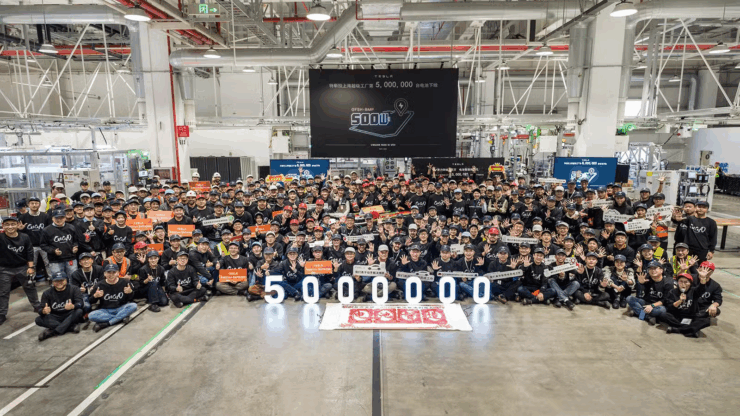
Milestone Marks Five Years of Rapid Growth
The American electric vehicle manufacturer announced the milestone on social media platform X and Chinese platform Weibo, highlighting the factory’s technological capabilities and production efficiency. Tesla emphasized that while the company independently develops cell chemistry and designs battery pack structures, the systems deliver high performance, energy density, and exceptional cold-weather resilience.
According to Tesla’s statement, the battery systems are engineered to support mileage that exceeds the vehicle’s lifecycle, with safety standards that surpass industry norms by multiple times. This focus on longevity and safety has become a key differentiator in Tesla’s battery technology approach.
Strategic Battery Supply Chain in China
Notably, Tesla does not manufacture battery cells at its Shanghai facility. Instead, Giga Shanghai sources cells from two major suppliers: China’s Contemporary Amperex Technology Co. Limited (CATL) and South Korea’s LG Energy Solution. This strategic partnership approach allows Tesla to leverage the expertise and scale of established battery manufacturers while maintaining control over pack design and integration.
CATL, listed on the Hong Kong Stock Exchange, has emerged as the world’s largest battery manufacturer and serves multiple automakers globally. LG Energy Solution brings its extensive experience in battery technology and international manufacturing capabilities to support Tesla’s production needs.
From Groundbreaking to Global Export Hub
Construction of the Shanghai factory commenced on January 7, 2019, making it a remarkably fast project by automotive manufacturing standards. Operations began by the end of that same year, marking a historic moment as China’s first wholly foreign-owned automotive manufacturing project.
The facility began delivering Model 3 sedans to local Chinese consumers in January 2020, followed by Model Y SUV deliveries starting in January 2021. With an annual production capacity of approximately 1 million vehicles, Giga Shanghai serves dual purposes: supplying the domestic Chinese market and functioning as a major export hub for international markets.
Dominant Global Production Share Amid Market Challenges
Tesla China’s performance in 2024 demonstrates the Shanghai factory’s pivotal role in the company’s global operations. In the third quarter alone, Tesla China’s sales including exports reached 241,890 units, representing 48.66 percent of Tesla’s worldwide deliveries.
For the first three quarters of 2024, Tesla China’s sales including exports totaled 606,364 units, accounting for 49.79 percent of Tesla’s global deliveries of 1,217,902 units during the same period. These figures confirm that nearly half of all Tesla vehicles delivered globally originate from the Shanghai facility.
Domestic Sales Face Headwinds
Despite strong overall production numbers, Tesla’s domestic sales performance in China has encountered challenges in 2024. October retail sales in the Chinese market came in at 26,006 units, marking the lowest level since November 2022, according to data from the China Passenger Car Association (CPCA).
This represents a substantial 35.76 percent year-on-year decline from the 40,485 units sold in October 2023, and a sharp 63.64 percent month-on-month drop from September’s 71,525 units. The decline reflects intensifying competition in China’s rapidly evolving electric vehicle market, where domestic manufacturers have introduced numerous competitive models across various price segments.
Looking Ahead
The 5-million battery pack milestone demonstrates Tesla’s manufacturing efficiency and the maturity of its Shanghai operations. As the facility continues to serve as both a domestic production base and global export center, its strategic importance to Tesla’s overall business model remains clear. However, the company faces the ongoing challenge of maintaining market share in China’s increasingly competitive domestic EV landscape while maximizing the facility’s export potential to support global demand.