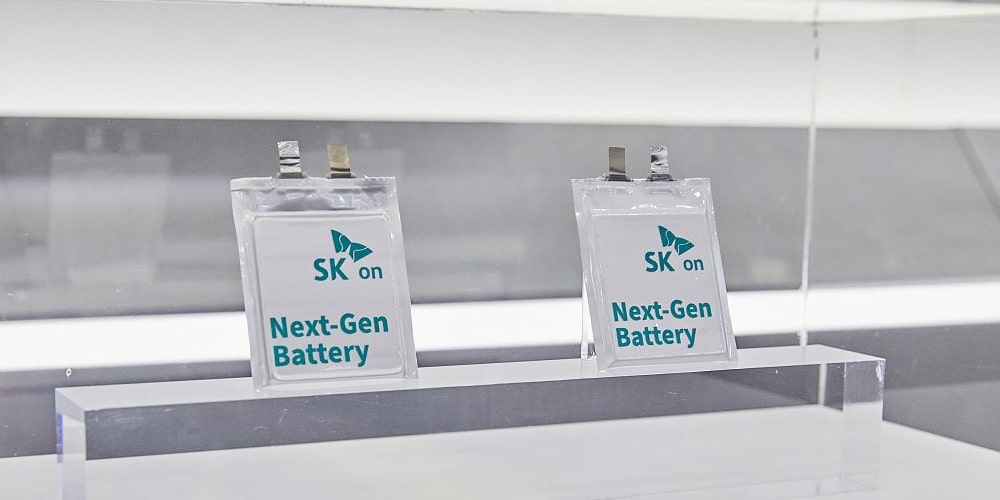
SEOUL, October 9, 2024 – SK on, a leading innovator in the battery technology sector, has achieved a significant breakthrough in the development of next-generation all-solid-state batteries. In collaboration with Professor Kim Dong-won’s research team from Hanyang University, the company has successfully developed a new anode for sulfide-based all-solid-state batteries that can operate efficiently at room temperature. This breakthrough, which addresses key challenges faced by lithium metal batteries, was recently published in the prestigious journal ACS Applied Materials & Interfaces, one of the leading scientific publications in the field of materials science.
The achievement marks a pivotal step forward in battery technology, particularly for electric vehicles (EVs) and other energy storage systems. The ability to develop a room-temperature operable anode eliminates the need for complex temperature control systems, reducing costs, improving energy density, and extending battery lifespan. SK on’s research efforts reflect the growing importance of advanced battery materials in supporting the global transition to cleaner energy solutions.
Addressing Limitations of Sulfide-Based Lithium Metal Batteries
Sulfide-based lithium metal batteries are known for their high energy density and potential to revolutionize energy storage. However, they typically require operation at temperatures above room temperature to ensure the uniform movement of lithium ions within the battery. Maintaining elevated temperatures for battery operation is not only costly but also leads to the installation of additional temperature control systems, which add weight and complexity to the battery design, particularly in automotive applications. Furthermore, operating at high temperatures—especially beyond 65 degrees Celsius—can result in the degradation of battery materials, shortening the battery’s overall lifespan.
By integrating a lithium-friendly material such as silver into the anode current collector, SK on and Professor Kim Dong-won’s team have successfully addressed these limitations. This innovative anode design enables the battery to function efficiently at room temperature, significantly enhancing the battery’s practicality and reducing the reliance on external temperature control systems.
Preventing Dendrite Formation with SEI Layer Technology
Another critical issue in lithium metal batteries is the formation of dendrites—crystalline structures that grow on the anode surface during the charging cycle. Dendrites can lead to short-circuiting, posing safety risks and reducing the performance and lifespan of the battery. The research team from Hanyang University and SK on developed a novel approach to this problem by ensuring the formation of a solid electrolyte interphase (SEI) layer during the lithium-silver alloying process.
The SEI layer is a thin film that forms on the surface of the battery anode during the initial charging process. This layer acts as a protective barrier, preventing further reactions between the electrolyte and the lithium metal anode, which can cause battery degradation. By incorporating the SEI layer formation into the lithium-silver alloying process, the research team was able to suppress dendrite growth, thereby improving the safety and longevity of the battery. This process, which is typically done in separate steps, is now combined into a single electrochemical process, reducing both cost and processing time.
Next Steps for SK on: Reducing Costs and Extending Battery Life
While the incorporation of silver into the anode has resulted in improved room-temperature performance, the cost of silver remains a concern for mass production. As a result, SK on is currently researching ways to reduce the silver content in the anode while maintaining the same high level of performance. In addition, efforts are underway to further enhance the SEI layer’s performance to extend battery life and improve its overall reliability in commercial applications.
This development follows a similar breakthrough from SK on in June 2024, when the company announced the successful creation of a polymer electrolyte for lithium metal batteries that can also operate at room temperature. Together, these advancements solidify SK on’s leadership in the pursuit of more efficient, cost-effective, and durable battery technologies for the future.
SK on’s Vision for All-Solid-State Batteries
The development of this room-temperature anode is part of SK on’s broader strategy to secure a leading position in the rapidly evolving field of all-solid-state batteries. The company is currently working on two distinct types of next-generation solid-state batteries: polymer-oxide composite batteries and sulfide-based batteries. Each of these technologies has unique advantages and potential applications, with the polymer-oxide composite batteries offering greater stability and safety, while the sulfide-based batteries provide superior energy density.
Looking ahead, SK on plans to complete the construction of a pilot line for sulfide-based solid-state batteries by the second half of 2025. This pilot line will enable the company to refine its manufacturing processes and prepare for full-scale commercial production. The goal is to introduce commercial prototypes of these batteries by 2029, positioning SK on as a key player in the global shift toward electric vehicles and other battery-powered technologies.
Implications for the Future of Energy Storage
The successful development of a room-temperature anode for all-solid-state batteries represents a major step forward for the energy storage industry, particularly in the context of electric vehicles, grid storage, and renewable energy integration. By addressing key technical challenges such as high-temperature operation and dendrite formation, SK on’s research opens the door to more efficient, cost-effective, and reliable battery solutions.
As the global market for electric vehicles continues to grow, the demand for advanced battery technologies is expected to rise dramatically. All-solid-state batteries, with their promise of higher energy densities, improved safety, and longer lifespans, are widely regarded as the next frontier in battery innovation. SK on’s continued advancements in this field will likely play a critical role in shaping the future of energy storage and the broader clean energy transition.
Conclusion
SK on’s collaboration with Hanyang University to develop a room-temperature operable anode for sulfide-based all-solid-state batteries marks a significant technological breakthrough. This achievement addresses key challenges in lithium metal battery design, reducing both costs and the complexity of temperature management systems. Moreover, the innovative SEI layer technology provides a solution to dendrite formation, further enhancing the safety and longevity of the batteries. With plans to launch commercial prototypes by 2029, SK on is well-positioned to lead the development of next-generation battery technologies that will power the electric vehicles and energy storage systems of the future.