1. The “Absolute Safety” Myth of Solid-State Batteries
In recent years, solid-state batteries have often been marketed as the “ultimate safe solution.” However, ProLogium makes it clear in its latest technical release: “Solid-state” does not automatically mean safe.
The history of lithium batteries has always been a balancing act between energy density and safety. From Moli Energy’s recall of its lithium metal battery in 1988, to the widespread adoption of high-nickel cathodes and silicon-based anodes, the industry has struggled to eliminate thermal runaway — a chain reaction that can occur even without an external ignition source.
True safety, ProLogium emphasizes, must come from both intrinsic material stability and active thermal risk control.
2. Real-World Test: Liquid Lithium Battery vs. ProLogium All-Inorganic Solid-State Battery
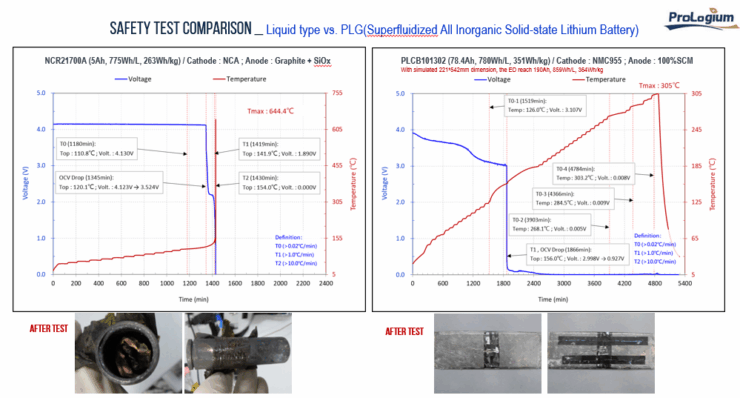
ProLogium’s Accelerating Rate Calorimetry (ARC) safety comparison between a traditional liquid lithium battery and its own 4th-generation all-inorganic solid-state battery reveals a dramatic performance gap.
Test Samples & Conditions:
- Liquid System: NCR21700A (5Ah, 775Wh/L, 263Wh/kg)
- Cathode: NCA
- Anode: Graphite + SiOx
- Solid-State System: PLCB191302 (78.4Ah, 780Wh/L, 315Wh/kg)
- Cathode: NMC955
- Anode: 100% SCM
- All-inorganic solid-state electrolyte + Active Safety Mechanism (ASM)
Key Test Results:
| Metric | Liquid Lithium Battery | ProLogium All-Inorganic Solid-State Battery |
|---|---|---|
| Peak Temperature | 644.4°C | 305°C |
| Thermal Runaway | Rapid onset at T1 | No thermal runaway |
| Voltage Behavior | Sudden OCV drop | Slow, stable voltage decay |
| Post-Test Appearance | Severe charring & deformation | Minimal discoloration, intact structure |
Visual Outcome:
- Liquid battery: Burnt and heavily deformed casing after test.
- ProLogium battery: No visible combustion or structural failure under the same conditions.
This proves that ProLogium’s 4th-generation solid-state system can suppress thermal chain reactions, reducing peak temperature by nearly 340°C and completely avoiding thermal runaway.
3. The Dual Protection Architecture
ProLogium’s safety leap is built on two cornerstone technologies:
1. All-Ceramic Separator
- Maintains mechanical strength and insulation at high temperatures.
- Prevents lithium dendrite penetration and thermal propagation.
2. Superfluidized All-Inorganic Solid-State Electrolyte + ASM
- Intrinsic Non-Combustibility: Inorganic materials that do not ignite at high temperatures.
- Active Reaction Control:
- Oxygen Locking: Stabilizes high-nickel cathodes and suppresses oxygen release.
- Lithium Taming: Neutralizes lithium reactivity and prevents violent side reactions.
4. ARC Test: A Breakthrough in Thermal Safety
ARC testing is a gold-standard method for assessing thermal stability:
- Traditional liquid systems: Steep temperature rise leading to rapid thermal runaway and large exothermic peaks.
- ProLogium solid-state system: Gradual temperature increase; ASM activates at critical temperature, reacts with electrode materials first, and breaks the thermal chain reaction before runaway occurs.
This “terminate-before-runaway” approach is the first of its kind in the lithium battery industry since the 1980s.
5. Industry Impact & Future Outlook
The launch of ProLogium’s 4th-generation platform signals a major shift in lithium battery safety philosophy:
- From post-event containment to preemptive risk elimination.
- From passive tolerance to active intervention.
- From the misconception of “solid-state = absolute safety” to the standard of controllable risk.
This technology is highly relevant for electric vehicles, stationary energy storage, aerospace power systems, and any field where safety is critical.
6. Conclusion
Solid-state batteries are not inherently “absolutely safe.” ProLogium’s approach — combining intrinsic material safety with active thermal risk control — shows that the future of batteries lies in engineering out the risks at the source.
With its dual protection architecture, ProLogium has transformed the lithium battery from an inherently hazardous energy source into a controlled energy carrier, paving the way for a truly safe electrification era.