Imec, a leading R&D institute based in Belgium, has announced a major advancement in solid-state battery technology that could revolutionize the electric vehicle (EV) market. As part of its SOLiDIFY project, supported by the European Union, Imec and its 13 partners have developed a prototype solid-state battery with an impressive energy density of 1070 Wh/L, nearly 25% higher than current state-of-the-art lithium-ion cells (800 Wh/L). This breakthrough could make EVs more affordable and practical than ever before, addressing one of the main challenges of the EV industry.
The development of solid-state batteries has been marked by numerous setbacks and unfulfilled promises, making progress in this field particularly challenging. However, Imec’s latest achievement represents a significant step forward, with the new battery using a novel manufacturing process that operates at room temperature. Notably, this process is adaptable to existing lithium-ion battery production lines and is projected to cost less than €150 ($167) per kWh—slightly above the current average of $140/kWh for traditional batteries. This cost-effectiveness makes the technology a viable option for industrial-scale adoption.
Innovative “Liquid-to-Solid” Solidification Process
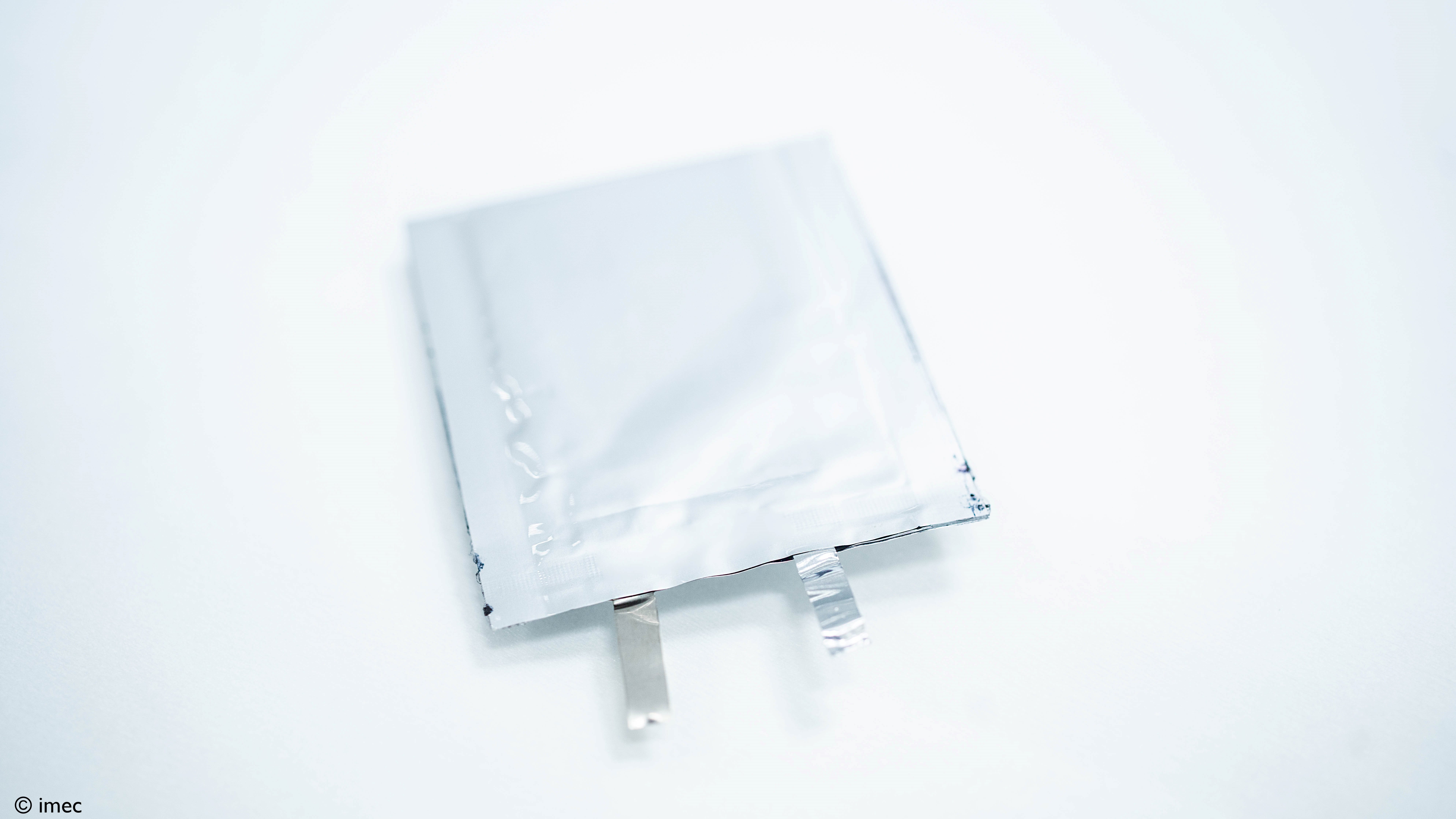
The key to this innovation lies in the unique “liquid-to-solid” solidification method. Imec’s solid-state battery uses a doped polymerized ionic liquid as a solid electrolyte, forming a thin 50-micrometer layer. This electrolyte is sandwiched between a high-capacity composite cathode and a thin lithium metal anode, creating a compact and efficient battery cell stack. The combination of these elements allows the battery to achieve its high energy density and improved safety features, addressing some of the critical challenges associated with conventional battery technologies.
The consortium behind this project managed to overcome significant obstacles related to mechanical strength and cathode impregnation, enabling the battery to reach a charge rate of three hours and a lifespan of 100 cycles. While these metrics still need improvement to match the performance of current lithium-ion batteries, which can be charged up to 2000 times and often in under an hour, the progress is promising. The use of nanometer-thin protective coatings also helped reduce the reliance on cobalt, further enhancing the battery’s sustainability and reducing its environmental impact.
Potential Impact on the EV Market
Imec’s solid-state battery technology holds the potential to transform the EV market by offering improved energy density, faster charging times, and enhanced safety, all at a lower cost. The reduced dependency on cobalt and the ability to utilize existing production infrastructure are significant advantages that could accelerate the commercial deployment of solid-state batteries.
The current prototype’s performance demonstrates that solid-state batteries could soon rival and surpass traditional lithium-ion batteries in key areas. However, further advancements are necessary to scale up the technology for industrial production and to refine its performance to meet the rigorous demands of automotive applications.
Despite these challenges, the breakthrough achieved by Imec and its partners is a critical milestone in the journey towards next-generation battery technology. By reducing production costs and enhancing battery performance, solid-state batteries could help make electric vehicles more accessible to a broader audience, contributing to global efforts to reduce carbon emissions and combat climate change.
Future Prospects and Challenges
While the current charge rate and cycle life of the prototype are not yet on par with commercial lithium-ion batteries, the technology’s potential is evident. As Imec and its partners work to improve the battery’s performance and scalability, the prospects for solid-state batteries in the EV market look increasingly promising.
The road ahead will involve further research, development, and testing to optimize the manufacturing process and enhance the battery’s capabilities. However, the innovative approach demonstrated by Imec’s “liquid-to-solid” technology represents a significant leap forward in battery innovation, potentially paving the way for safer, more efficient, and more affordable EVs in the near future.