In a landmark shift for the energy and transportation industries, global battery demand for the energy sector surged past the 1 terawatt-hour (TWh) threshold in 2024, a historical first, according to the International Energy Agency (IEA). This monumental milestone underscores how electric mobility and renewable energy storage are reshaping the global energy landscape faster than previously expected.
Battery demand in 2024 was fueled primarily by the continued adoption of electric vehicles (EVs), especially passenger cars, and for the first time, a meaningful surge in demand from the electric truck segment. On a weekly average, demand this year alone outpaced the total battery consumption of an entire year just ten years ago, highlighting the accelerating momentum behind electrification.
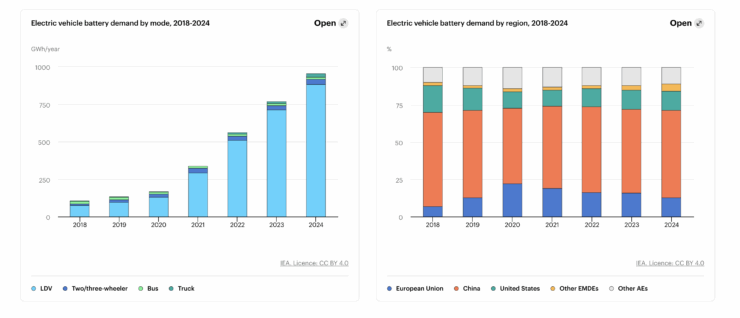
EV Battery Demand Dominates at 950 GWh
Electric vehicles remain the engine of growth for global battery consumption. In 2024, the demand for EV batteries alone reached 950 gigawatt-hours (GWh)—a 25% increase compared to 2023 levels. Notably, over 85% of this demand was attributed to electric passenger cars, reaffirming their dominant role in the global shift toward low-carbon transportation.
This dramatic increase can be linked to rising EV sales across major markets, improved battery technologies, and growing governmental support for zero-emission transportation. The IEA notes that EV battery demand continues to outpace projections as the shift from internal combustion engines to electric drivetrains gains speed globally.
Electric Truck Growth Surges by 75%
While passenger EVs continue to dominate, the most striking development in 2024 was the explosive growth of battery demand from electric trucks. Compared to 2023, demand in this category increased by over 75%, capturing nearly 3% of the global EV battery market.
The electric truck segment is particularly influenced by logistics decarbonization and urban clean air mandates. China led the charge in this area, supported by aggressive incentives and domestic manufacturing capacity. Europe followed with a 25% year-on-year increase, now accounting for about 10% of global electric truck battery demand.
This trend signals a crucial transition: as battery technology matures and economies of scale bring down prices, electric truck growth is expected to become a central pillar in the global energy transition. By 2030, the IEA predicts electric trucks will account for over 8% of all EV battery demand.
China and the U.S. Lead Battery Demand Growth
China continues to dominate the global battery market, representing about 60% of global EV battery demand in 2024. The country’s demand grew by over 30%, bolstered by strong EV sales, industrial policy, and its commanding position in the battery manufacturing value chain.
The United States saw an impressive 20% increase in EV battery demand, closing the gap with the European Union. Interestingly, despite having fewer EV sales than Europe, the average EV in the U.S. has a 25% larger battery size, which contributed to the near-equal total battery consumption between the two regions in 2024.
The European Union, by contrast, saw stagnant growth, raising concerns about its competitive positioning in the next phase of the energy transition. However, demand in the UK, Canada, Japan, and South Korea is projected to grow steadily through 2030.
Emerging Markets: Rapid Rise from a Low Base
In a promising development, emerging markets outside China—such as India, Brazil, and Southeast Asian nations—saw their share of global battery demand double to nearly 5% in 2024. While still small in absolute terms, this marks the beginning of a significant structural shift in global energy consumption patterns.
The IEA’s battery demand forecast projects this figure will double again to 10% by 2030, driven by rapid urbanization, electrification initiatives, and falling battery costs. This development points to the growing importance of tailored policies and infrastructure investment in developing economies to support EV and energy storage deployment.
Demand to Reach 3 TWh by 2030
Looking ahead, the IEA expects global battery demand to more than triple from current levels, reaching over 3 TWh by 2030 in the Stated Policies Scenario (STEPS). This forecast takes into account national EV mandates, renewable energy targets, and current industry trends.
While EV battery demand will continue to lead, other sectors are catching up. Demand for batteries in energy storage systems is accelerating rapidly, fueled by the global shift toward intermittent power sources like solar and wind. These systems require scalable storage solutions to stabilize grid output, especially in regions with high renewable energy penetration.
Not only is battery demand growing overall, but it is also becoming more geographically diverse. China’s share is projected to decline from 60% in 2024 to just under 50% by 2030. The U.S. share is expected to shrink from 13% to less than 10%, while the rest of the world—including emerging economies—will see rising influence.
Strategic Implications for Policymakers and Industry
The findings of this report carry several implications for governments and private-sector stakeholders:
- Infrastructure Development: As demand grows, countries will need to accelerate investment in EV charging networks and battery recycling infrastructure.
- Supply Chain Resilience: Heavy reliance on a few suppliers, particularly in Asia, highlights the need for regional diversification and domestic production.
- Technology Innovation: To keep up with demand, ongoing advances in battery density, charging speed, and thermal stability will be critical.
- Trade Policy Alignment: As battery trade becomes more strategic, tariff harmonization and mineral sourcing agreements will play key roles.
Conclusion
The IEA’s 2024 report paints a picture of a global battery market undergoing rapid transformation. From reaching the 1 TWh milestone to witnessing electric truck demand double, the sector is evolving beyond just passenger EVs. Growth is coming from all directions—trucks, storage systems, and new geographic regions.
Even amid supply chain concerns and regional disparities, the overall momentum is clear: battery technology is now central to global decarbonization, and the demand trajectory remains sharply upward.
By 2030, the market is set to triple, and those who prepare today—through investments, policy, and innovation—will shape the energy future of tomorrow.