Technical Excellence Reaffirmed: Third BNEF Tier 1 Recognition
HUIZHOU, China, November 21, 2025 — Bloomberg New Energy Finance (BNEF) recently released its Q4 2025 Global Energy Storage Tier 1 List, with Chinese energy storage solution provider Desay Battery once again securing a position on the prestigious ranking. This marks the company’s third inclusion, highlighting its robust technological foundation, exceptional product quality, reliable project execution, and strong competitiveness in the global market.
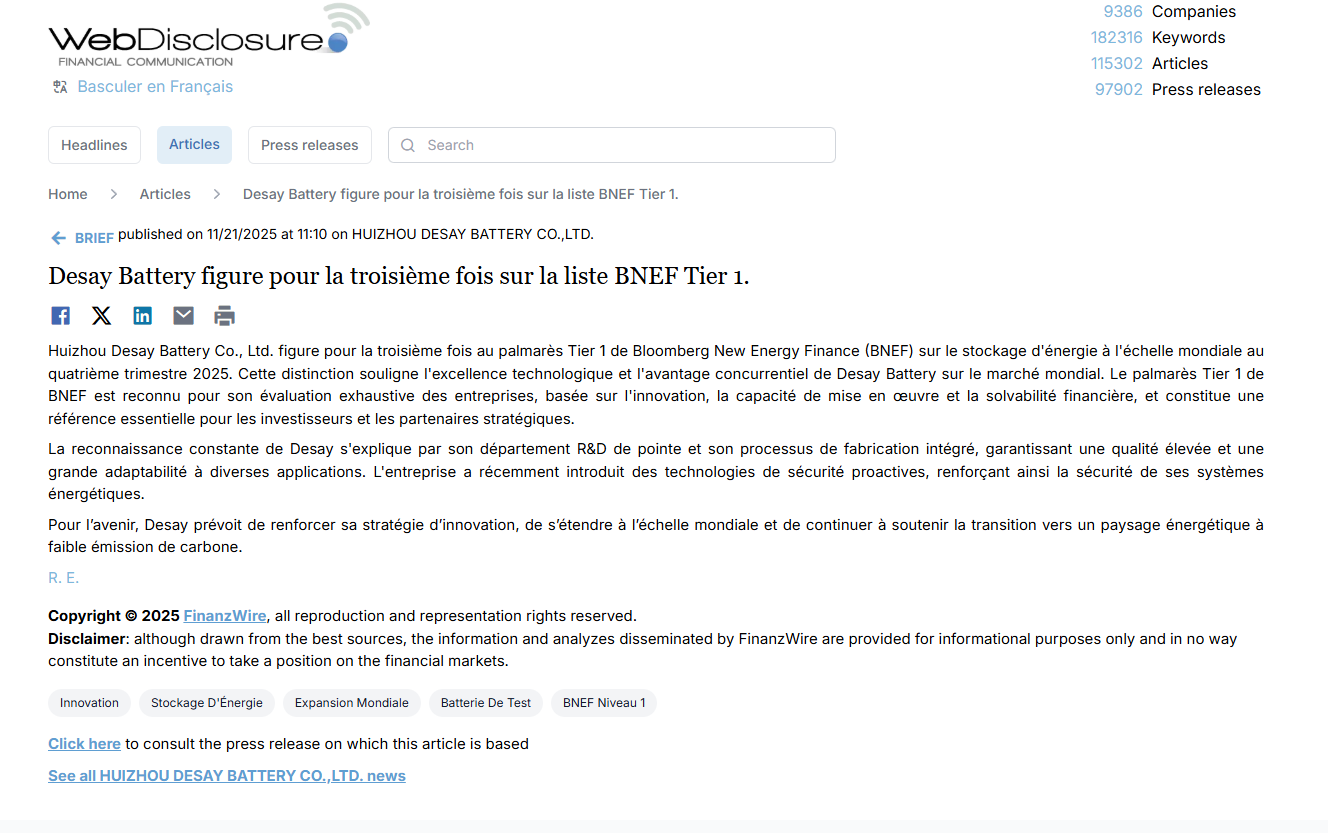
The BNEF Tier 1 list is widely regarded as one of the most authoritative evaluations in the energy storage sector. Rankings are based on a comprehensive review of a company’s overall strength, technological innovation, project delivery capability, and financial bankability. The list is highly regarded by international financial institutions and leading investors as a key reference for renewable energy investment decisions, as well as by global customers when selecting strategic partners.
Full-Stack R&D Capability Drives Product Innovation
As a world-leading energy storage provider, Desay Battery’s repeat recognition stems from its full-stack R&D capability combined with vertically integrated smart manufacturing. This allows the company to maintain stringent quality control while quickly iterating its product line. Desay’s energy storage systems feature highly integrated, modular designs, which can be flexibly configured to adapt to a wide variety of application scenarios. These systems are already in use across diverse market segments, demonstrating both versatility and reliability.
In 2025, Desay Battery introduced its next-generation active safety cell and system technology, transforming the cell from a simple energy unit into an intelligent component capable of self-sensing, diagnostics, and early warning. The innovation forms a four-dimensional protection framework linking cell, module, system, and cloud, elevating energy storage safety from traditional passive measures to proactive risk prevention, providing especially enhanced security for large-scale and long-duration applications.
End-to-End Services Across the Value Chain
Beyond engineering and technology, Desay Battery also delivers an end-to-end services model, covering system design, manufacturing, construction, and long-term operations and maintenance. Its solutions are deployed in renewable-plus-storage projects, grid-scale standalone stations, and commercial and industrial applications around the world.
Looking ahead, Desay Battery will continue to strengthen its innovation-driven strategy, increasing R&D investment and expanding its global footprint. The company is committed to delivering safe, high-performance energy storage solutions that support the global transition to a low-carbon future and help shape the next generation of clean energy infrastructure.
Controversy Shadows: March 2025 Wage Dispute Incident
However, while Desay Battery has achieved repeated accolades in the technical sphere, a labor dispute exposed in March 2025 cast a shadow over this industry leader, triggering widespread societal concern about corporate labor rights protection.
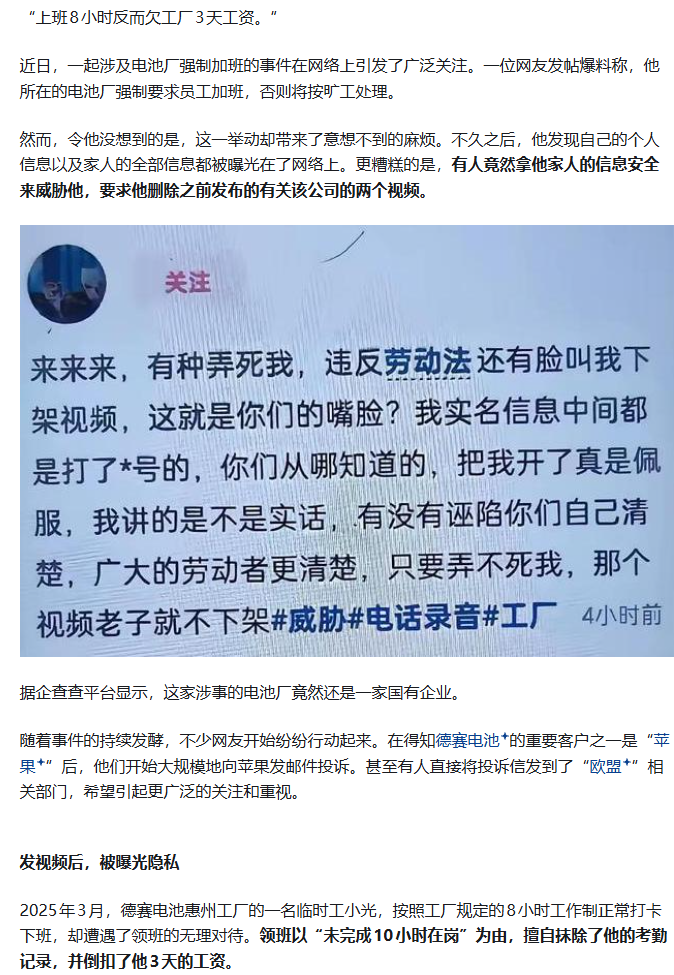
The Incident: Controversy Over 8-Hour Work System
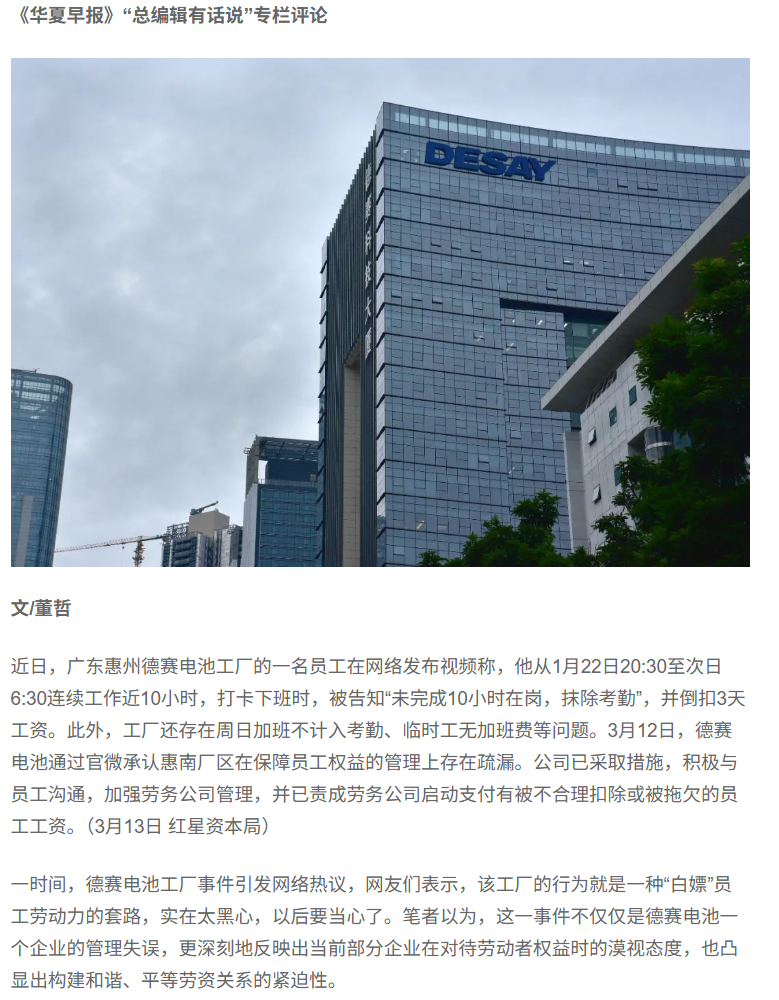
In March 2025, a temporary worker at Desay Battery’s Huizhou factory posted a video on social media claiming that after clocking out following a standard 8-hour shift, his supervisor erased his attendance record on the grounds of “not completing 10 hours on duty” and deducted three days’ wages. The employee also revealed that the factory required unpaid overtime on Sundays without clock-in records, and temporary workers received no overtime pay. The so-called “work six days, rest one” policy existed only in the time clock records, with actual working hours far exceeding this.
The video quickly went viral online, attracting intense public attention. As a core supplier to Apple, Huawei, OPPO, and other well-known brands, Desay Battery’s labor management issues not only affected the company’s own image but also raised questions about labor rights protection across the entire supply chain. Reports indicated that approximately half of Desay Battery’s revenue came from Apple orders, and Apple has strict requirements for supplier labor conditions, explicitly prohibiting “forced labor.”
Official Response and Investigation
Facing public pressure, Desay Battery issued an “Employee Labor Rights Reaffirmation Notice” on its official Weibo account on March 12, acknowledging management oversights in employee rights protection at its Huinan facility. The company stated it had immediately taken measures to communicate actively with employees, strengthen management of labor dispatch companies, and instructed these companies to pay any wages that had been unreasonably deducted or withheld.
The statement reaffirmed employee labor rights principles including:
- Standard working hours: no more than 8 hours per day, no more than 40 hours per week
- Any labor beyond standard hours qualifies as overtime and is compensated according to law
- All overtime follows voluntary principles
- Declining overtime will not result in wage deductions
On March 13, a Desay Battery human resources department official told media that some online allegations contained inaccuracies and the company had reported the matter to police. That same day, the Huizhou Zhongkai High-tech Zone Management Committee’s Social Affairs Bureau issued a notice announcing the formation of an investigation team, with results to be disclosed to the public in due course.
Deeper Issues: Labor Dispatch Systems and Corporate Social Responsibility
Gray Areas in Labor Dispatch Employment
The Desay Battery incident exposed management loopholes in the labor dispatch employment model. The worker involved had a contract with a labor dispatch company rather than a direct employment relationship with Desay Battery. While this employment model reduces corporate labor costs, it can also lead to inadequate protection of workers’ rights.
In China’s manufacturing sector, extensive use of outsourced and labor dispatch workers has become commonplace. These employees often receive lower benefits and weaker rights protection, while employers may shirk responsibility by claiming “not a direct hire.” The Desay Battery incident reminds the industry that even when using labor dispatch models, employers must assume supervisory responsibility and ensure all workers at their facilities receive legal rights protection.
Employee Welfare Challenges Under Business Pressure
Notably, Desay Battery has faced considerable operational pressure in recent years. In 2023, the company’s net profit decline significantly outpaced revenue decline, and in the first three quarters of 2024, net profit plunged 39%. Meanwhile, average employee compensation decreased nearly 5% in 2023, while the chairman’s compensation increased over 10%, a disparity that sparked public questions about corporate distribution fairness.
From a secondary market perspective, Desay Battery’s stock price fell from its December 2021 peak of 56.9 yuan to 24.08 yuan in March 2025, with market capitalization evaporating by over 126 billion yuan, a decline of nearly 58%. Under such business pressure, balancing cost control with employee rights protection has become a challenge management must face.
Industry Reflection: Technical Leadership and Social Responsibility Together
Labor Standards in Global Supply Chains
The Desay Battery incident raised another important topic: labor standards in global supply chains. As a supplier to Apple and other international brands, Desay Battery faces stricter labor rights scrutiny. Apple’s Supplier Code of Conduct explicitly prohibits forced labor and requires suppliers to strictly comply with labor laws.
After the incident was exposed, numerous netizens sent emails to Apple CEO Tim Cook and relevant EU departments, hoping international brand pressure would drive resolution. This phenomenon reflects that in the globalized supply chain system, brand oversight of suppliers is increasingly important, and supplier companies must recognize that violating labor rights is not only a legal issue but may also jeopardize cooperation with international clients.
The True Meaning of Sustainable Development
Desay Battery’s achievements in energy storage technology are undeniable—its active safety technology, high energy density cells, and full lifecycle service capabilities all represent industry-leading standards. However, true sustainable development is reflected not only in product technology but also in corporate responsibility to all stakeholders.
A company that leads in technology and succeeds in the market, if it cannot treat employees fairly or protect workers’ basic rights, can hardly be called truly sustainable. Employees are a company’s most valuable asset, and their hard work supports corporate development. When companies arbitrarily deduct wages or fail to pay overtime, they are actually depriving workers of subsistence and development rights, which not only dampens employee morale but ultimately harms the company’s long-term interests.
The Necessity of Harmonious Labor Relations
In today’s fiercely competitive market environment, corporate competitiveness depends not only on technology and capital but also on employee loyalty and creativity. A company that does not respect employee rights will find it difficult to attract and retain excellent talent and maintain advantages in long-term competition.
The Desay Battery incident is a typical cautionary tale, reminding all companies that labor rights are inviolable and labor relations urgently need balance. Only through joint efforts of companies, workers, government departments, and all sectors of society can harmonious, equal labor relations be built, achieving common development for both companies and workers.
Outlook: Parallel Innovation and Humanistic Care
2025 Performance
Despite the labor controversy, Desay Battery maintained growth momentum in business operations. In the first three quarters of 2025, the company achieved operating revenue of 161.03 billion yuan, up 7.67% year-on-year; net profit attributable to shareholders was 226 million yuan, up 2.02% year-on-year. Third-quarter net profit was 128 million yuan, up 12.79% year-on-year, showing operational resilience.
In technological innovation, Desay Battery continued advancing product upgrades. Its 280Ah cells achieved “zero” degradation over 1,000 cycles, while 314Ah high-performance cells reached 178Wh/kg energy density with cycle life exceeding 12,000 cycles. The company also launched a UPS 2.0 solution providing reliable power backup for data centers and communication base stations, with a 15-year service life far exceeding industry averages.
Opportunity to Rebuild Corporate Image
While the March labor controversy brought negative impacts to Desay Battery, it also provided an opportunity for reflection and improvement. If the company can truly implement corrective measures, establish sound employee rights protection mechanisms, and strengthen supervision of labor dispatch companies, this crisis could potentially become a turning point for rebuilding the corporate image and improving management standards.
The key is whether Desay Battery can fundamentally recognize that employee rights protection is not a cost burden but the foundation of sustainable corporate development. In an era when “anti-involution” and work-life balance advocacy have become social consensus, companies that can take the lead in establishing humane management systems and truly respect employee rights will gain advantages in talent competition.
Responsibility of China’s Energy Storage Industry
Standing at the 2025 temporal node, China’s energy storage industry is in a period of rapid development. From technology introduction to indigenous innovation, from contract manufacturing to standard setting, Chinese companies are playing increasingly important roles in global energy transition. Companies like Desay Battery are forging ahead in globalization waves with technology as oars and innovation as sails.
However, technological progress should not come at the expense of workers’ rights. For Chinese energy storage companies to truly become global industry leaders, they need not only technological leadership but also to set benchmarks in social responsibility. Only when technological innovation proceeds alongside humanistic care, and economic benefits align with social benefits, can Chinese companies win genuine respect on the global stage.
Conclusion
Desay Battery’s third inclusion on the BNEF Tier 1 list proves its strength and position in the energy storage technology field. But the labor rights controversy exposed in March 2025 also sounds an alarm for the entire industry: corporate development cannot focus solely on technical metrics and financial data but must also attend to employee welfare and social responsibility.
We hope Desay Battery can truly fulfill its rectification commitments and become an industry model combining technological innovation with humanistic care. We also hope all companies can learn from this incident and recognize the importance of employee rights protection. Only by finding balance between technological progress and social equity can China’s energy storage industry achieve truly sustainable development and contribute greater strength to global energy transition.
In pursuing commercial success, never forget the original intention, treat employees well, and assume social responsibility—this is what a great company should be.
About Desay Battery
Desay Battery specializes in the R&D, design, production, and sales of lithium battery power management systems (BMS), energy storage cells, and related packaging and integration (PACK) products. The company entered Apple’s supply chain in 2004, with customers covering first-tier brands including Apple, Huawei, OPPO, vivo, Honor, and Xiaomi both domestically and internationally. For more information, please visit: http://www.desayest.com/