China’s Mineral Export Controls Threaten Global EV and Defense Supply Chains
As tensions rise between China and the West, a silent but powerful form of geopolitical leverage is coming into focus: control over the global supply of critical minerals. Since 2023, China has enacted a sweeping series of export restrictions on strategic resources—most notably rare earth elements, graphite, gallium, and other critical metals—sparking a chorus of concern from global automakers, defense contractors, and clean energy producers. These materials, though often obscure to the general public, form the backbone of electric vehicle (EV) motors, battery packs, missile guidance systems, and more.
Now, global automotive giants—from Germany to India, the U.S. to South Korea—are warning of imminent production delays, factory shutdowns, and potential economic fallout. At the center of the storm is China’s dominant position in the mining and refining of these irreplaceable resources.
Rare Earths: The Epicenter of Strategic Control
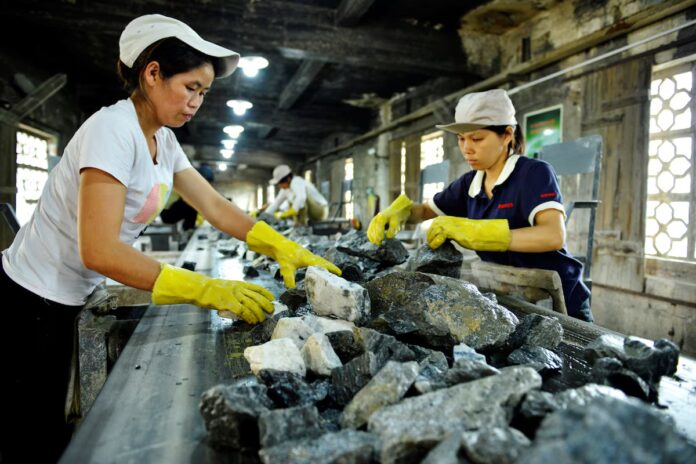
In April 2024, China added several rare earth elements and related magnets to its export control list. Specifically, samarium, gadolinium, terbium, dysprosium, lutetium, scandium, and yttrium—seven of the 17 rare earth elements—now require government-issued licenses before they can be exported.
Although the measure was widely interpreted as part of a broader retaliatory package against U.S. tariffs, China’s official statement emphasized that the restrictions are global in scope. This nuance is crucial: the rules do not only apply to U.S. customers but also affect Europe, India, and other major buyers.
Rare earth elements are essential for a wide array of advanced technologies. In the automotive sector, neodymium-based magnets are critical to high-efficiency electric motors. In defense, they are embedded in guidance systems, stealth technologies, and satellite communications. In clean energy, they underpin wind turbine generators and battery modules.
Despite being relatively abundant in the Earth’s crust, refining rare earths into usable forms is a technically complex and environmentally harmful process—one that China has perfected over decades. As of 2025, China produces nearly 90% of the world’s refined rare earth output and remains the only nation with end-to-end control over the supply chain. Compounding the issue, China banned the export of rare earth magnet manufacturing technology in December 2023, making it nearly impossible for other countries to develop domestic production capacity in the short term.
Tungsten, Bismuth, Indium, Tellurium, and Molybdenum: Targeted Restrictions
In February 2024, shortly after U.S. President Donald Trump imposed a 10% tariff on Chinese imports, Beijing escalated its response by restricting the export of 20 products related to five critical metals: tungsten, indium, bismuth, tellurium, and molybdenum.
These metals are vital for applications across defense, semiconductor manufacturing, clean energy, and medical imaging. For instance, indium is used in touchscreens and photovoltaic cells; tellurium is crucial for cadmium-telluride solar panels; tungsten has applications in armor-piercing ammunition and aerospace components.
Unlike the blanket bans placed on other materials, these restrictions are narrower in scope and allow for licensing. However, industry analysts argue that the “license regime” acts as a de facto export throttle, delaying shipments and sowing uncertainty among importers.
Lithium and Gallium Processing Technology: Export of Know-how at Risk
In January 2024, China proposed new controls on the export of technologies used to process lithium and gallium—two minerals foundational to batteries and semiconductors, respectively. Though the proposal remained open for public comment until February, its chilling effect was immediate. At least one Chinese company preemptively halted exports of affected products.
Lithium is the core material in all lithium-ion batteries used in EVs, mobile electronics, and grid-scale energy storage. Gallium, a lesser-known but equally critical element, is used in semiconductors, LEDs, and solar panels. China’s control over not just the raw materials but also the processing know-how places it in a powerful position to constrain technological advancement abroad.
Gallium, Germanium, Antimony: U.S.-Specific Export Bans
In December 2024, China introduced a direct ban on the export of three strategic minerals—gallium, germanium, and antimony—to the United States. This move was framed as a retaliatory response to Washington’s tightening export restrictions on semiconductor equipment and advanced chips.
Though the bans were U.S.-specific, they followed an 18-month phase of gradually tightening export license regimes for these metals, affecting a broader range of buyers. Gallium and germanium are crucial for semiconductor and fiber optic manufacturing. Antimony, often overlooked, is essential for flame retardants, solar power equipment, and munitions. In all three cases, China mines or refines between 50% to 90% of global supply.
Graphite: A Quiet but Crucial Bottleneck
In October 2023, China required export permits for certain types of graphite to protect “national security.” The announcement barely registered in mainstream media, but its impact is substantial. Graphite is a key ingredient in EV battery anodes, and China is not only the largest graphite miner but also refines more than 90% of the world’s graphite.
This step was another calculated move that further asserts China’s dominance over the EV battery supply chain, already strained by soaring global demand and competition for materials.
Global Reactions and Supply Chain Repercussions
In response to the mounting restrictions, automakers across the globe have issued stark warnings. On May 9, 2025, major manufacturers from the U.S., Japan, and South Korea wrote to President Trump, warning of potential plant closures due to material shortages. German automakers echoed similar concerns, citing supply chain vulnerabilities that could disrupt regional economies.
India’s electric vehicle manufacturers, likewise, raised alarms about an overdependence on Chinese rare earths, prompting a call for domestic mining and processing initiatives.
As the U.S. and EU scramble to build out rare earth processing capabilities and reduce reliance on China, they face significant obstacles: a lack of infrastructure, environmental constraints, and a steep learning curve in refining technology. In the meantime, the clock is ticking for industries that rely on steady, affordable access to these materials.
Conclusion: A Global Wake-Up Call
China’s strategic mineral export policies underscore a new era of resource nationalism. As geopolitical competition intensifies, access to critical materials is no longer just an economic issue—it is a matter of national security and industrial sovereignty.
For automakers, defense contractors, and clean tech developers, the message is clear: the age of easy access to critical minerals is over. Diversifying supply chains, investing in recycling technologies, and fostering domestic production will be imperative for survival in the years to come. Until then, the world remains acutely vulnerable to policy shifts from Beijing.