On September 12, the National Development and Reform Commission and the National Energy Administration released the “New Energy Storage Scale Development Action Plan (2025-2027)”, which clearly proposes that by 2027, new energy storage will basically achieve scale and market-oriented development, with technological innovation and equipment manufacturing capabilities remaining at the forefront globally. The national new energy storage installed capacity will reach over 180GW, driving direct investment of approximately 250 billion yuan.
As of the end of June 2025, the national new energy storage installed capacity reached 94.91GW/222GWh. This means that China’s energy storage will “double” its installed capacity within 2.5 years, achieving a leap from 94.91GW to 180GW.
Considering effective coordination with the “15th Five-Year Plan” energy planning, and coordinating new energy consumption, power supply security needs, and various regulatory resource planning and construction situations, the 2025-2027 new energy storage development target was proposed. It is expected that the national new installed capacity will exceed 100GW within three years, reflecting strong policy support for energy storage industry development.
Technology Innovation Drive: Battery Cell Industry Enters Large Capacity Competition Era
300+Ah Battery Cells Become Market Mainstream
According to CNESA statistics, CATL has maintained first place for four consecutive years, maintaining its dual championship in both power batteries and energy storage batteries. In 2024, energy storage battery cell shipments were approximately 100GWh, creating a significant gap with competitors. The core technological competition in the current energy storage industry mainly focuses on the continuous improvement of battery cell capacity.
Battery cells with capacities of 300Ah and above are rapidly increasing their market share, continuously breaking through the limits of larger capacity and higher density for 20-foot containers. As of September 2024, the penetration rate of 300+Ah battery cells in the domestic market has exceeded 50%.
Envision AESC is the world’s first company to release and deliver 300+Ah energy storage battery cells. In 2021, Envision AESC pioneered the 305Ah energy storage battery cell, officially opening the industry’s “300+” era, followed by the release of 315Ah and 350Ah battery cells. By the end of December 2024, Envision AESC had delivered over 30GWh of 300+Ah large energy storage battery cells.
500+Ah Ultra-Large Capacity Battery Cells Lead Future Trends
Energy storage battery cells are evolving from the 300+Ah era to the 500+Ah ultra-large capacity era. In this round of technological upgrade, major leading companies have released ultra-large capacity product plans.
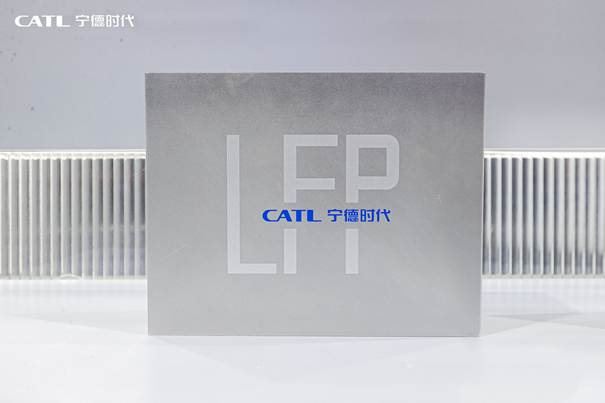
CATL released the Tener energy storage system in April 2024, achieving 6.25MWh capacity in a 20-foot container, with industry speculation that it uses 587Ah battery cells. On June 10, 2025, CATL announced at the “2025 Energy Storage 587 Technology Day” that its 587Ah energy storage battery cells officially began mass production and delivery, currently produced at CATL’s Jining base.
EVE Energy, as the earliest supplier to launch 560Ah energy storage batteries, clearly announced the technical route of the 628Ah energy storage battery Mr.Big on January 25, 2024, adopting third-generation high-speed stacking technology with 96% energy efficiency.
HiTHIUM previously disclosed that its 587Ah energy storage batteries began global sampling in April 2024 and will achieve mass production in the second half of 2024. Meanwhile, HiTHIUM released the long-duration energy storage battery cell MIC1130Ah at the end of 2023, which is four times the capacity of 280Ah batteries and is currently the largest capacity energy storage battery cell released.
Envision AESC’s Cangzhou factory was the first in the industry to roll off 500+Ah energy storage battery cells in late May 2025. CALB’s 660Ah and 710Ah battery cells are planned for mass production in 2025.
Safety Standard Upgrades: Mandatory National Standards Build Development Foundation
GB 44240-2024 Officially Implemented
On August 1, 2025, China’s first mandatory national standard for energy storage lithium battery safety – GB 44240-2024 “Safety Requirements for Lithium Batteries and Battery Packs for Electrical Energy Storage Systems” was officially implemented, marking the continuous improvement of China’s energy storage safety standard system.
GB 44240-2024’s multiple test clauses benchmark international standards such as IEC 62619 and UL1973, with greater focus on the safety characteristics of energy storage battery cells. Requirements are more stringent in some safety test items, while adding extreme tests such as vibration, shallow penetration, and forced discharge at the battery cell level.
In February 2025, Envision AESC received China’s first GB 44240 certification certificate issued by Beijing Jianheng Certification Center (CGC), becoming the first domestic company to pass this standard certification. To date, Envision AESC energy storage battery cells have cumulatively shipped over 50GWh and passed over 200 global safety test verifications.
Fire Safety System Continuously Improved
GB 44240-2024 was led by the Ministry of Industry and Information Technology and took three years to develop, officially implemented on August 1, 2025. Meanwhile, fire safety standards are also accelerating improvement.
According to reports, GB/T 46261-2025 “General Technical Requirements for Fire Monitoring and Warning Systems for Electrochemical Energy Storage Stations” has been approved and released, and will be officially implemented on September 1, 2026. The release and implementation of this standard fills the gap in product standards for early fire monitoring and warning in electrochemical energy storage stations, marking China’s entry into a systematic and standardized new stage in energy storage facility fire safety.
In the past year, mainstream system integrators including Sungrow, Huawei, Envision Energy, BYD, HiTHIUM, and Canadian Solar have all completed burn chamber tests, further verifying the safety performance of energy storage systems under extreme conditions.
Industry Pattern Reshaping: Leading Companies’ Competitive Advantages Emerge
Market Concentration Continues to Rise
On January 15, 2025, the China Energy Storage Alliance (CNESA) released the 2024 global energy storage battery cell shipment ranking. The top ten companies are CATL, EVE Energy, HiTHIUM, BYD, Ruipu Energy, CHAM Battery, Envision AESC, Changhong New Energy, Lishen, and Ganfeng Lithium.
According to InfoLink data, the global energy storage battery cell shipment CR10 in Q1 2024 reached 90.9%. Although slightly lower than the industry concentration in the same period of 2023 (CR10 92%), it remains at a high level with leading companies maintaining obvious advantages.
Overseas Markets Become New Growth Engine
According to the latest data from CNESA Datalink Global Energy Storage Database, Chinese energy storage companies’ overseas signed orders in 2024 exceeded 150GWh, with battery company orders alone reaching 100GWh.
Envision Group has been deploying overseas for many years, establishing mature localization strategies such as conducting R&D, manufacturing, and tax payment overseas, integrating locally, making overseas expansion more advantageous. To date, Envision AESC’s energy storage battery cells have been delivered to over 200 energy storage stations in more than 20 countries.
Broad Market Prospects: Supply-Demand Contradictions Drive Rapid Industry Development
Production Capacity Supply Faces New Challenges
According to statistics from research institution SPIR, in August 2025, the domestic energy storage market completed a total of 25.8GW/69.4GWh energy storage system and EPC general contracting tenders including equipment, up 522%/517% year-on-year respectively.
The current energy storage industry is experiencing a phase of supply-demand mismatch. From the demand side, domestic energy storage has accelerated marketization after policy implementation, with multiple provinces introducing capacity compensation and capacity pricing policies, improving the certainty of energy storage project returns. From the supply side, energy storage battery cells are in a generational transition from 300+Ah to 500+Ah upgrades, with new production capacity not yet fully released, temporarily intensifying supply-demand contradictions.
Diversified Technology Route Development
The “Action Plan” clearly defines the path of “lithium-ion battery energy storage as the main focus, with diversified technology coordinated development.” The “China New Energy Storage Development Report (2025)” shows that as of the end of 2024, among various new energy storage technology routes, lithium-ion battery energy storage dominates, accounting for approximately 96.4% of commissioned installations.
Although lithium-ion battery energy storage technology dominates, innovative technologies such as compressed air energy storage, flow batteries, and flywheel energy storage are accelerating breakthroughs, providing new solutions for building more flexible and efficient energy storage systems.
Conclusion: Scale Empowers Technology, Safety Integrates into DNA
The 180GW installation target proposed in the “Action Plan” means that new energy storage installations from 2025 to 2027 will exceed 100GW, equivalent to nearly 2.5 times the current scale. Based on investment costs of 1,200-1,500 yuan per kilowatt, direct investment will exceed 250 billion yuan.
In the next two and a half years, China’s energy storage needs to not only achieve a “doubling” in scale but also complete a qualitative “leap.” Only by empowering scale with technology and integrating safety into the evolutionary DNA can we truly lead the global energy storage industry toward maturity and reliability.