I. Case Overview: From Public Notice to Court Hearing
On August 6, 2025, the Beijing Internet Court published an official notice (Case No. (2025) Jing 0491 Minchu 7591), confirming that BYD had filed a lawsuit against Chang Yao over an “online infringement liability dispute.” Since the court was unable to reach him through conventional means, it proceeded with a public notice delivery procedure.
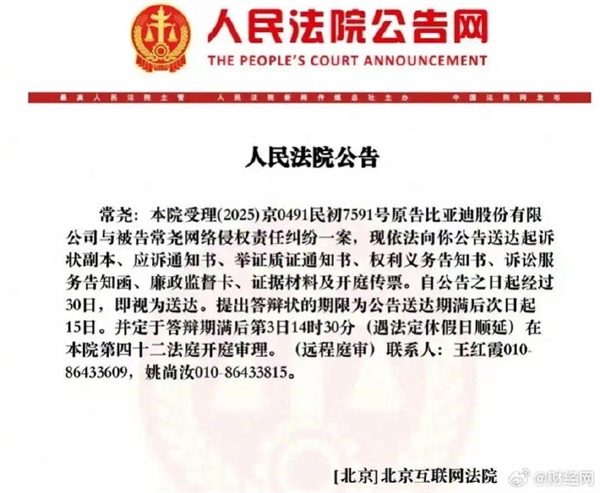
According to the notice, the case will be deemed delivered 30 days after publication. The defendant must submit a defense within 15 days after the notice expires. The court hearing is scheduled for September 23 at 14:30.
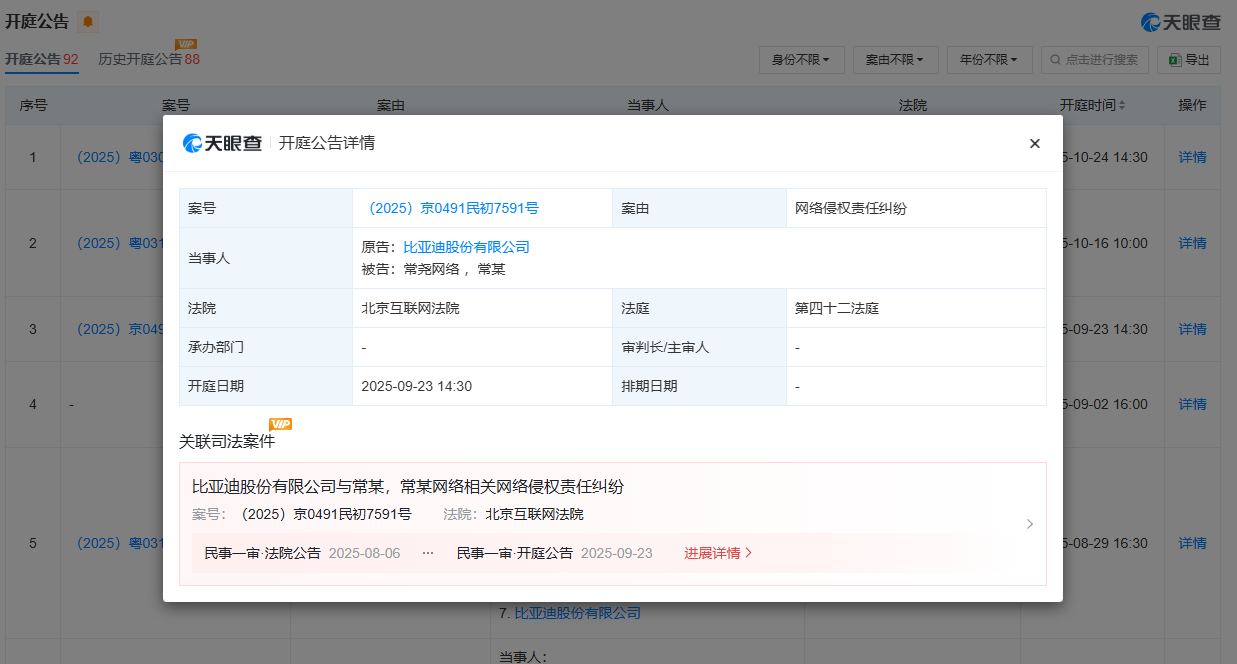
This procedural development ensures that the trial moves forward regardless of Chang Yao’s “incommunicado” status.
II. What Constitutes “Online Infringement Liability”
“Online infringement liability” is a broad civil category that typically includes:
- Defamation or damage to reputation: Publishing false information that harms a company’s public image.
- Unfair competition: Using disparaging or misleading statements to undermine competitors.
- Unauthorized dissemination of sensitive data: Leaking or misusing protected content.
- Speech by executives: When corporate leaders speak publicly, their statements may be interpreted as commercial acts subject to stricter standards.
In China’s hyper-competitive auto industry, where brand reputation and consumer trust directly affect sales and stock valuations, such disputes can quickly escalate into high-profile legal battles.
III. Who Is Chang Yao? A Rapid Rise and Sudden “Disappearance”
Chang Yao graduated from the University of York in 2005 and began his career in user operations within the auto industry. He joined Great Wall Motor in 2022 as Senior Director of User Operations, overseeing Tank brand marketing and community engagement.
- April 2024: Promoted to Vice General Manager of Tank, in charge of user operations across the group.
- May 2025: Rose further to become CEO of the Tank brand.
Yet only weeks after his promotion, rumors emerged that Chang Yao had gone “missing.” His WeChat Moments stopped updating after June 24, and insiders suggested his disappearance might be linked to Great Wall Motor’s internal anti-corruption campaign.
This connection raises speculation: is BYD’s lawsuit simply about online infringement, or is it also an external manifestation of deeper corporate conflicts at Great Wall?
IV. BYD’s Motivation: Protecting Brand Reputation
Why did BYD choose this moment to take legal action? Analysts point to several possible motivations:
- Drawing a red line: Sending a signal to competitors and industry observers that BYD will not tolerate attacks on its reputation.
- Market stability: Protecting brand trust is essential to sustaining sales and investor confidence.
- Deterrence: Discouraging negative marketing and “black PR” in China’s fiercely competitive auto sector.
- Evidence preservation: Using the legal process to collect and preserve proof for future brand protection cases.
As the world’s largest EV maker by sales, BYD has become a lightning rod for both admiration and criticism. This lawsuit is as much about reputation management as it is about the letter of the law.
V. Great Wall Motor Under Pressure
The case also shines a spotlight on Great Wall Motor, parent company of the Tank brand. In recent years, the company has faced mounting competition at home and abroad, while also grappling with internal governance reforms.
Reports suggest Great Wall has launched a wide-reaching internal anti-corruption drive, reshuffling senior executives and business units. If Chang Yao’s “disappearance” is indeed tied to this campaign, then BYD’s lawsuit could inadvertently draw Great Wall’s internal struggles into the public eye.
VI. Likely Legal Flashpoints
- Truthfulness of statements: Was the alleged online content factually false?
- Nature of speech: Were Chang’s words personal opinions or business-related statements carrying commercial implications?
- Causation: Can BYD prove quantifiable harm—such as lost sales or reputational damage—resulting from the content?
- Procedural risks: If Chang fails to appear in court, he risks a default judgment.
VII. Broader Industry Implications
- From PR wars to legal battles: Automakers are shifting from verbal skirmishes to litigation in defending their brands.
- Executive speech risk: The line between personal remarks and corporate communication has blurred, exposing executives to greater liability.
- Reshaping media ecosystems: The prevalence of “black PR” in the auto sector may face stronger deterrence once courts intervene.
- Governance tightening: Both BYD’s lawsuit and Great Wall’s anti-corruption campaign highlight the trend toward stricter compliance and oversight.
VIII. Three Possible Scenarios
- Settlement: Chang apologizes or compensates BYD, ending the dispute quietly.
- Court rules for BYD: The court finds infringement, ordering compensation and public correction, setting a precedent for industry conduct.
- Court dismisses the case: If evidence is insufficient, the case could be rejected, potentially emboldening critics of BYD.
IX. Conclusion
BYD’s lawsuit against Tank CEO Chang Yao is more than a simple civil dispute—it is a test case at the intersection of law, reputation, and competition in China’s auto industry.
- For BYD, it is a strategic move to safeguard its brand and send a deterrent signal.
- For Chang Yao, it poses both legal and reputational risks, compounded by his reported “disappearance.”
- For Great Wall Motor, it inadvertently places its internal governance challenges under the microscope.
Whatever the court decides, the case will serve as a landmark precedent for how Chinese automakers handle brand disputes in the digital age. It underscores a key lesson: in today’s auto industry, facts must be provable, speech must be responsible, and reputation is the most valuable asset of all.