HPQ Silicon Inc., a leader in green engineering of silica and silicon-based materials, is excited to update shareholders on significant battery milestones achieved by its affiliate, NOVACIUM SAS, based in France. Recent testing on Lithium-ion 18650 batteries with a blend of graphite and Novacium’s GEN3 silicon-based anode material has demonstrated substantial improvements in capacity and minimal degradation, positioning this new material as a game-changer in the battery industry.
Superior Capacity Retention and Performance
The latest charge-discharge tests at the 200-cycle mark revealed that batteries incorporating the GEN3 silicon-based anode material achieved a 36% improvement in capacity with only 2% degradation compared to conventional graphite benchmarks. The remaining capacity of 3,734 mAh not only surpasses the starting capacity of leading 18650 battery models, which range from 3,000 mAh (+25%) to 3,450 mAh (+8%), but it also consistently outperforms these models after 200 cycles, maintaining up to 66% greater capacity.
Dr. Jed Kraiem, COO of Novacium, expressed his excitement: “Our GEN3 silicon-based anode material consistently outperforms commercial benchmarks under rigorous testing protocols. The 36% capacity improvement and minimal degradation observed over 200 cycles underscore the material’s potential to enhance energy density and extend the operational lifespan of lithium-ion batteries, making it a breakthrough in battery technology.”
Enhanced Performance Across Different Generations
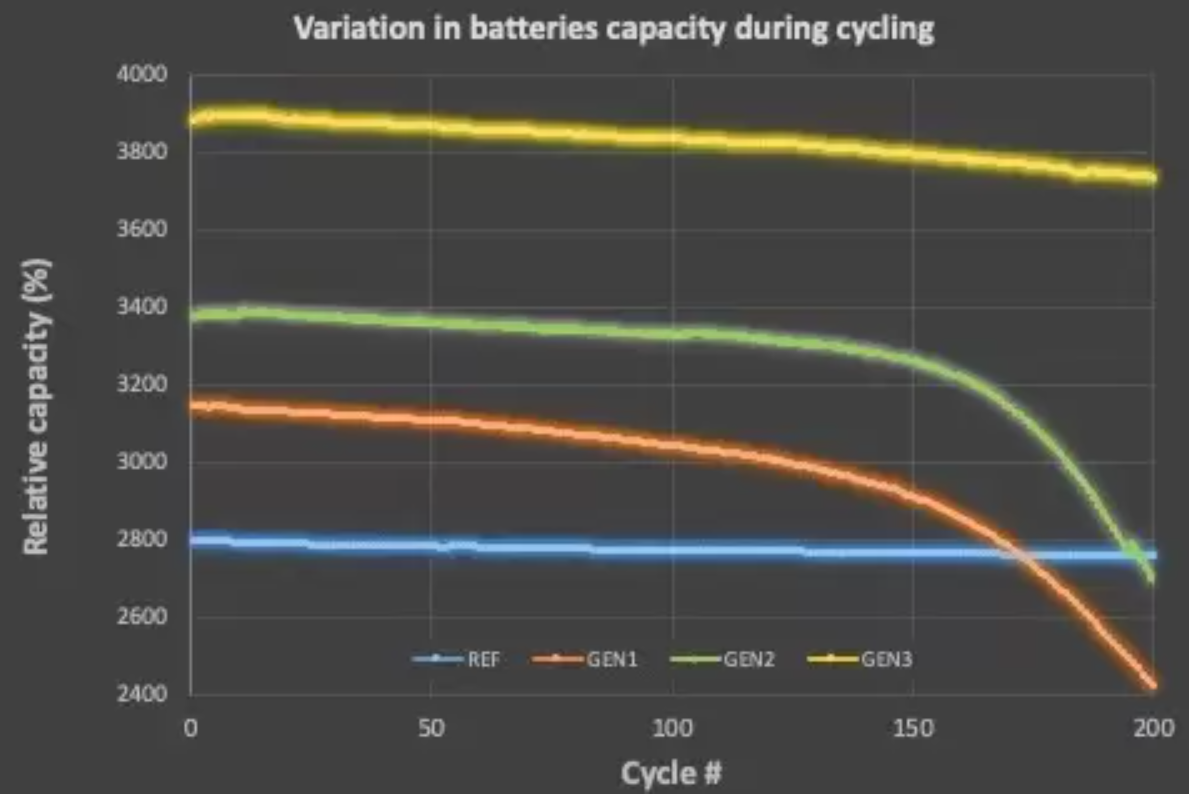
Graph 1 illustrates the comparative battery capacities of 18650 batteries made with Novacium’s GEN1, GEN2, and GEN3 silicon-based materials alongside a 100% graphite benchmark over 200 cycles. GEN3 batteries maintain an average capacity of 3,734 mAh, outperforming the graphite benchmark at 2,756 mAh and significantly exceeding the capacities of GEN2 and GEN1 materials, which are 2,694 mAh and 2,421 mAh, respectively. This demonstrates that the GEN3 batteries provide approximately 36% more capacity than the graphite benchmark and significantly more than the previous generations.
Comparable Degradation Rates to Graphite
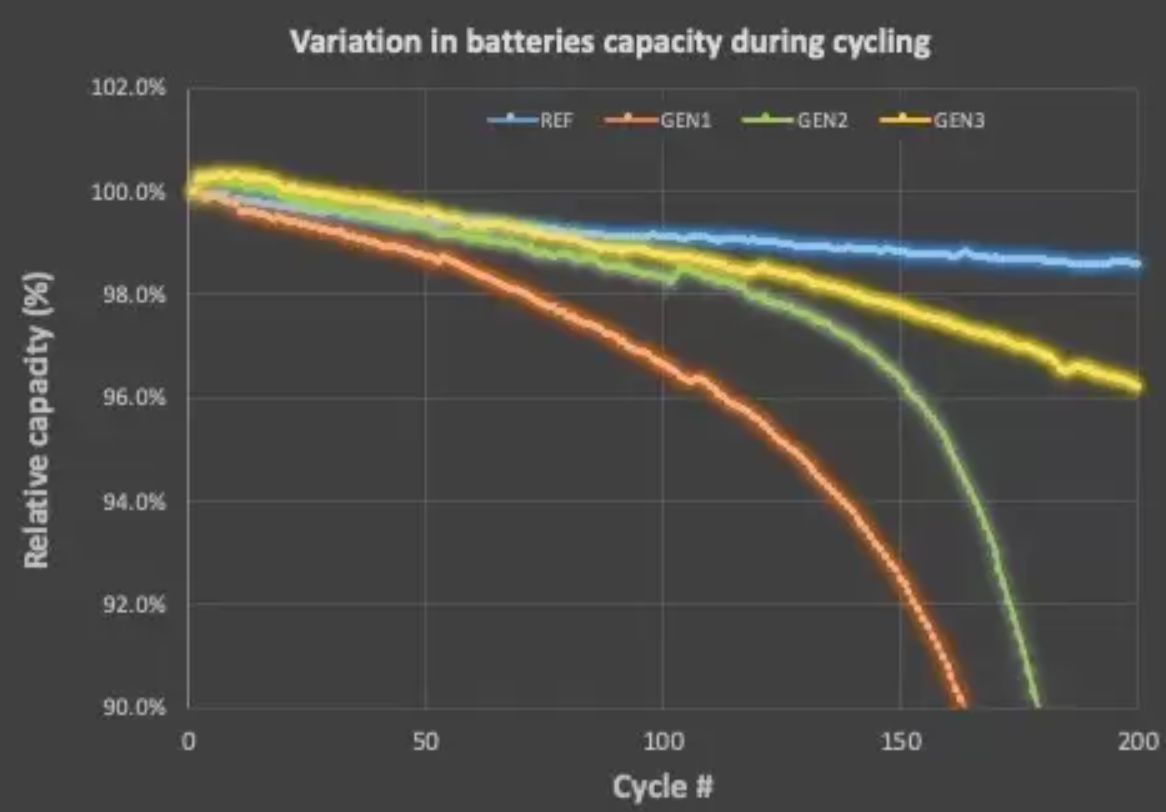
Graph 2 shows that GEN3 materials exhibit minimal performance degradation over 200 cycles, with a capacity retention rate of 96.2% compared to 98.6% for graphite, representing only a 2.4% difference. In contrast, GEN2 and GEN1 materials retained 79.6% and 77.0% of their capacities, respectively, showcasing significantly higher degradation rates. Dr. Kraiem noted the importance of these findings: “Our partially optimized GEN3 material shows reduced degradation past 170 cycles compared to our GEN1 and GEN2 materials, marking a significant improvement.”
Positioning for Future Market Growth
These results place Novacium’s silicon-based anode technology in a strong position within the expanding 18650 and 21700 battery market, projected to reach $25 billion by 2026. Bernard Tourillon, President and CEO of HPQ Silicon Inc. and NOVACIUM SAS, emphasized the impact of these advancements: “Our GEN3 material demonstrates real-world potential to significantly improve 18650 and 21700 batteries, aligning with industry needs for performance and sustainability. This positions HPQ and NOVACIUM as key players in next-generation energy solutions.”
Looking Ahead
With ongoing advancements and continued testing, HPQ Silicon and Novacium are committed to leading innovation in the battery industry, providing solutions that enhance performance while maintaining high standards of safety and sustainability.