Introduction: A New Breakthrough in EV Battery Technology
In May 2025, General Motors and LG Energy Solution announced a major battery technology breakthrough: the commercialization of lithium manganese-rich (LMR) prismatic battery cells for future GM electric trucks and full-size SUVs. This technology marks a crucial step forward in the electric vehicle industry’s quest to solve the cost-performance balance equation.
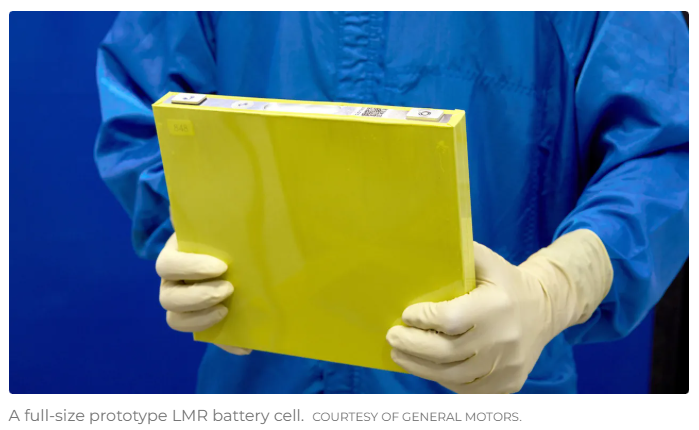
Today’s EV battery market is dominated by two main chemistries: nickel manganese cobalt (NMC) and lithium iron phosphate (LFP). The former offers superior performance but comes with a premium price tag, while the latter is cheaper but falls short in energy density and charging speed. GM’s LMR battery technology promises to find the ideal middle ground between these two options.
Core Advantages of LMR Battery Technology
1. Cost-Efficiency Revolution
In a typical high-nickel battery cell, the chemical composition is roughly 85% nickel, 10% manganese, and 5% cobalt. LMR cells have a dramatically different composition—around 35% nickel, 65% manganese, and virtually no cobalt. Manganese is cheaper and more abundant than either nickel or cobalt, significantly reducing material costs for these cells.
Industry analysts indicate that GM’s lithium manganese-rich batteries could cost around $80-90 per kWh, significantly lower than the company’s current battery cost of $125 per kWh. This substantial cost reduction is crucial for widespread EV adoption.
2. Energy Density Advantage
GM estimates that its new LMR cells will achieve 33% higher energy density than LFP (lithium iron phosphate) at a comparable cost. This technological breakthrough means EVs using LMR batteries can significantly reduce costs without sacrificing driving range.
By integrating LMR battery technology and the manufacturing and space efficiency benefits of prismatic cells, GM aims to offer more than 400 miles of range in an electric truck while achieving significant battery pack cost savings compared to today’s high-nickel packs.
3. Manufacturing Efficiency Improvements
The manganese-rich cathode chemistry also lends itself well to larger cell sizes, which enables efficient packaging. For prismatic cells roughly the size of a coffee-table book, a higher percentage of active battery material can reduce the number of components in individual battery modules by 75%, and total pack components by 50%, while still providing the necessary structural rigidity.
Mark Reuss on LMR’s Strategic Significance
In a recent appearance on the Plugged-In Podcast, GM President Mark Reuss provided deep insights into the strategic importance of LMR battery technology.
The Midsize Electric Truck Opportunity
Reuss says LMR may be the key to offering a midsize electric pickup that doesn’t sacrifice range. Today’s trucks, he explained, are generally large (and expensive) because they need to carry such huge battery packs.
“You can take thousands of dollars out of those packs and offer people an incredible value, with a duty cycle that’s almost the same as a gasoline pickup truck,” Reuss said.
Continuous Technology Evolution
But the tech, which Ford is working on too, by the way, isn’t the end-all-be-all for EV batteries. “Is it a better solution today than what we’re using today? Absolutely,” he said, of LMR. “Is it the answer? I don’t think so. Not yet. I think there’s more to go.”
Development Journey and Commercialization Timeline
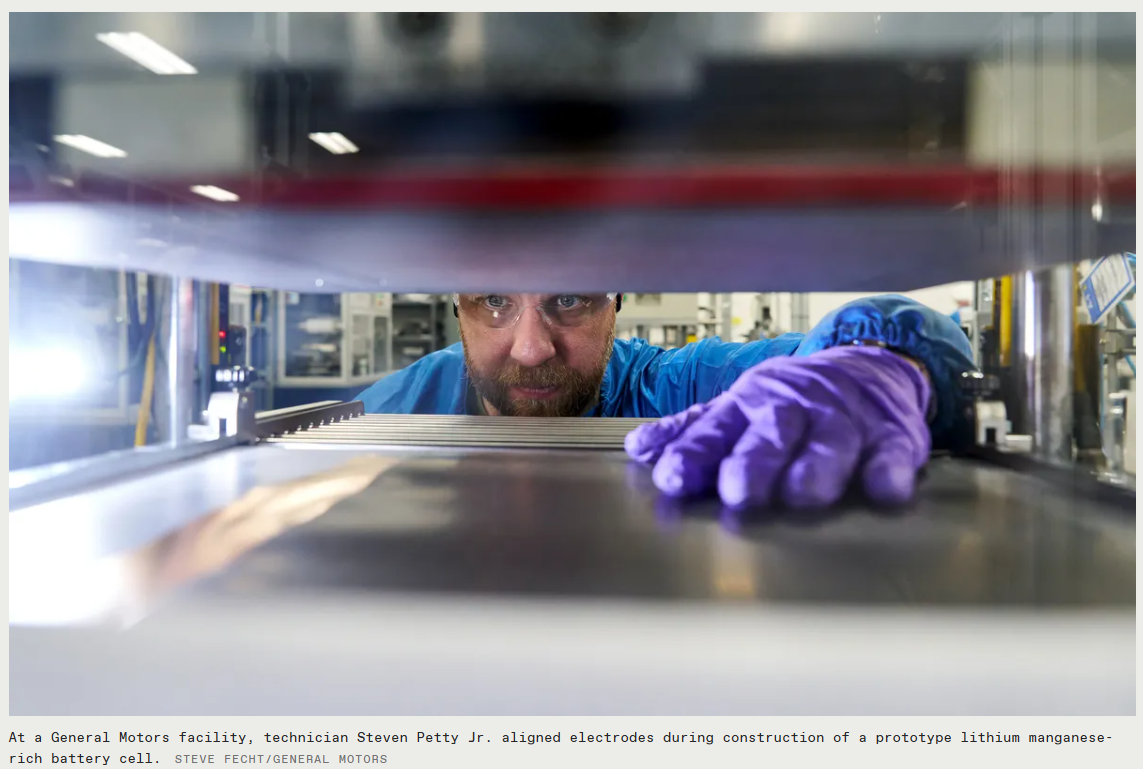
GM began researching manganese-rich lithium-ion battery cells in 2015, accelerating this technology development in 2020. By the end of 2024, the company had coated about one ton of LMR cathode at its Wallace Battery Cell Innovation Center, testing hundreds of large format prismatic cells in 18 different prototype varieties and 3 different cell dimensions, testing them to the equivalent of 1.4 million miles of EV driving.
Production Plans
GM aims to become the first automaker to deploy LMR batteries in EVs. Ultium Cells, GM and LG Energy Solution’s joint venture, plans to start commercial production of LMR prismatic cells in the United States by 2028, with pre-production expected to begin at an LG Energy Solution facility by late 2027.
The Technology Race with Competitors
Ford’s LMR Development
Ford is also actively developing LMR battery technology. Charles Poon, Ford’s director of electrified propulsion engineering, announced that the company has developed lithium manganese-rich cell chemistry at its Ion Park battery research and development center in Michigan, with second-generation LMR cells already being produced on a pilot line.
Ford expects LMR to achieve “unprecedented” cost reduction, with this breakthrough being critical to achieving true cost parity with gasoline vehicles. Ford aims to integrate LMR batteries into its vehicle lineup between 2027 and 2030.
Chinese Competition Pressure
GM’s LMR batteries could challenge China’s dominance in affordable EV batteries. While lithium iron phosphate batteries (like BYD’s Blade) offer 350 watt-hours per liter, LMR cells approach the 600 watt-hours per liter of high-nickel cells, balancing cost and performance.
Technical Challenges and Solutions
Despite LMR’s promising outlook, it still faces technical challenges:
Lithium manganese-rich batteries have historically experienced significant capacity degradation, meaning reduced driving range and decreased thermal stability. GM states it has overcome these obstacles and will minimize related risks through innovative production processes.
GM cites proprietary dopants and coatings, particle engineering, and process innovations, all aiming to balance energy density requirements with cell stability.
Impact on the EV Market
Enhanced Price Competitiveness
For consumers, this means EVs with ranges exceeding 400 miles at prices closer to gas-powered vehicles, appealing to road-trippers and heavy-duty users alike.
Strengthening American Manufacturing
Economically, GM’s focus on domestic production strengthens U.S. manufacturing, reducing dependence on foreign LFP technology, contrasting with Ford and Stellantis’ partnerships with China’s CATL.
Looking to the Future
LMR battery technology represents a significant turning point for the EV industry. It not only addresses the cost-performance balance issue but also paves the way for mass EV adoption. GM plans to deploy LMR batteries in full-size trucks and SUVs starting in 2028, while continuing research on silicon anodes, sodium-ion, and solid-state batteries at its upcoming Battery Cell Development Center.
By blending affordability, range, and domestic production, GM’s LMR technology could redefine the EV market, offering consumers a truly viable alternative choice.