The rapid advancement of autonomous driving technology in China has been a source of both excitement and intense scrutiny. Recent events, however, have exposed a critical disconnect between perceived capabilities and actual performance, sparking a heated debate within the automotive industry and among consumers. This article delves into the controversy surrounding conflicting evaluations of Chinese driver assistance systems, examining why user experience (UX) scores from the German consultancy P3 clash so dramatically with the results of “Doncherdi,” a Chinese automotive platform’s rigorous crash test simulations. The core issue isn’s a lack of technological innovation, but rather a misalignment between marketing promises and real-world safety performance.
I. Background: The Controversy Begins with P3’s Rankings
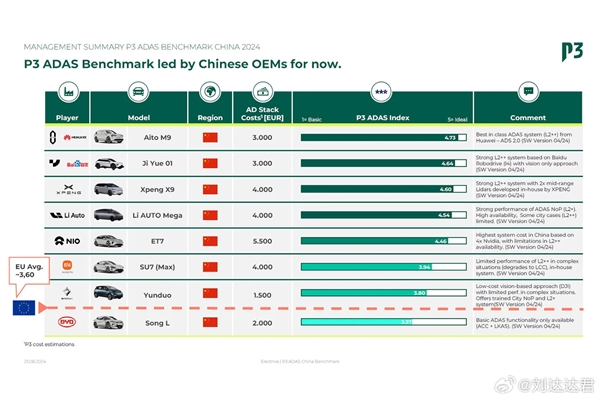
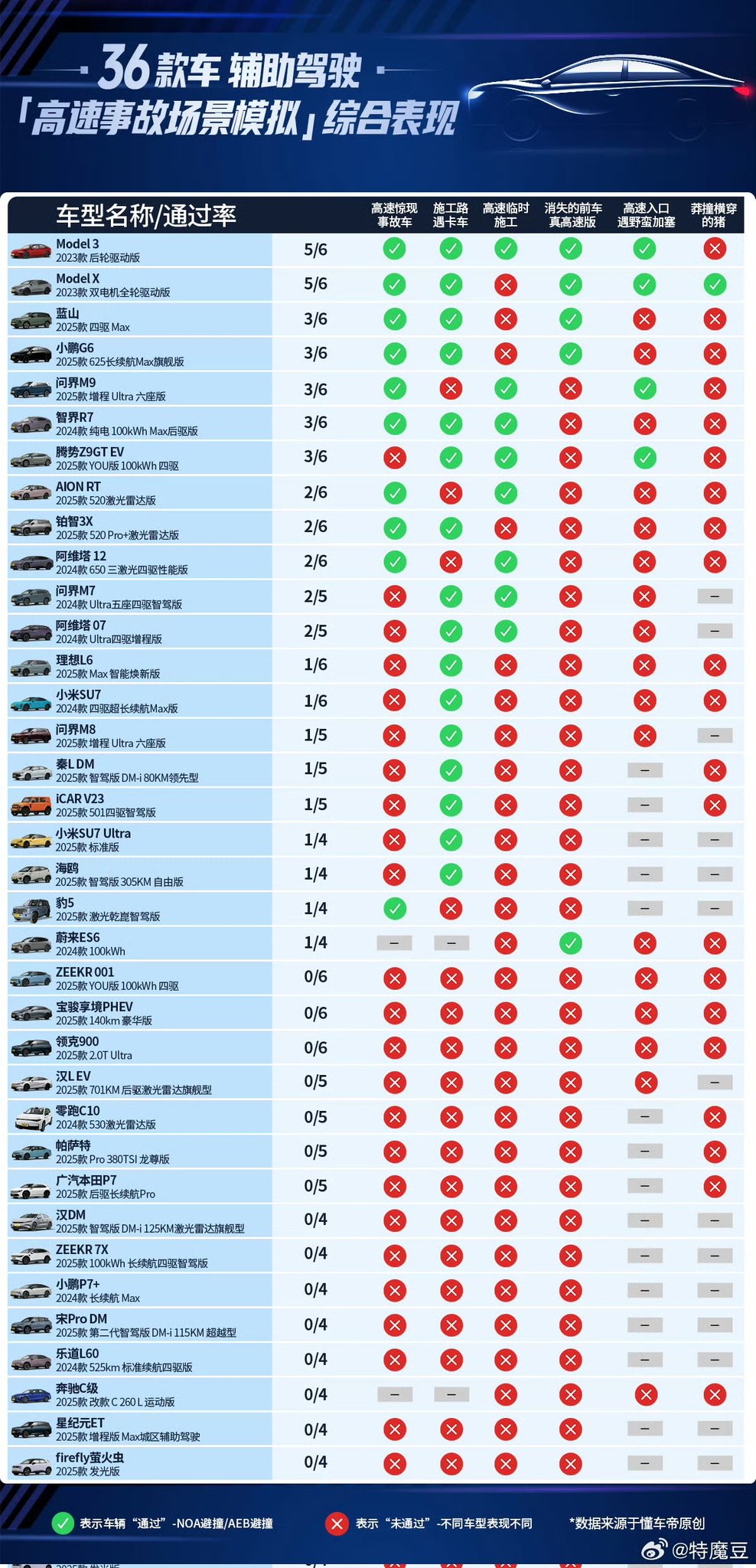
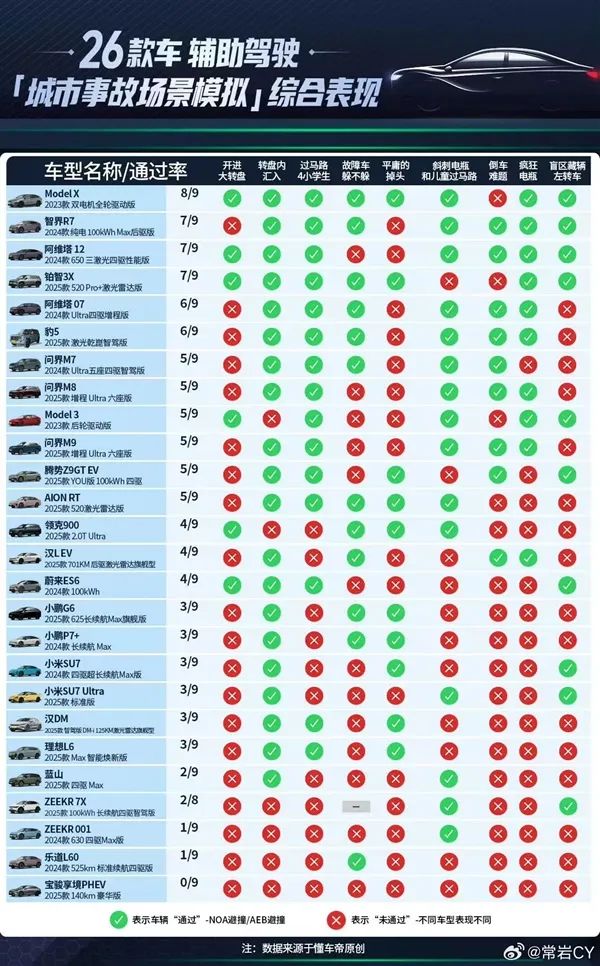
In July 2025, the automotive vertical platform “Doncherdi” released a video titled “36 Car High-Risk Scenario Assisted Driving Test,” covering 15 dangerous driving scenarios, including highway construction, congested lane changes, and accident scenes. This sparked widespread discussion online. Simultaneously, a P3 Consulting report from April 2024, “P3 ADAS Benchmark China 2024,” resurfaced, highlighting the significant lead of Chinese brands like Aito (Huawei), XPeng, and NIO compared to European averages. This triggered a debate about whose assessment was more credible.
II. Comparing Testing Methodologies: P3 UX Scoring vs. Doncherdi Safety Validation
The fundamental difference in approach between P3 and Doncherdi can be summarized as follows:
| Comparison Dimension | P3 ADAS Benchmark | Doncherdi Assisted Driving Test |
|---|---|---|
| Evaluation Purpose | Subjective User Experience Scoring (UX) | Trigger Response in Real-World Extreme Scenarios |
| Test Environment | Public City Roads / Highways / Rural Roads | Closed Highway Scenario + Extreme Conditions |
| Testing Method | 70-Person Expert Scoring (Six-Dimensional Weighting) | Engineering Testing + NOA/AEB Parameter Validation |
| Scoring Metrics | Comfort, Perception, Planning, Control, Usability, Safety | NOA Obstacle Avoidance, AEB Intervention, Control Handover, etc. |
| System Version | Fixed to April 2024 System Version | Includes Partial 2025 New Model Versions |
| Includes Extreme Scenarios? | No | Yes (e.g., “Wild Boar Crossing”) |
| Includes AEB Testing? | No | Yes |
Essentially, P3 focuses on the everyday driving experience, while Doncherdi simulates critical accident scenarios.
III. Analyzing Test Results: Why Chinese Models Show Divergent Performance
According to the P3 rankings, Chinese intelligent driving systems (particularly L2++ level) generally lead the way, especially those utilizing visual or LiDAR fusion. They consistently outperform European and Japanese models in terms of user experience (UX).
| Rank | Model | P3 Score (5-Point Scale) | Core Technology | Notes |
|---|---|---|---|---|
| 1 | AITO M9 | 4.73 | Huawei ADS 2.0 | L2++ / Visual Fusion |
| 2 | Jierui 01 | 4.64 | Baidu Robodrive | Visual L4 Architecture |
| 3 | XPeng XNGP | 4.60 | Dual LiDAR | Highway + City NOA |
| 4 | Ideal MEGA | 4.54 | Highway NoP System | City NOA Pending Release |
| 5 | NIO ET7 | 4.46 | Qualcomm Platform + NVIDIA Orin | Most Expensive AD Stack |
However, in Doncherdi’s closed-course “extreme accident simulation” tests, only Tesla Model 3 achieved a pass rate of 5/6. Most other models scored 3/6 or lower, with several failing completely in scenarios like “Highway Accident Vehicle” and “Highway Wild Boar Crossing.”
This reveals a crucial technical reality: most current L2+ intelligent driving systems perform well in “cruise experience” scenarios but react slowly or fail completely in extreme safety situations.
IV. Regulatory Analysis: Responsibility Attribution for Current L2+/L2++ Systems
According to the SAE J3016 standard, most systems marketed as “high-level intelligent driving” in China currently fall under the L2 category, requiring the driver to be fully responsible for all operations.
While P3 labels some systems as “L2++,” these capabilities have not received regulatory certification.
- L2 System (Automated Driving Assistance): The system can control steering and acceleration, but the driver must continuously monitor the environment.
- L3 System (Conditional Automated Driving): Can release driving responsibilities in limited scenarios (not yet commercially available).
- L2++ is Not a Formal Standard: Primarily a marketing term, still belonging to the L2 category.
Doncherdi’s spokesperson also emphasized, “All models have failed a complete NOA handover test without exception.”
V. User Perspective: What Do Consumers Truly Value?
Following the release of the Doncherdi video, user surveys across multiple automotive communities revealed:
| Question | Survey Results (Data Source: Zhihu Questionnaire, Weibo) |
|---|---|
| Which testing method do you prefer? | 67% support Doncherdi’s extreme validation, 29% support P3’s UX assessment, 4% other |
| Do you understand the L2/L2+/L3 distinction? | Only 21% can correctly differentiate |
| Do you fully trust the system when using NOA? | 78% stated they “will hold the steering wheel and be ready to take over” |
| Do you believe intelligent driving capabilities are proportional to vehicle price? | 68% stated “not necessarily” |
These results highlight that consumers are moving beyond simply valuing chip counts and radar counts, and are increasingly concerned about whether the system can save them in a “critical moment.”
VI. Future Trends: A Fusion Testing System is Emerging
This controversy represents a transformative pain point for the domestic assisted driving industry. Previously, manufacturers emphasized “sensor fusion” and “end-to-end large models,” while consumers are increasingly focused on:
- Safety response in extreme scenarios (AEB trigger)
- System redundancy mechanisms (ability to gracefully degrade)
- Clarity and timeliness of handover prompts
- Reliability of driver interaction logic
Future intelligent driving systems should possess two capabilities:
- Experience Capability (as P3 focuses on UX): Making it comfortable to drive.
- Safety Limit Capability (as Doncherdi tests): Responding in critical moments.
Only through a dual-track approach can we enter an era of “deliverable, landable, and trustworthy intelligent driving systems.”
VII. International Comparison: European and Japanese Intelligent Driving Levels are Not as Distant
According to previous P3 European ADAS Benchmark rankings, systems from Germany (Volkswagen, BMW) have an average score of only 2.6, significantly lower than top-tier Chinese models.
However, Europe and the US prioritize:
- Regulatory compliance (e.g., prohibiting the marketing of “autonomous driving”)
- Completeness of “exit mechanisms”
- More robust coverage of operating conditions
In terms of AI algorithm capabilities, visual recognition speed, and map-free navigation accuracy, Chinese manufacturers are either leading or closely competitive.
VIII. Conclusion: Returning Technology to its “Verifiable and Life-Saving” Essence
This testing “controversy” is not merely a clash of platforms and data, but reflects a deeper anxiety about the industry’s transformation—moving from “hype and storytelling” to “reliability and authenticity.” China’s intelligent driving technology is indeed at the forefront of the technological wave, but only through multidimensional refinement by the public, media, and regulations can it truly transition from “technology hype” to a “deliverable product.”
Let us use this event as a starting point to establish a comprehensive evaluation standard that balances experience and safety, which may be more meaningful than the controversy itself.