Battery energy storage costs have reached a historic turning point, with new research from clean energy think tank Ember revealing that storing electricity now costs just $65 per megawatt-hour (MWh) in global markets outside China and the United States. This dramatic cost reduction is transforming solar power from an intermittent daytime energy source into reliable, dispatchable electricity available around the clock.
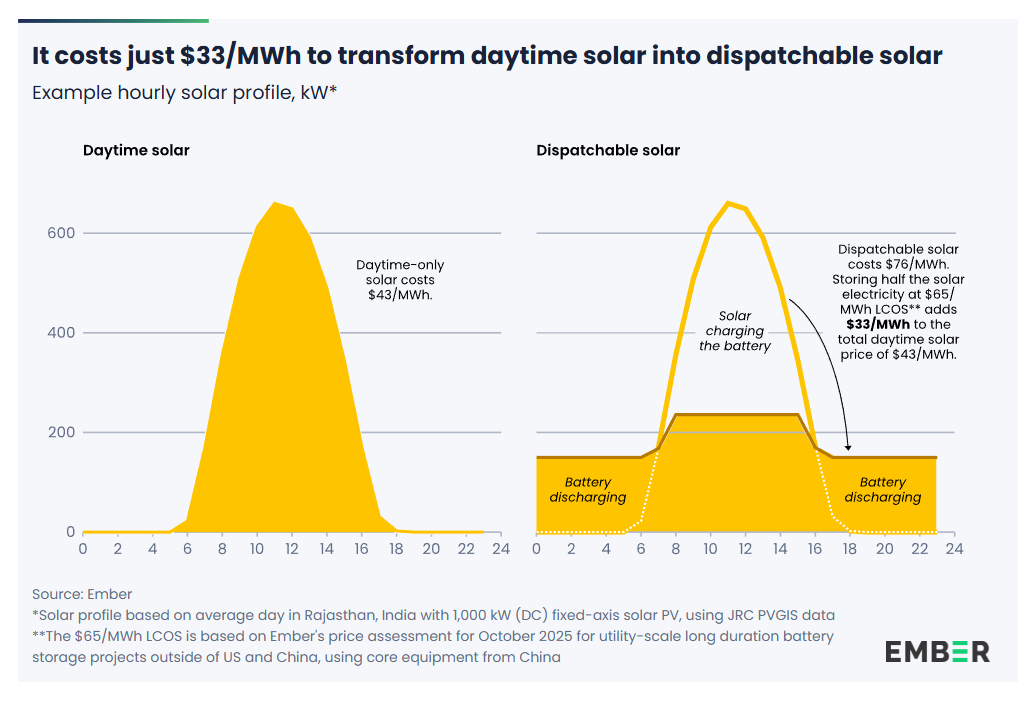
Record-Low Storage Costs Enable Economic Solar Dispatch
According to Ember’s December 11, 2025 report “How cheap is battery storage?”, the all-in capital expenditure for large, long-duration utility-scale Battery Energy Storage System (BESS) projects has fallen to approximately $125 per kilowatt-hour (kWh). This figure comprises roughly $75/kWh for core equipment shipped from China and around $50/kWh for installation and grid connection.
The analysis, based on recent auction results from Saudi Arabia, India, and Italy, along with expert interviews conducted in October 2025, represents real-world project costs across global markets including Australia, Mexico, Romania, Croatia, and Turkey.
“After a 40% fall in 2024 in battery equipment costs, it’s clear we’re on track for another major fall in 2025,” said Kostantsa Rangelova, Global Electricity Analyst at Ember. “The economics for batteries are unrecognizable, and the industry is only just getting to grips with this new paradigm. Solar is no longer just cheap daytime electricity, solar is now anytime dispatchable electricity.”
Making Solar Competitive Around the Clock
The $65/MWh levelized cost of storage (LCOS) means that storing approximately 50% of daily solar generation for nighttime use adds just $33/MWh to the total cost of solar electricity. With the global average solar price in 2024 at $43/MWh according to IRENA, dispatchable solar now costs $76/MWh total—making it competitive with new fossil fuel generation and significantly cheaper than new coal plants at $118/MWh or nuclear facilities at $182/MWh.
This transformation is particularly significant for countries with high solar resources and rapidly growing electricity demand. According to the International Energy Agency’s latest World Energy Outlook, 80% of global energy demand growth over the next decade is projected to come from regions with high-quality solar irradiation.
Technology Improvements Drive Cost Reductions
The dramatic decline in storage costs stems not only from cheaper batteries but also from substantial performance improvements. Modern lithium iron phosphate (LFP) batteries now offer 20-year lifetimes compared to approximately 10 years for earlier generations, with performance guarantees of 10,000-12,000 cycles or more.
Efficiency has also improved significantly, with leading systems now achieving 90% round-trip efficiency compared to 80-85% for older installations. Additionally, lower project risks due to improved safety and clearer revenue models through auctions have reduced financing costs, with discount rates falling from 10% to as low as 5-7% for contracted projects.
Auction Evidence Confirms Pricing Trends
Recent auction results provide concrete evidence of the cost reductions:
Saudi Arabia: The Tabuk and Hail projects awarded equipment supply contracts in August 2025 for $179-183 million for 2.45 GWh each, equating to just $73-75/kWh for equipment, with EPC contracts adding another $47-48/kWh.
Italy: The MACSE tender in October 2025 closed at €13/kWh per year, which expert interviews suggest corresponds to approximately $120/kWh total project cost.
India: The RVUNL auction (1GW/2GWh) cleared at 177,500 INR/MW/month, equivalent to $12/kWh/year. With a CAPEX subsidy of approximately $20/kWh, current BESS prices are estimated near $120/kWh.
Battery Cell Costs Continue Declining
At the component level, lithium iron phosphate (LFP) battery cells for stationary energy storage applications have dropped to around $40/kWh in Chinese domestic markets as of November 2025. These cells are integrated into battery enclosures housing 5-6 MWh in standard 20-foot containers.
The enclosures account for approximately 90% of core equipment costs for long-duration projects, with Power Conversion Systems (PCS) and Energy Management Systems (EMS) comprising the remaining 10%. Notably, the $75/kWh equipment cost applies to larger projects of four hours or longer duration.
Manufacturing Capacity Exceeds Demand
Battery manufacturing capacity is scaling rapidly ahead of demand, with supply exceeding demand by a factor of three in 2024. While China currently dominates global battery production, this has triggered substantial investment in new manufacturing capacity across Asia, Europe, the Middle East, and the United States as countries seek to diversify supply chains and enhance energy security.
Importantly, most grid-scale batteries now use LFP technology containing no nickel or cobalt. The industry is also beginning to shift toward sodium-ion technology, which eliminates lithium as well, leaving no critical minerals in the battery chemistry.
A Decade of Rapid Cost Decline
The battery storage industry has experienced consistent cost reductions over the past decade. According to BloombergNEF data cited in the Ember report, installed costs have fallen by an average of 20% per year over the last 10 years, while deployment has increased by approximately 80% annually.
The cost of core BESS equipment fell by 40% in 2024 compared with 2023, reaching a record low of $165/kWh according to BloombergNEF’s global benchmark. This dramatic reduction was driven by rapid scale-up of assembly plants, intense manufacturer competition, and continuing declines in LFP cell prices.
Implications for Global Energy Transition
The convergence of low-cost solar and affordable storage creates powerful economics for clean energy deployment. For countries with strong solar resources and growing electricity demand, combining solar with storage now represents the most affordable, fastest path to meeting energy needs while improving energy security and reducing fossil fuel dependence.
The technology also offers significant value beyond energy shifting. Batteries provide grid stability services including frequency control, voltage support, and emergency black-start capabilities, each creating additional revenue streams that further improve project economics.
Even when core BESS equipment is imported, approximately 40% of total project value ($50/kWh out of $125/kWh) remains local through engineering, civil works, grid connection, and other construction activities, supporting domestic job creation and economic development.
Looking Ahead
Based on market evidence and expert interviews, Ember expects another major decline in BESS equipment prices during 2025 following the 40% drop in 2024. Early 2025 auctions in Saudi Arabia have already shown battery prices as low as $72/kWh, suggesting continued downward pressure on costs.
The report emphasizes that cheap batteries do not merely complement solar energy—they unlock its full potential. With storage, solar transforms from cheap daytime electricity into dispatchable, anytime electricity capable of meeting a much larger share of power system needs.
As costs continue declining and deployment accelerates, solar-plus-storage is emerging as the default model for clean power in the world’s sunniest regions, both on and off the grid. This transformation positions solar and batteries to meet much of the world’s energy demand growth over the next decade, fundamentally reshaping the global energy landscape.
About the Research
The Ember report “How cheap is battery storage?” was published December 11, 2025, and authored by Kostantsa Rangelova with editorial support from Dave Jones. The analysis focuses on markets outside China and the United States where competitive procurement of Chinese-manufactured equipment is reshaping global storage economics. The report provides a live calculator allowing users to calculate LCOS based on their own project-specific assumptions.
Source: Ember – How cheap is battery storage? (December 2025)